Pandey Deeksha, Sardana Parnita, Saxena Aashish, Dogra Luvdeep, Coondoo Ambika, Kamath Asha
Department of Obstetrics & Gynecology, KMC Manipal, Manipal University, Manipal, Karnataka, India.
MBBS Student, KMC Manipal, Manipal University, Manipal, Karnataka, India.
PLoS One. 2015 May 19;10(5):e0126575. doi: 10.1371/journal.pone.0126575. eCollection 2015.
Present study was aimed to analyze the impact of education, employment and financial independence in breastfeeding practices among Indian women.
Present explorative questionnaire based survey included 256 women (128 pairs) in the final analysis. A pair means--a) pregnant lady (in her third trimester) representing younger generation and b) her mother/mother in law representing the elder generation.
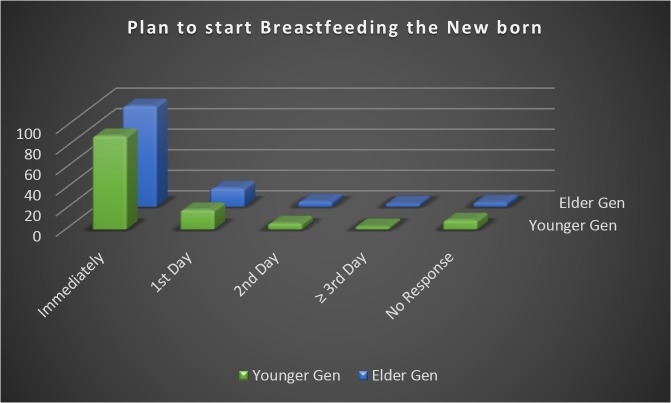
We found that the overall awareness regarding 'breast milk' being the best food for baby was excellent (overall 97.3%; younger generation: 96.9%; elder generation: 97.7%). Overall knowledge regarding the correct technique (28.9% younger generation and 21.9% elder generation) and frequency of breastfeeding (20.3% of younger generation and 34.4% of elder generation) was very poor. Less than 60% (younger generation: 57.8%; elder generation: 58.6%) were aware that the only major contraindication for breastfeeding is a mother infected with human immunodeficiency virus (HIV). On comparing responses obtained from the two generations of women, difference was not statistically significant among most of the issues related to breastfeeding. With regards to the attitude, despite better awareness, only 94.5% women in younger generation and 89.1% women in elder generation were planning to give mother's milk as the first feed to the newborn. Similarly, less than 75% of women were ready to breast-feed the newborn immediately after birth. This was contradictory to the fact that 86% of pregnant women were aware that the baby should be breast-fed within an hour of birth.
Awareness with regards to breastfeeding issues had not changed significantly with the educational progress of Indian women. Despite the good level of awareness in the society regarding breastfeeding, attitude to practice the same is lacking.
本研究旨在分析教育、就业和经济独立对印度女性母乳喂养行为的影响。
本探索性问卷调查最终分析纳入了256名女性(128对)。一对指的是:a)代表年轻一代的孕妇(孕晚期)和b)代表年长一代的其母亲/婆婆。
我们发现,关于“母乳”是婴儿最佳食物的总体认知度很高(总体为97.3%;年轻一代:96.9%;年长一代:97.7%)。关于正确喂养技巧(年轻一代为28.9%,年长一代为21.9%)和母乳喂养频率(年轻一代为20.3%,年长一代为34.4%)的总体知识非常匮乏。不到60%(年轻一代:57.8%;年长一代:58.6%)的人知道母乳喂养的唯一主要禁忌是感染人类免疫缺陷病毒(HIV)的母亲。比较两代女性的回答,在大多数与母乳喂养相关的问题上,差异无统计学意义。在态度方面,尽管认知度较高,但年轻一代中只有94.5%的女性和年长一代中只有89.1%的女性计划将母乳作为新生儿第一口食物。同样,不到75%的女性准备在新生儿出生后立即进行母乳喂养。这与86%的孕妇知道婴儿应在出生后一小时内进行母乳喂养这一事实相矛盾。
随着印度女性教育水平的提高,她们对母乳喂养问题的认知并没有显著改变。尽管社会对母乳喂养的认知水平较高,但缺乏实践母乳喂养的态度。