Aklilu Lemma Institute of Pathobiology, Addis Ababa University, Addis Ababa, Ethiopia,
BMC Public Health. 2010 Jan 19;10:21. doi: 10.1186/1471-2458-10-21.
Soil-transmitted helminths (STHs) are widespread in underdeveloped countries. In Ethiopia, the prevalence and distribution of helminth infection varies by place and with age. We therefore investigated the prevalence of and risk factors for STH infection in mothers and their one year-old children living in Butajira town and surrounding rural areas in southern Ethiopia.
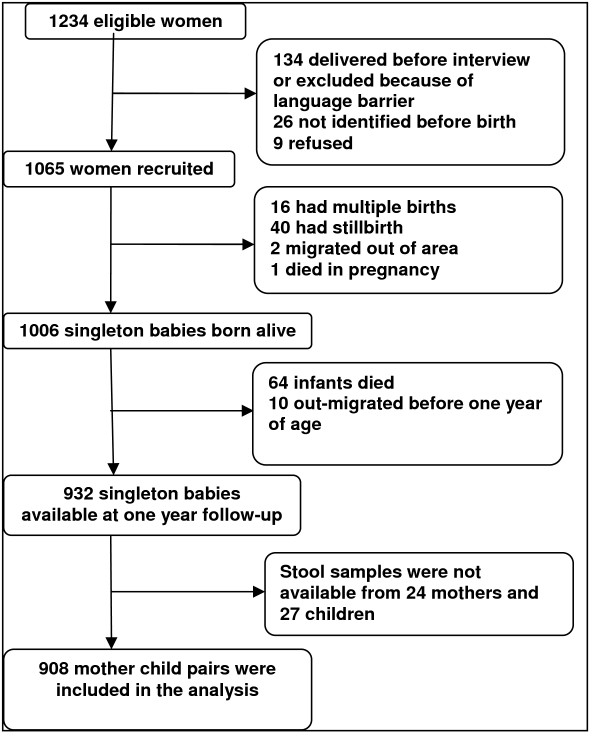
In 2005-2006, 1065 pregnant women were recruited in their third trimester of pregnancy. In 2006-2007, when children reached their first birthdays, data on the infants and their mothers were collected, including stool samples for qualitative STH analysis. Questionnaire data on various demographic, housing and lifestyle variables were available. Logistic regression analysis was employed to determine the independent risk factors for STH infection in the mothers and children.
908 mothers and 905 infants provided complete data for analysis. Prevalence of any STH infection was 43.5% (95% confidence interval (CI) 40.2-46.8%) in mothers and 4.9% (95%CI 3.6-6.5%) in children. In the fully adjusted regression model, infrequent use of soap by the mother was associated with increased risk (odds ratio (OR) 1.40, 95% CI 1.04-1.88, and 1.66, 95% CI 0.92-2.99, for use at least once a week and less frequent than once a week respectively, relative to daily use; p for trend = 0.018), and urban place of residence (OR 0.45, 95% CI 0.28-0.73, p = 0.001) was associated with reduced risk of maternal STH infection. The only factor associated with STH infection in infants was household source of water, with the greatest risk in those using piped water inside the compound (OR 0.09, 95% CI 0.02-0.38 for river water, 0.20, 95% CI 0.56-0.69 for either well or stream water and 0.21, 95% CI 0.09-0.51 for piped water outside compared with piped water inside the compound, overall p = 0.002)
In this rural Ethiopian community with a relatively high prevalence of STH infection, we found a reduced risk of infection in relation to maternal hygiene and urban living. Daily use of soap and a safe supply of water are likely to reduce the risk of STH infection.
土壤传播的蠕虫(STHs)在欠发达国家中广泛存在。在埃塞俄比亚,蠕虫感染的流行程度和分布因地点和年龄而异。因此,我们调查了居住在埃塞俄比亚南部布塔吉拉镇及其周边农村地区的母亲及其一岁婴儿的 STH 感染的流行率和危险因素。
2005-2006 年,在妊娠晚期招募了 1065 名孕妇。2006-2007 年,当婴儿满一岁时,收集了有关婴儿及其母亲的数据,包括定性 STH 分析的粪便样本。可获得有关各种人口统计学、住房和生活方式变量的问卷调查数据。采用逻辑回归分析确定母亲和儿童中 STH 感染的独立危险因素。
908 名母亲和 905 名婴儿提供了完整的数据进行分析。母亲的 STH 感染总流行率为 43.5%(95%置信区间(CI)40.2-46.8%),儿童的流行率为 4.9%(95%CI 3.6-6.5%)。在完全调整的回归模型中,母亲很少使用肥皂与感染风险增加相关(每周至少使用一次和使用频率低于每周一次的相对每日使用的比值比(OR)分别为 1.40,95%CI 1.04-1.88 和 1.66,95%CI 0.92-2.99,p 趋势=0.018),城市居住地(OR 0.45,95%CI 0.28-0.73,p=0.001)与母亲 STH 感染风险降低相关。唯一与婴儿 STH 感染相关的因素是家庭用水来源,使用院内管道水的风险最大(与院内管道水相比,河水的比值比(OR)为 0.09,95%CI 0.02-0.38,井水或溪流水为 0.20,95%CI 0.56-0.69,院外管道水为 0.21,95%CI 0.09-0.51,总体 p=0.002)。
在这个 STH 感染流行率相对较高的农村埃塞俄比亚社区中,我们发现与母亲卫生和城市生活相关的感染风险降低。日常使用肥皂和安全供水可能会降低 STH 感染的风险。