Jatoi Aminah, Muss Hyman, Allred Jake B, Cohen Harvey J, Ballman Karla, Hopkins Judith O, Gajra Ajeet, Lafky Jacqueline, Wolff Antonio, Kottschade Lisa, Gralow Julie, Hurria Arti
Department of Oncology, Mayo Clinic, Rochester, MN, USA.
University of North Carolina at Chapel Hill, Lineberger Comprehensive Cancer Center, Chapel Hill, NC, USA.
Psychooncology. 2016 Apr;25(4):441-6. doi: 10.1002/pon.3850. Epub 2015 May 20.
Studies point to a direct association between social support and better cancer outcomes. This study examined whether baseline social support is associated with better survival and fewer chemotherapy-related adverse events in older, early-stage breast cancer patients.
This study is a pre-planned secondary analysis of CALGB 49907/Alliance A171301, a randomized trial that compared standard adjuvant chemotherapy versus capecitabine in breast cancer patients 65 years of age or older. A subset reported on the extent of their social support with questionnaires that were completed 6 times over 2 years.
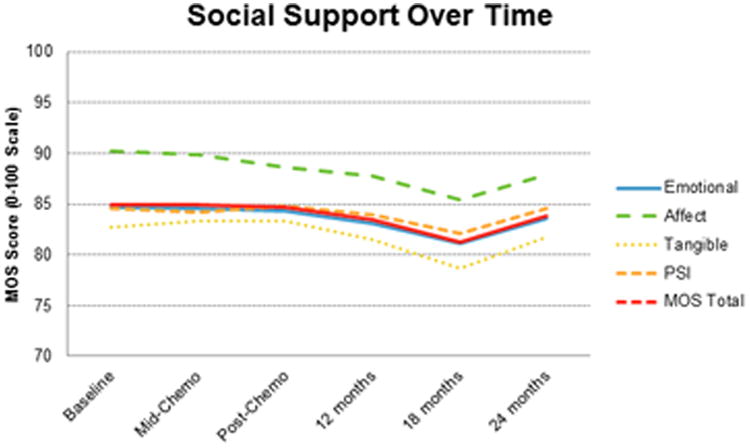
The median age of this 331-patient cohort was 72 years (range: 65, 90); 179 (55%) were married, and 210 (65%) lived with someone. One hundred forty-five patients (46%) described a social network of 0-10 people; 110 (35%) of 11-25; and 58 (19%) of 26 or more. The Medical Outcomes Study (MOS) social support survey revealed that the median scores (range) for emotional/informational, tangible, positive social interaction, and affectionate social support were 94 (3, 100), 94 (0, 100), 96 (0, 100), and 100 (8, 100), respectively. Social support scores appeared stable over 2 years and higher (more support) than in other cancer settings. No statistically significant associations were observed between social support and survival and adverse events in multivariate analyses. However, married patients had smaller tumors, and those with arthritis reported less social support.
Although social support did not predict survival and adverse events, the exploratory but plausible inverse associations with larger tumors and arthritis suggest that social support merits further study.
研究表明社会支持与更好的癌症治疗结果之间存在直接关联。本研究探讨了基线社会支持是否与老年早期乳腺癌患者更好的生存率及更少的化疗相关不良事件有关。
本研究是对CALGB 49907/联盟A171301进行的预先计划的二次分析,这是一项随机试验,比较了65岁及以上乳腺癌患者接受标准辅助化疗与卡培他滨化疗的效果。一个亚组通过在两年内完成6次的问卷调查来报告其社会支持程度。
这个331名患者队列的中位年龄为72岁(范围:65至90岁);179人(55%)已婚,210人(65%)与他人同住。145名患者(46%)描述其社交网络中有0至10人;110名(35%)有11至25人;58名(19%)有26人或更多。医学结局研究(MOS)社会支持调查显示,情感/信息支持、实际支持、积极社交互动和情感支持的中位得分(范围)分别为94(3至100)、94(0至100)、96(0至100)和100(8至100)。社会支持得分在两年内似乎稳定,且高于其他癌症患者群体(支持更多)。在多变量分析中,未观察到社会支持与生存率及不良事件之间存在统计学上的显著关联。然而,已婚患者的肿瘤较小,患有关节炎的患者报告的社会支持较少。
尽管社会支持不能预测生存率和不良事件,但与较大肿瘤和关节炎之间探索性但合理的反向关联表明,社会支持值得进一步研究。