Leonard Laurence B, Hansson Kristina, Nettelbladt Ulrika, Deevy Patricia
Purdue University.
Lund University.
Lang Acquis. 2004;12(4):219-246. doi: 10.1080/10489223.1995.9671744.
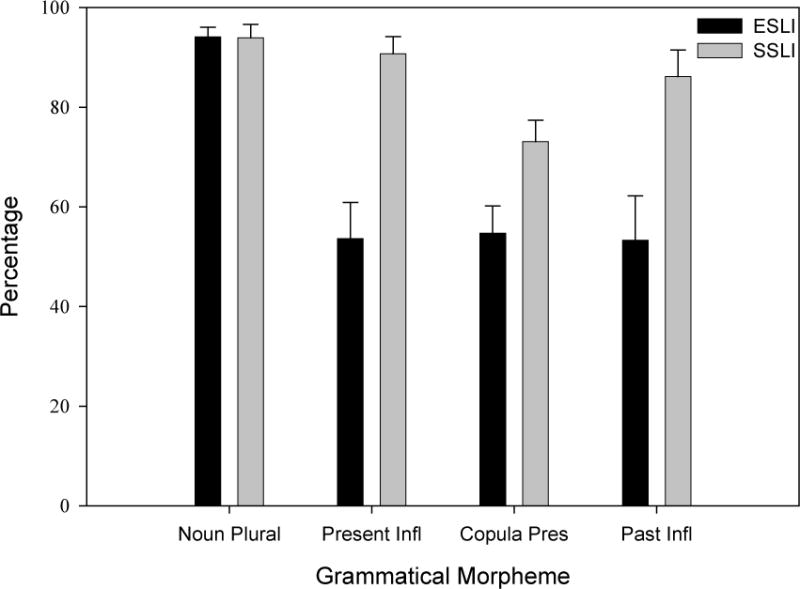
We report a cross-linguistic investigation of English- and Swedish-speaking children with specific language impairment (SLI) in an attempt to determine whether Wexler's (1998; 2003) (Extended) Unique Checking Constraint (EUCC) can account for the grammatical profiles of these groups of children. In Study I, a group of Swedish-speaking preschoolers with SLI showed greater use of finite verb inflections and copula forms than a group of English-speaking preschoolers with SLI, even though the two groups were carefully matched according to both age and severity of language impairment. In Study II, the same Swedish-speaking children with SLI showed high levels of appropriate verb-second use with finite verbs. However, they were less proficient in this regard than a group of younger typically developing Swedish children with similar mean lengths of utterance. The findings from both studies were generally compatible with predictions based on the EUCC. Issues in need of future investigation are discussed.
我们报告了一项针对患有特定语言障碍(SLI)的英语和瑞典语儿童的跨语言调查,旨在确定韦克斯勒(1998年;2003年)的(扩展)独特核查约束(EUCC)是否能够解释这些儿童群体的语法特征。在研究I中,一组患有SLI的瑞典语学龄前儿童比一组患有SLI的英语学龄前儿童更多地使用限定动词屈折变化和系动词形式,尽管这两组儿童在年龄和语言障碍严重程度方面都经过了仔细匹配。在研究II中,同样患有SLI的瑞典语儿童在使用限定动词时表现出较高水平的恰当动词第二位用法。然而,在这方面,他们不如一组平均语句长度相似的年龄较小的瑞典语正常发育儿童熟练。两项研究的结果总体上与基于EUCC的预测相符。文中还讨论了需要未来进一步研究的问题。