Li Chong, Wang Lingling, Zheng Liang, Zhan Xianghong, Xu Bin, Jiang Jingting, Wu Changping
Department of Tumor Biological Treatment, the Third Affiliated Hospital, Soochow University, Changzhou, People's Republic of China ; Cancer Immunotherapy Engineering Research Center of Jiangsu Province, Changzhou, People's Republic of China.
Department of Medical Education, Jinling Hospital, Medical School of Nanjing University, Nanjing, People's Republic of China.
Onco Targets Ther. 2015 Apr 30;8:977-84. doi: 10.2147/OTT.S82378. eCollection 2015.
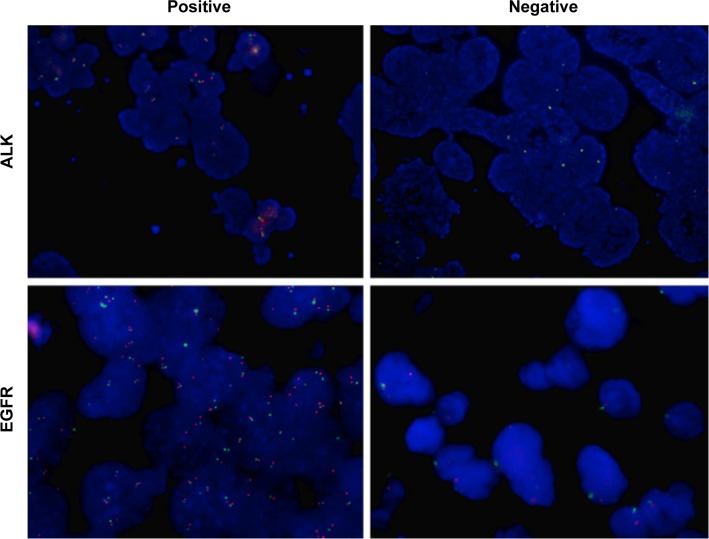
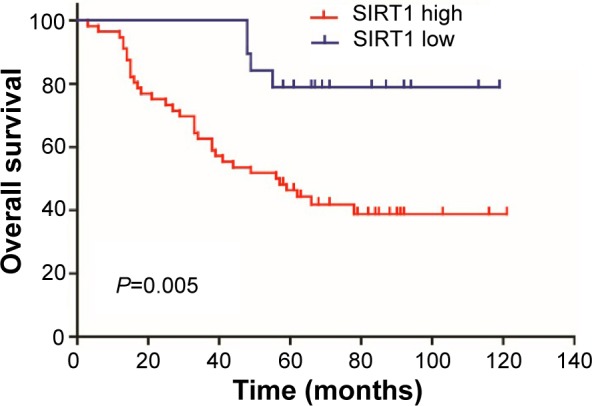
Several studies have reported that the overexpression of Sirtuin 1 (SIRT1) was associated with poor prognosis in various human cancers. However, little is known regarding the prognostic value of SIRT1 in lung adenocarcinoma. Therefore, the aim of this study is to evaluate the role of SIRT1 in the prognosis of lung adenocarcinoma patients. Using a tissue microarray, we detected SIRT1 expression by immunohistochemistry in lung adenocarcinoma tissue, as well as in corresponding noncancerous tissues (NCTs). A high expression level of SIRT1 was observed in 74.7% (56/75) of patients with lung adenocarcinoma and 6.7% (5/75) of NCTs (P<0.001). SIRT1 expression was significantly associated with high pathological stage. Importantly, we found that SIRT1 expression was associated with worse overall survival in these lung adenocarcinoma patients (67.0 months vs 104.5 months; P=0.005). In addition, anaplastic lymphoma kinase, epidermal growth factor receptor, vascular endothelial growth factor (VEGF), and Survivin expression were evaluated by fluorescent in situ hybridization or immunohistochemistry, respectively. We found that VEGF and Survivin were both highly expressed in the lung adenocarcinoma tissues, as compared to NCTs. Moreover, the SIRT1 and VEGF expression statuses were significantly positively correlated (r=0.238, P=0.039), while SIRT1 and Survivin expression status were not significantly correlated (r=0.220, P=0.058). Correlation analysis showed a positive correlation between VEGF and Survivin expression (r=0.436, P<0.001). However, we found that VEGF and Survivin expression were not associated with the prognosis of lung adenocarcinoma patients (P=0.334; P=0.433, respectively). Taken together, our findings suggest that SIRT1 plays a role in the progression of lung adenocarcinoma and may be a significant prognostic indicator for lung adenocarcinoma patients.
多项研究报告称,沉默调节蛋白1(SIRT1)的过表达与多种人类癌症的不良预后相关。然而,关于SIRT1在肺腺癌中的预后价值知之甚少。因此,本研究的目的是评估SIRT1在肺腺癌患者预后中的作用。我们使用组织芯片,通过免疫组织化学检测了肺腺癌组织以及相应的非癌组织(NCT)中SIRT1的表达。在74.7%(56/75)的肺腺癌患者和6.7%(5/75)的NCT中观察到SIRT1高表达水平(P<0.001)。SIRT1表达与高病理分期显著相关。重要的是,我们发现SIRT1表达与这些肺腺癌患者较差的总生存期相关(67.0个月对104.5个月;P=0.005)。此外,分别通过荧光原位杂交或免疫组织化学评估了间变性淋巴瘤激酶、表皮生长因子受体、血管内皮生长因子(VEGF)和生存素的表达。我们发现,与NCT相比,VEGF和生存素在肺腺癌组织中均高表达。此外,SIRT1和VEGF表达状态显著正相关(r=0.238,P=0.039),而SIRT1和生存素表达状态无显著相关性(r=0.220,P=0.058)。相关性分析显示VEGF和生存素表达之间呈正相关(r=0.436,P<0.001)。然而,我们发现VEGF和生存素表达与肺腺癌患者的预后无关(分别为P=0.334;P=0.433)。综上所述,我们的研究结果表明,SIRT1在肺腺癌进展中起作用,可能是肺腺癌患者的一个重要预后指标。