Berg Kristin M, Piper Megan E, Smith Stevens S, Fiore Michael C, Jorenby Douglas E
Department of Medicine, University of Wisconsin School of Medicine and Public Health, Center for Tobacco Research and Intervention, 1930 Monroe, Suite 200, Madison, WI53711, United States; Advanced Fellowship in Women's Health-William S. Middleton Memorial Veterans Hospital, 2500 Overlook Terrace, Madison, WI53705, United States.
Department of Medicine, University of Wisconsin School of Medicine and Public Health, Center for Tobacco Research and Intervention, 1930 Monroe, Suite 200, Madison, WI53711, United States.
Addict Behav. 2015 Sep;48:52-7. doi: 10.1016/j.addbeh.2015.04.004. Epub 2015 Apr 29.
Alcohol and nicotine are commonly used substances in the U.S., with significant impacts on health. Using both substances concurrently impacts quit attempts. While studies have sought to examine changes in alcohol use co-occurring with tobacco cessation, results have not been consistent. Understanding these changes has clinical implications. The objective of this study is to identify changes in alcohol consumption that occur following tobacco cessation, as well as predictors of alcohol use patterns following a smoking cessation attempt.
A secondary analysis of a randomized, placebo-controlled trial evaluating the efficacy of five tobacco cessation pharmacotherapies. Participants (N=1301) reported their smoking and alcohol consumption daily for two weeks prior to, and two weeks after, the target quit date (TQD).
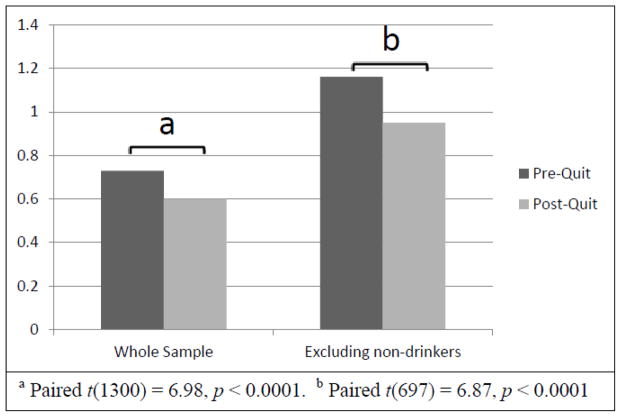
Generally, alcohol use decreased post-TQD. Smokers who reported less pre-quit alcohol use, as well as smokers who were female, non-white, and had a history of alcohol dependence tended to use less alcohol post-quit. Pre- and post-quit alcohol use were more strongly related among men and among those without a history of alcohol dependence.
For most smokers alcohol use decreased following smoking cessation. These results suggest that the expectation should be of decreased alcohol use post cessation. However, attention may be warranted for those who drink higher amounts of alcohol pre-cessation because they may be more likely to drink more in the post-quit period which may influence smoking cessation success.
酒精和尼古丁是美国常用的物质,对健康有重大影响。同时使用这两种物质会影响戒烟尝试。虽然已有研究试图探究与戒烟同时发生的酒精使用变化,但结果并不一致。了解这些变化具有临床意义。本研究的目的是确定戒烟后酒精消费的变化,以及戒烟尝试后酒精使用模式的预测因素。
对一项评估五种戒烟药物疗法疗效的随机、安慰剂对照试验进行二次分析。参与者(N = 1301)在目标戒烟日期(TQD)前两周和后两周每天报告他们的吸烟和酒精消费情况。
总体而言,TQD后酒精使用量减少。报告戒烟前酒精使用量较少的吸烟者,以及女性、非白人且有酒精依赖史的吸烟者,戒烟后往往饮酒量较少。戒烟前后的酒精使用在男性和没有酒精依赖史的人群中相关性更强。
对于大多数吸烟者来说,戒烟后酒精使用量会减少。这些结果表明,预期戒烟后酒精使用量会减少。然而,对于戒烟前饮酒量较高的人可能需要予以关注,因为他们在戒烟后可能更有可能饮酒量增加,这可能会影响戒烟成功。