Shahnazi Vahideh, Zaree Mina, Nouri Mohammad, Mehrzad-Sadaghiani Mahzad, Fayezi Shabnam, Darabi Maryam, Khani Sajjad, Darabi Masoud
Women's Reproductive Health Research Center, Al-zahra Hospital, Tabriz University of Medical Sciences, Tabriz, Iran.
Department of Biochemistry and Clinical Laboratories, School of Medicine, Tabriz University of Medical Sciences, Tabriz, Iran.
Iran J Reprod Med. 2015 Feb;13(2):71-8.
The omega-3 (ω-3) fatty acid eicosapentaenoic acid (EPA) is currently used in the clinic as a nutritional supplement to improve infertility, particularly in women with polycystic ovarian syndrome (PCOS).
The present study was designed to investigate the effect of EPA on insulin-like growth factor 1 (IGF-1) and cyclooxygenase 2 (COX-2) gene expression in primary cultured granulosa cells from patients undergoing in vitro fertilization (IVF), and also to compare this effect with those in granulosa cells of PCOS patients.
In this experimental study, human granulosa cells were isolated from follicular fluid of normal and PCOS women undergoing IVF by hyaluronidase digestions, followed by Percoll gradient centrifugation. Cells were cultured in vitro, exposed to a range of concentrations of the EPA (25-100 µM) for 24 hr, and investigated with respect to COX-2 and IGF-1 gene expression by real time-PCR.
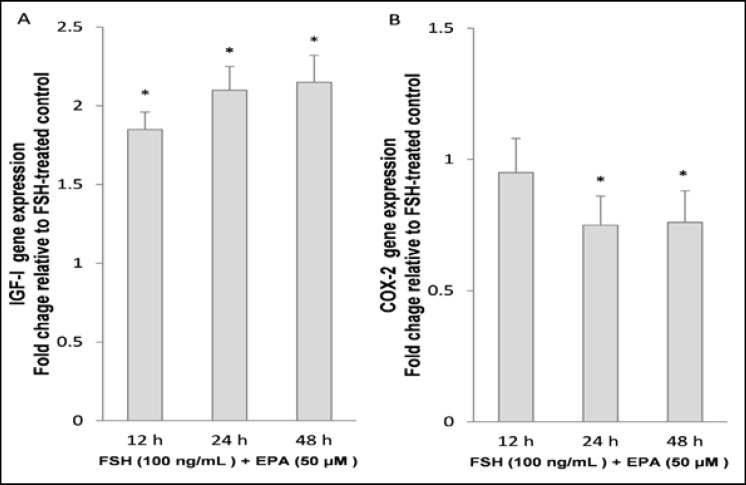
In both groups, all doses of the EPA significantly induced IGF-1 mRNA gene expression compared to the untreated control. High doses of EPA in the presence of recombinant (r) FSH produced a stimulatory effect on IGF-1 and a suppressive effect (p=0.01) on the COX-2 gene expression, which were more pronounced in granulosa cells from PCOS patients.
EPA affect diversely the gene expression of IGF-1 and COX-2 in granulosa cells, which were more pronounced in PCOS compared to control. These findings represent the possible underlying molecular mechanisms for the positive impact of the ω-3 fatty acids on reproduction, especially in patients with PCOS.
ω-3(Ω-3)脂肪酸二十碳五烯酸(EPA)目前在临床上作为营养补充剂用于改善不孕症,尤其是多囊卵巢综合征(PCOS)女性的不孕症。
本研究旨在调查EPA对体外受精(IVF)患者原代培养颗粒细胞中胰岛素样生长因子1(IGF-1)和环氧合酶2(COX-2)基因表达的影响,并将其与PCOS患者颗粒细胞中的影响进行比较。
在本实验研究中,通过透明质酸酶消化从接受IVF的正常和PCOS女性的卵泡液中分离出人颗粒细胞,然后进行Percoll梯度离心。将细胞在体外培养,暴露于一系列浓度的EPA(25-100μM)24小时,并通过实时PCR研究COX-2和IGF-1基因表达。
在两组中,与未处理的对照相比,所有剂量的EPA均显著诱导IGF-1 mRNA基因表达。在重组(r)FSH存在下,高剂量的EPA对IGF-1产生刺激作用,对COX-2基因表达产生抑制作用(p=0.01),这在PCOS患者的颗粒细胞中更为明显。
EPA对颗粒细胞中IGF-1和COX-2的基因表达有不同影响,与对照组相比,在PCOS中更为明显。这些发现代表了ω-3脂肪酸对生殖产生积极影响的可能潜在分子机制,尤其是在PCOS患者中。