Chu Qi, Yu Yue-Xin, Zhang Jing-Zi, Zhang Yi-Tong, Yu Jia-Ping
Department of Reproductive Medicine, General Hospital of Northern Theater Command, Shenyang, Liaoning, China.
Front Endocrinol (Lausanne). 2024 Feb 26;15:1280760. doi: 10.3389/fendo.2024.1280760. eCollection 2024.
This study was designed to explore the effects of flaxseed oil on the metaphase II (MII) oocyte rates in women with decreased ovarian reserve (DOR).
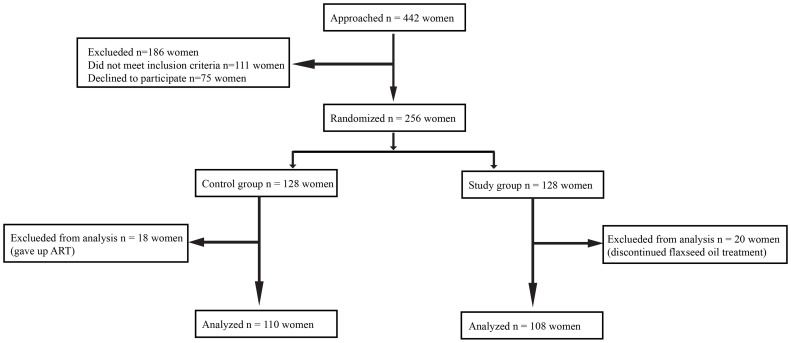
The women with DOR were divided into a study group (n = 108, flaxseed oil treatment) and a control group (n = 110, no treatment). All patients were treated with assisted reproductive technology (ART). Subsequently, the ART stimulation cycle parameters, embryo transfer (ET) results, and clinical reproductive outcomes were recorded. The influencing factors affecting the MII oocyte rate were analyzed using univariate analysis and multivariate analysis.
Flaxseed oil reduced the recombinant human follicle-stimulating hormone (r-hFSH) dosage and stimulation time and increased the peak estradiol (E2) concentration in DOR women during ART treatment. The MII oocyte rate, fertilization rate, cleavage rate, high-quality embryo rate, and blastocyst formation rate were increased after flaxseed oil intervention. The embryo implantation rate of the study group was higher than that of the control group ( = 0.05). Additionally, the female age [odds ratio (OR): 0.609, 95% confidence interval (CI): 0.52-0.72, < 0.01] was the hindering factor of MII oocyte rate, while anti-Müllerian hormone (AMH; OR: 100, 95% CI: 20.31-495, < 0.01), peak E2 concentration (OR: 1.00, 95% CI: 1.00-1.00, = 0.01), and the intake of flaxseed oil (OR: 2.51, 95% CI: 1.06-5.93, = 0.04) were the promoting factors for MII oocyte rate.
Flaxseed oil improved ovarian response and the quality of oocytes and embryos, thereby increasing the fertilization rate and high-quality embryo rate in DOR patients. The use of flaxseed oil was positively correlated with MII oocyte rate in women with DOR.
https://www.chictr.org.cn/, identifier ChiCTR2300073785.
本研究旨在探讨亚麻籽油对卵巢储备功能下降(DOR)女性的卵母细胞减数分裂中期II(MII)率的影响。
将DOR女性分为研究组(n = 108,接受亚麻籽油治疗)和对照组(n = 110,未接受治疗)。所有患者均接受辅助生殖技术(ART)治疗。随后,记录ART刺激周期参数、胚胎移植(ET)结果及临床生殖结局。采用单因素分析和多因素分析方法分析影响MII卵母细胞率的因素。
在ART治疗期间,亚麻籽油降低了DOR女性的重组人促卵泡激素(r-hFSH)剂量和刺激时间,并提高了峰值雌二醇(E2)浓度。亚麻籽油干预后,MII卵母细胞率、受精率、卵裂率、优质胚胎率和囊胚形成率均有所提高。研究组的胚胎着床率高于对照组(P = 0.05)。此外,女性年龄[比值比(OR):0.609,95%置信区间(CI):0.52 - 0.72,P < 0.01]是MII卵母细胞率的阻碍因素,而抗苗勒管激素(AMH;OR:100,95% CI:20.31 - 495,P < 0.01)、峰值E2浓度(OR:1.00,95% CI:1.00 - 1.00,P = 0.01)和亚麻籽油摄入量(OR:2.51,95% CI:1.06 - 5.93,P = 0.04)是MII卵母细胞率的促进因素。
亚麻籽油改善了卵巢反应及卵母细胞和胚胎质量,从而提高了DOR患者的受精率和优质胚胎率。亚麻籽油的使用与DOR女性的MII卵母细胞率呈正相关。