Pandey Manjula, Elshenawy Mohamed M, Jergic Slobodan, Takahashi Masateru, Dixon Nicholas E, Hamdan Samir M, Patel Smita S
Department of Biochemistry and Molecular Biology, Rutgers, the State University of New Jersey, Robert Wood Johnson Medical School, Piscataway, NJ 08854, USA
Division of Biological and Environmental Sciences and Engineering, King Abdullah University of Science and Technology, Thuwal 23955, Saudi Arabia.
Nucleic Acids Res. 2015 Jul 13;43(12):5924-35. doi: 10.1093/nar/gkv527. Epub 2015 May 24.
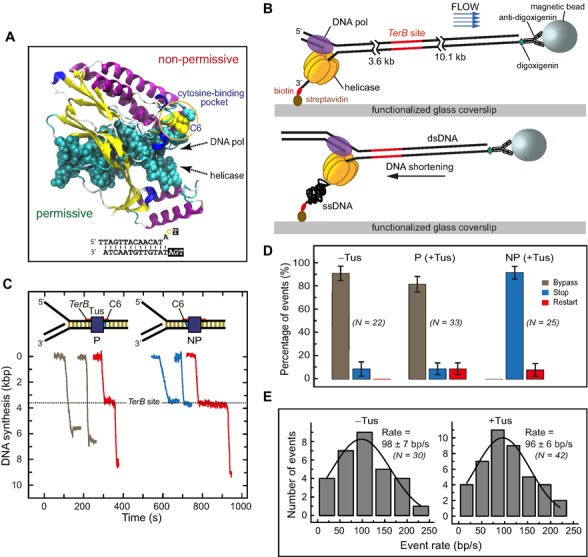
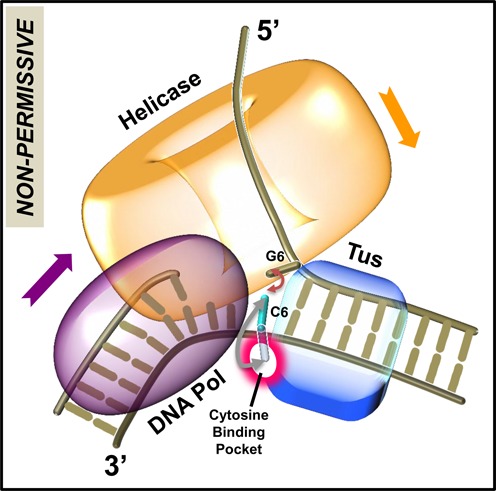
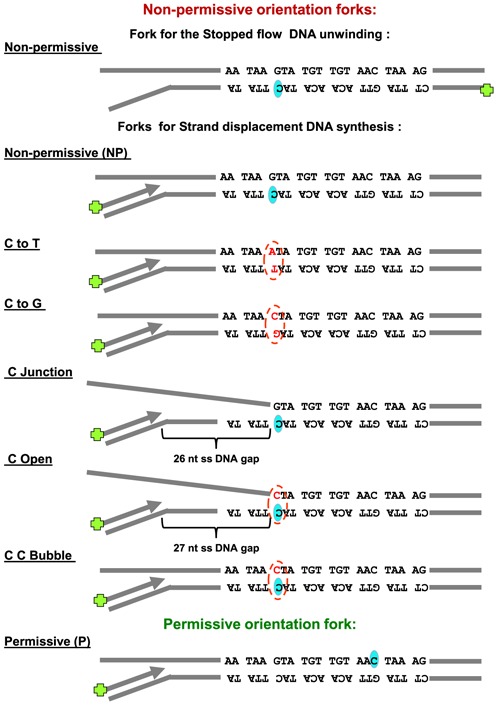
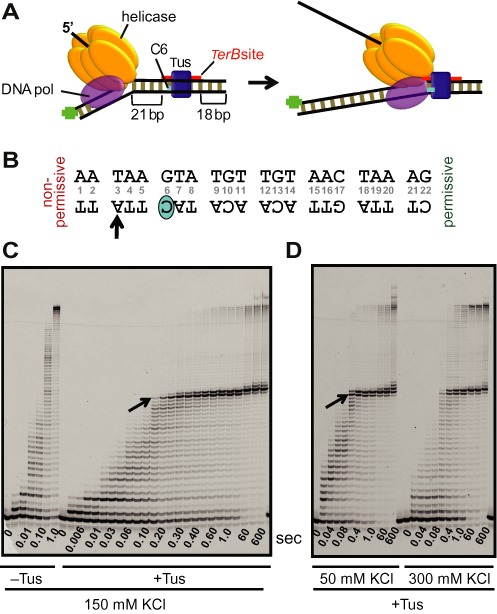
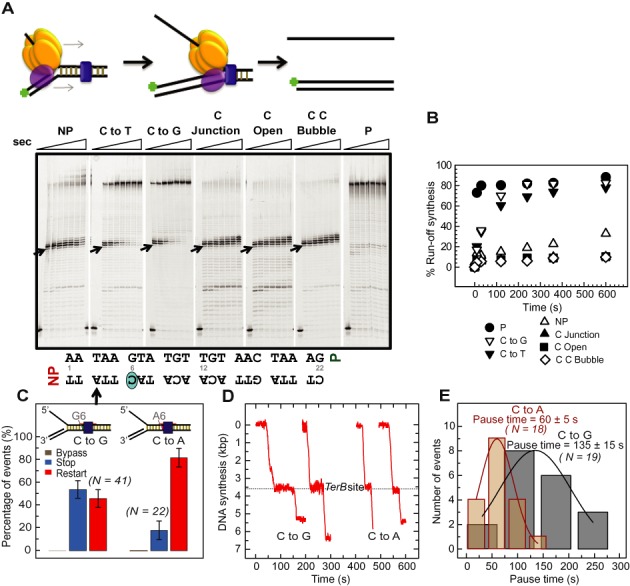
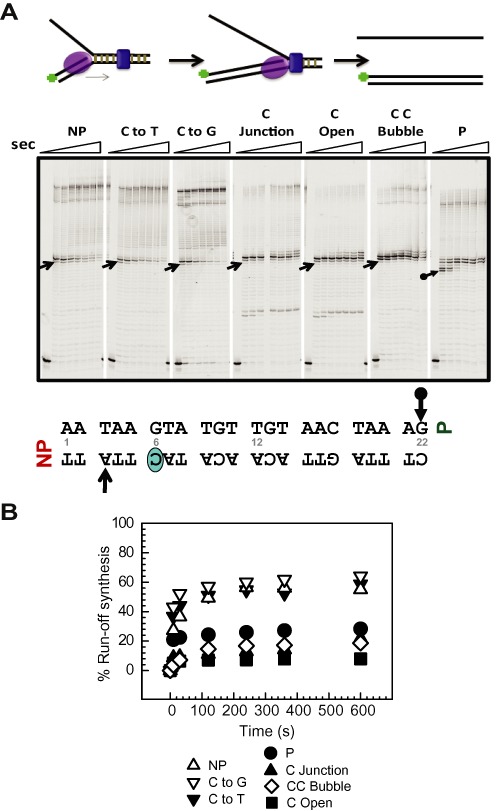
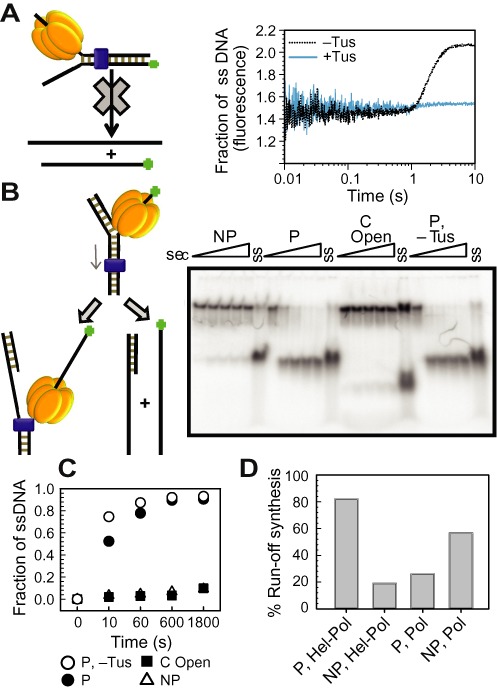
The Escherichia coli replication terminator protein (Tus) binds to Ter sequences to block replication forks approaching from one direction. Here, we used single molecule and transient state kinetics to study responses of the heterologous phage T7 replisome to the Tus-Ter complex. The T7 replisome was arrested at the non-permissive end of Tus-Ter in a manner that is explained by a composite mousetrap and dynamic clamp model. An unpaired C(6) that forms a lock by binding into the cytosine binding pocket of Tus was most effective in arresting the replisome and mutation of C(6) removed the barrier. Isolated helicase was also blocked at the non-permissive end, but unexpectedly the isolated polymerase was not, unless C(6) was unpaired. Instead, the polymerase was blocked at the permissive end. This indicates that the Tus-Ter mechanism is sensitive to the translocation polarity of the DNA motor. The polymerase tracking along the template strand traps the C(6) to prevent lock formation; the helicase tracking along the other strand traps the complementary G(6) to aid lock formation. Our results are consistent with the model where strand separation by the helicase unpairs the GC(6) base pair and triggers lock formation immediately before the polymerase can sequester the C(6) base.
大肠杆菌复制终止蛋白(Tus)与Ter序列结合,以阻止复制叉从一个方向靠近。在这里,我们使用单分子和瞬态动力学来研究异源噬菌体T7复制体对Tus-Ter复合物的反应。T7复制体以一种由复合捕鼠器和动态钳模型解释的方式,在Tus-Ter的非允许端被阻滞。通过结合到Tus的胞嘧啶结合口袋中形成锁的未配对C(6),在阻滞复制体方面最有效,而C(6)的突变消除了障碍。分离的解旋酶在非允许端也被阻滞,但出乎意料的是,分离的聚合酶没有被阻滞,除非C(6)未配对。相反,聚合酶在允许端被阻滞。这表明Tus-Ter机制对DNA马达的转位极性敏感。沿着模板链追踪的聚合酶捕获C(6)以防止锁的形成;沿着另一条链追踪的解旋酶捕获互补的G(6)以帮助锁的形成。我们的结果与这样的模型一致,即解旋酶引起的链分离使GC(6)碱基对解链,并在聚合酶能够隔离C(6)碱基之前立即触发锁的形成。