Szekendi Marilyn K, Williams Mark V, Carrier Danielle, Hensley Laurie, Thomas Stephen, Cerese Julie
Performance Improvement, University HealthSystem Consortium, Chicago, Illinois.
Department of Internal Medicine, University of Kentucky, Lexington, Kentucky.
J Hosp Med. 2015 Sep;10(9):563-8. doi: 10.1002/jhm.2375. Epub 2015 May 26.
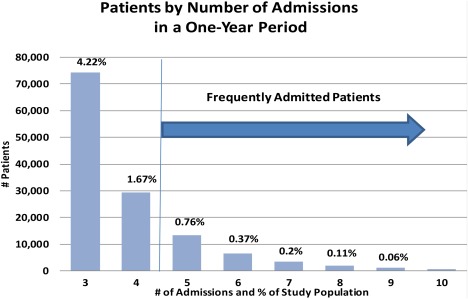
The recent intense attention to hospital readmissions and their implications for quality, safety, and reimbursement necessitates understanding specific subsets of readmitted patients. Frequently admitted patients, defined as patients who are admitted 5 or more times within 1 year, may have some distinguishing characteristics that require novel solutions.
A comprehensive administrative database (University HealthSystem Consortium's Clinical Data Base/Resource Manager) was analyzed to identify demographic, social, and clinical characteristics of frequently admitted patients in 101 US academic medical centers.
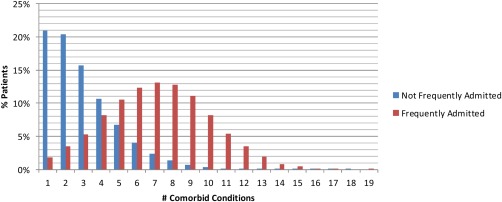
We studied 28,291 frequently admitted patients with 180,185 admissions over a 1-year period (2011-2012). These patients comprise 1.6% of all patients, but account for 8% of all admissions and 7% of direct costs. Their admissions are driven by multiple chronic conditions; compared to other hospitalized patients, they have significantly more comorbidities (an average of 7.1 vs 2.5), and 84% of their admissions are to medical services. A minority, but significantly more than other patients, have comorbidities of psychosis or substance abuse. Moreover, although they are slightly more likely than other patients to be on Medicaid or to be uninsured (27.6% vs 21.6%), nearly three-quarters have private or Medicare coverage.
Patients who are frequently admitted to US academic medical centers are likely to have multiple complex chronic conditions and may have behavioral comorbidities that mediate their health behaviors, resulting in acute episodes requiring hospitalization. This information can be used to identify solutions for preventing repeat hospitalization for this small group of patients who consume a highly disproportionate share of healthcare resources.
近期对医院再入院情况及其对医疗质量、安全和报销的影响给予了高度关注,这就需要了解再入院患者的特定亚组情况。频繁入院患者,定义为在1年内入院5次或更多次的患者,可能具有一些需要新解决方案的独特特征。
分析了一个综合管理数据库(大学卫生系统联盟的临床数据库/资源管理器),以确定美国101家学术医疗中心频繁入院患者的人口统计学、社会和临床特征。
我们研究了28291名频繁入院患者,在1年期间(2011 - 2012年)共有180185次入院。这些患者占所有患者的1.6%,但占所有入院次数的8%和直接费用的7%。他们的入院是由多种慢性疾病驱动的;与其他住院患者相比,他们有明显更多的合并症(平均7.1种 vs 2.5种),并且他们84%的入院是接受医疗服务。少数患者患有精神病或药物滥用合并症,但比其他患者明显更多。此外,尽管他们比其他患者更有可能参加医疗补助计划或未参保(27.6% vs 21.6%),但近四分之三的患者有私人保险或医疗保险。
美国学术医疗中心的频繁入院患者可能患有多种复杂的慢性疾病,并且可能有行为合并症影响他们的健康行为,导致需要住院治疗的急性发作。这些信息可用于为这一小部分消耗了极高比例医疗资源的患者确定预防再次住院的解决方案。