Kumar Palanisamy Satheesh, Pillai Gopalakrishna N, Manjusha Ushadevi
Central Marine Fisheries Research Institute, Kochi, Kerala 682 018 India.
Springerplus. 2014 Oct 9;3(1):591. doi: 10.1186/2193-1801-3-591. eCollection 2014.
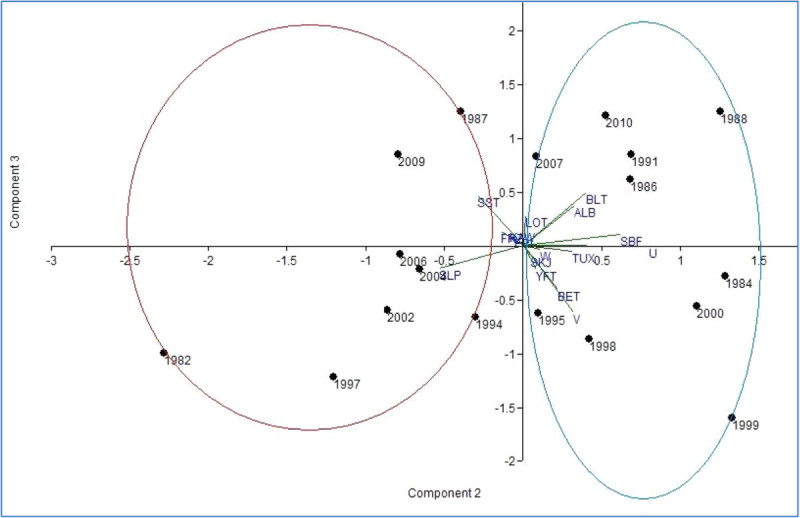
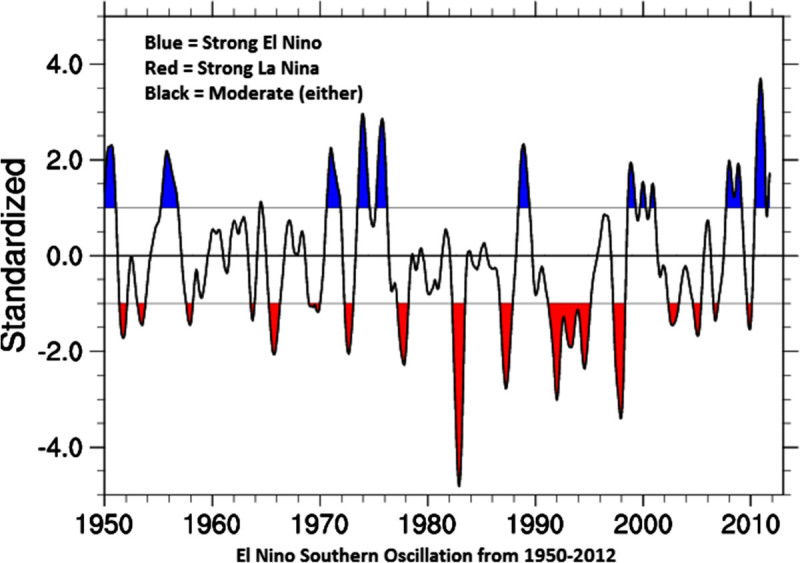
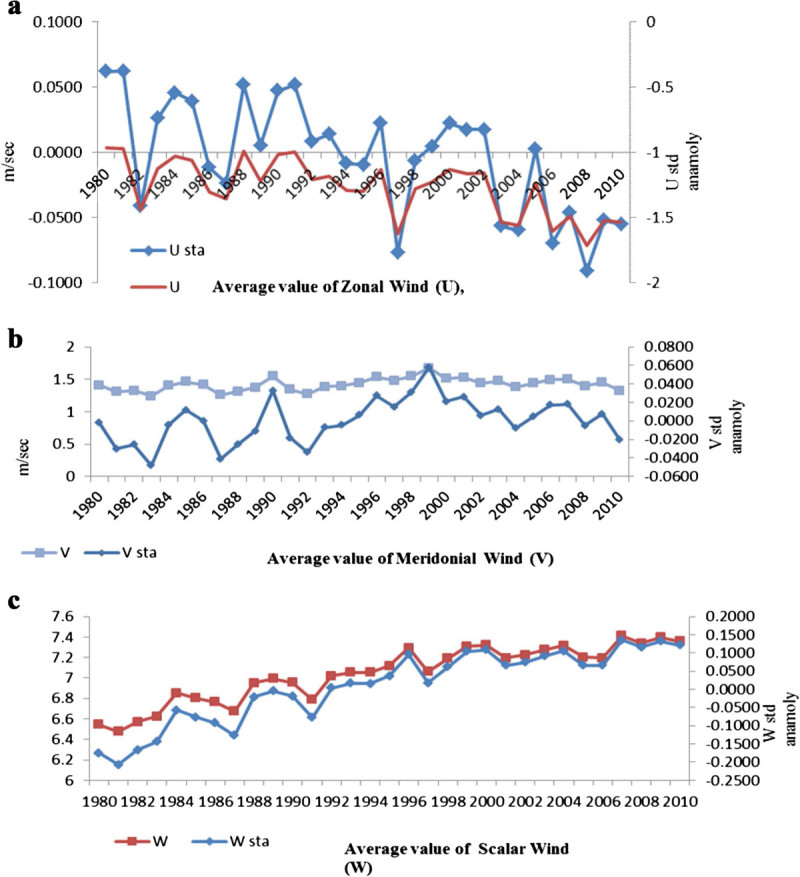
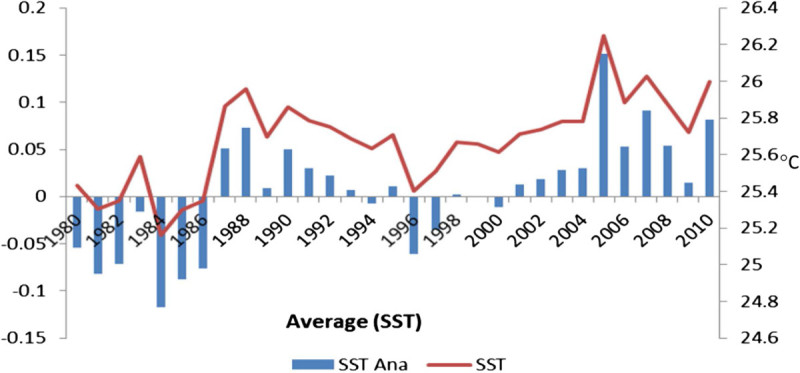
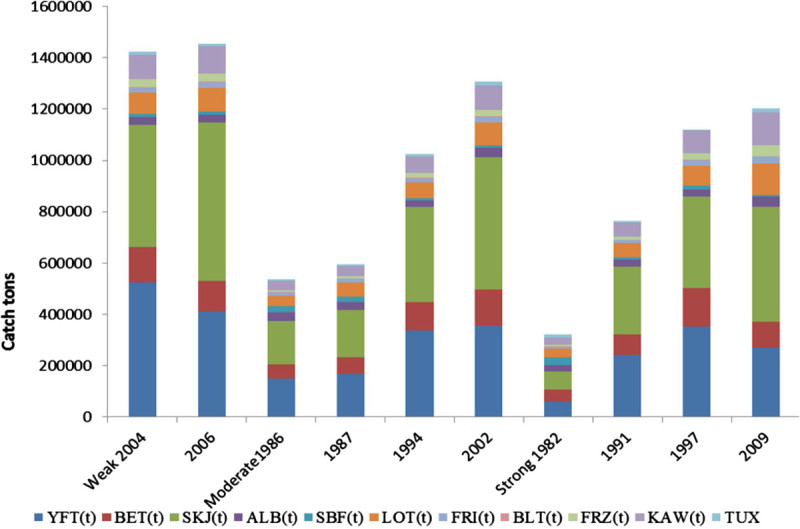
El Nino Southern Oscillation (ENSO) is an important driver of interannual variations in climate and ecosystem productivity in tropical regions. However, detailed information about this important phenomenon of the Indian Ocean is scarce. Consequently, the objective of this study is to improve understanding of the impact of warm event El Nino and cool event La Nina on annual tuna landings from the Indian Ocean from 1980 to 2010. In this study, maximum tuna landings were recorded during a weak El Nino year (1456054 t in 2006) and during a weak La Nina year (1243562 t in 2000), although the lowest tuna catch was followed during the strong El Nino year (1204119 t in 2009) and during a strong La Nina year (706546 t in 1988). Validation of predicted tuna landings and SST were showing a significant positive correlation (p < 0.01) was observed all the major tuna species except Southern Bluefin Tuna. Whereas the other relationships such as sea level pressure, Wind actions; Zonal Wind (U), Meridonial Wind (V), and Scalar Wind (W) are less well-defined. In contrast with principal component analysis we find that Principal Components 1 explains 75.5% of the total variance and suggest that sea surface temperature plays a major role in determining tuna availability in the region especially during warm event El Nino years; landings in Indian Ocean tend to be optimum SST 25 to 26°C in ENSO event. Our results confirm the ENSO impact on climate, tuna abundance and production in the Indian Ocean. However, among the oceanic variables SST explained the highest deviance in generalized additive models and therefore considered the best habitat predictor in the Indian Ocean followed by sea level pressure and Winds (U, V, W).
厄尔尼诺 - 南方涛动(ENSO)是热带地区气候和生态系统生产力年际变化的重要驱动因素。然而,关于印度洋这一重要现象的详细信息却很匮乏。因此,本研究的目的是增进对1980年至2010年期间暖事件厄尔尼诺和冷事件拉尼娜对印度洋年度金枪鱼渔获量影响的理解。在本研究中,金枪鱼渔获量最高值出现在弱厄尔尼诺年(2006年为1456054吨)和弱拉尼娜年(2000年为1243562吨),尽管在强厄尔尼诺年(2009年为1204119吨)和强拉尼娜年(1988年为706546吨)之后金枪鱼渔获量最低。预测的金枪鱼渔获量与海表温度的验证显示,除南方蓝鳍金枪鱼外,所有主要金枪鱼品种均呈现显著正相关(p < 0.01)。而其他关系,如海平面气压、风的作用;纬向风(U)、经向风(V)和标量风(W)则不太明确。与主成分分析相比,我们发现主成分1解释了总方差的75.5%,这表明海表温度在确定该地区金枪鱼可获得性方面起着主要作用,尤其是在暖事件厄尔尼诺年期间;在ENSO事件中,印度洋的渔获量往往在海表温度为25至26°C时达到最佳。我们的结果证实了ENSO对印度洋气候、金枪鱼丰度和产量的影响。然而,在海洋变量中,海表温度在广义相加模型中解释的偏差最高,因此被认为是印度洋最佳的栖息地预测指标,其次是海平面气压和风(U、V、W)。