Department of Human Genetics, Medical School, Saarland University, Building 60, 66421 Homburg/Saar, Germany.
Chair for Clinical Bioinformatics, Saarland University, Building E.2.1, 66123 Saarbrücken, Germany.
PLoS One. 2015 Jun 3;10(6):e0128235. doi: 10.1371/journal.pone.0128235. eCollection 2015.
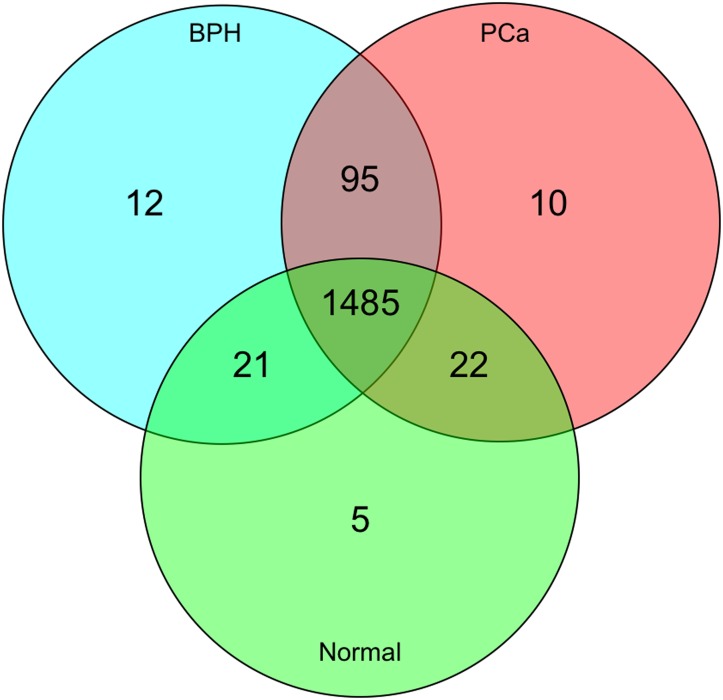
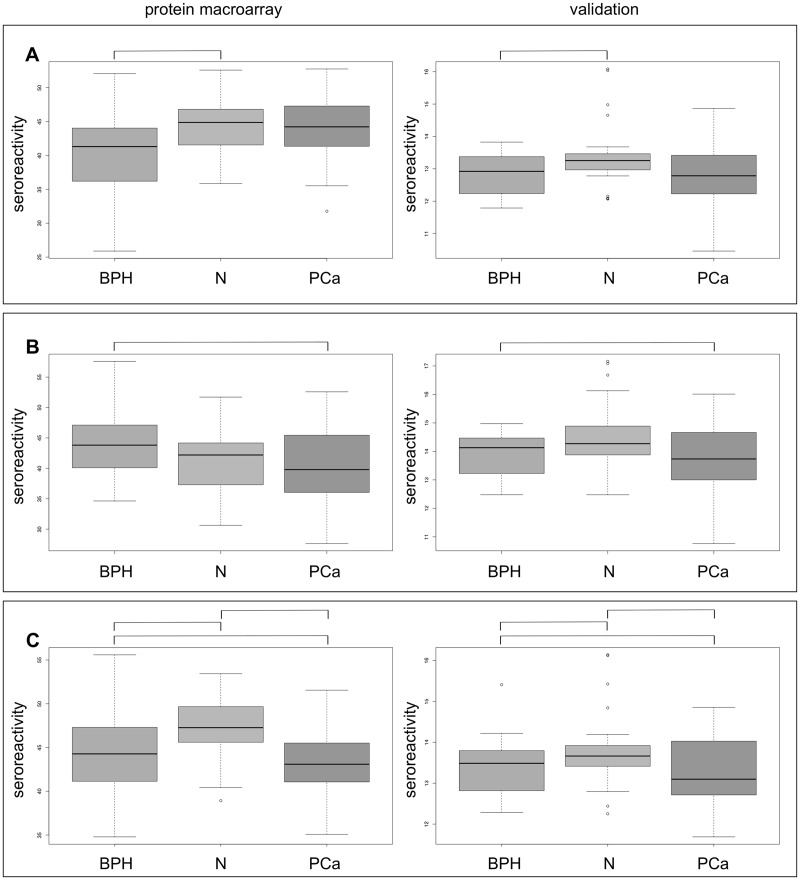
Although an increased level of the prostate-specific antigen can be an indication for prostate cancer, other reasons often lead to a high rate of false positive results. Therefore, an additional serological screening of autoantibodies in patients' sera could improve the detection of prostate cancer. We performed protein macroarray screening with sera from 49 prostate cancer patients, 70 patients with benign prostatic hyperplasia and 28 healthy controls and compared the autoimmune response in those groups. We were able to distinguish prostate cancer patients from normal controls with an accuracy of 83.2%, patients with benign prostatic hyperplasia from normal controls with an accuracy of 86.0% and prostate cancer patients from patients with benign prostatic hyperplasia with an accuracy of 70.3%. Combining seroreactivity pattern with a PSA level of higher than 4.0 ng/ml this classification could be improved to an accuracy of 84.1%. For selected proteins we were able to confirm the differential expression by using luminex on 84 samples. We provide a minimally invasive serological method to reduce false positive results in detection of prostate cancer and according to PSA screening to distinguish men with prostate cancer from men with benign prostatic hyperplasia.
虽然前列腺特异性抗原水平升高可能是前列腺癌的一个指征,但其他原因常常导致高假阳性结果。因此,对患者血清中的自身抗体进行额外的血清学筛选可以提高前列腺癌的检出率。我们用来自 49 例前列腺癌患者、70 例良性前列腺增生患者和 28 例健康对照者的血清进行了蛋白质微阵列筛选,并比较了这些组中的自身免疫反应。我们能够以 83.2%的准确度将前列腺癌患者与正常对照者区分开来,以 86.0%的准确度将良性前列腺增生患者与正常对照者区分开来,以 70.3%的准确度将前列腺癌患者与良性前列腺增生患者区分开来。将血清反应模式与 PSA 水平大于 4.0ng/ml 结合起来,可以将这种分类的准确性提高到 84.1%。对于选定的蛋白质,我们能够通过在 84 个样本上使用 Luminex 验证差异表达。我们提供了一种微创的血清学方法,以减少前列腺癌检测中的假阳性结果,并根据 PSA 筛查来区分前列腺癌患者和良性前列腺增生患者。