Department of Human Genetics, Medical School, Saarland University, Building 60, 66421 Homburg/Saar, Germany.
Respir Res. 2010 Feb 10;11(1):18. doi: 10.1186/1465-9921-11-18.
Lung cancer is a very frequent and lethal tumor with an identifiable risk population. Cytological analysis and chest X-ray failed to reduce mortality, and CT screenings are still controversially discussed. Recent studies provided first evidence for the potential usefulness of autoantigens as markers for lung cancer.
We used extended panels of arrayed antigens and determined autoantibody signatures of sera from patients with different kinds of lung cancer, different common non-tumor lung pathologies, and controls without any lung disease by a newly developed computer aided image analysis procedure. The resulting signatures were classified using linear kernel Support Vector Machines and 10-fold cross-validation.
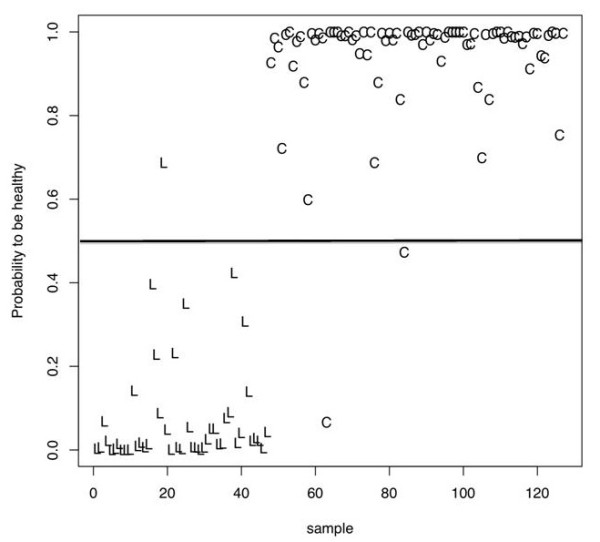
The novel approach allowed for discriminating lung cancer patients from controls without any lung disease with a specificity of 97.0%, a sensitivity of 97.9%, and an accuracy of 97.6%. The classification of stage IA/IB tumors and controls yielded a specificity of 97.6%, a sensitivity of 75.9%, and an accuracy of 92.9%. The discrimination of lung cancer patients from patients with non-tumor lung pathologies reached an accuracy of 88.5%.
We were able to separate lung cancer patients from subjects without any lung disease with high accuracy. Furthermore, lung cancer patients could be separated from patients with other non-tumor lung diseases. These results provide clear evidence that blood-based tests open new avenues for the early diagnosis of lung cancer.
肺癌是一种非常常见且致命的肿瘤,其具有明确的风险人群。细胞学分析和胸部 X 光检查未能降低死亡率,而 CT 筛查仍存在争议。最近的研究首次提供了自身抗原作为肺癌标志物的潜在有用性的证据。
我们使用扩展的阵列抗原面板,并通过新开发的计算机辅助图像分析程序,确定来自不同类型肺癌、不同常见非肿瘤性肺部病变以及无任何肺部疾病的对照患者的血清中的自身抗体特征。使用线性核支持向量机和 10 倍交叉验证对得到的特征进行分类。
这种新方法能够以 97.0%的特异性、97.9%的敏感性和 97.6%的准确性将肺癌患者与无任何肺部疾病的对照组区分开来。IA/IB 期肿瘤和对照组的分类特异性为 97.6%,敏感性为 75.9%,准确性为 92.9%。将肺癌患者与非肿瘤性肺部疾病患者区分开来的准确率达到 88.5%。
我们能够以很高的准确性将肺癌患者与无任何肺部疾病的受试者区分开来。此外,还可以将肺癌患者与其他非肿瘤性肺部疾病患者区分开来。这些结果清楚地表明,基于血液的测试为肺癌的早期诊断开辟了新途径。