Lombardi Sara, Fuoco Ilenia, di Fluri Giorgia, Costa Francesco, Ricchiuti Angelo, Biondi Graziano, Nardini Vincenzo, Scarpato Roberto
Unità di Genetica, Dipartimento di Biologia, University of Pisa, Pisa, Italy.
Research Center Nutraceuticals and Food for Health-Nutrafood, University of Pisa, Pisa, Italy.
Oncotarget. 2015 Jun 20;6(17):14852-64. doi: 10.18632/oncotarget.4032.
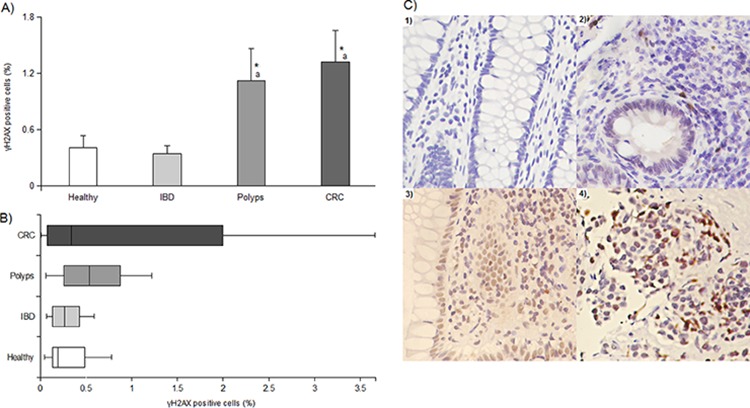
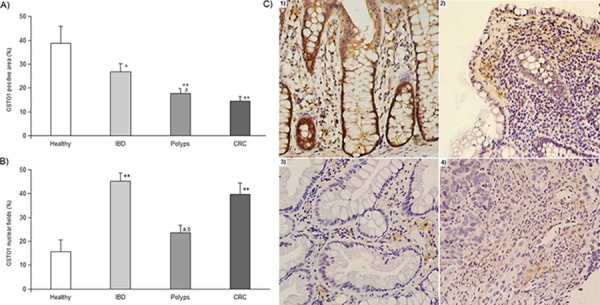
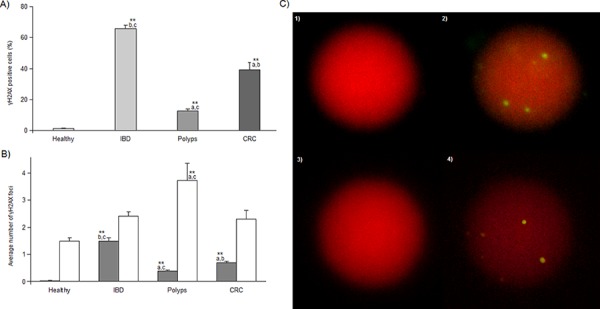
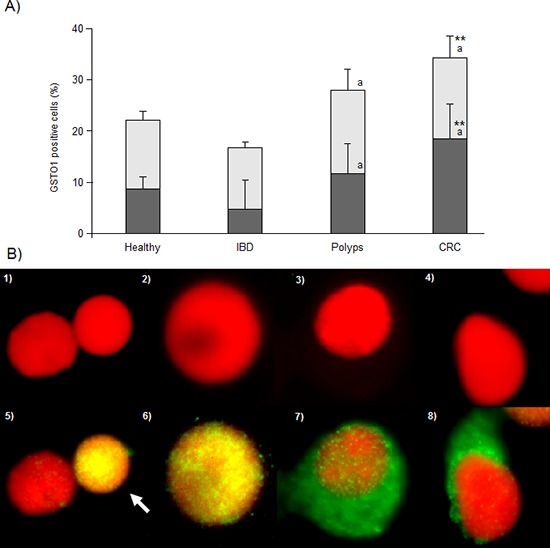
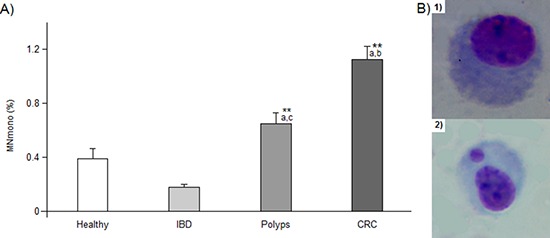
Inflammatory bowel disease (IBD) and polyps, are common colorectal pathologies in western society and are risk factors for development of colorectal cancer (CRC). Genomic instability is a cancer hallmark and is connected to changes in chromosomal structure, often caused by double strand break formation (DSB), and aneuploidy. Cellular stress, may contribute to genomic instability. In colorectal biopsies and peripheral blood lymphocytes of patients with IBD, polyps and CRC, we evaluated 1) genomic instability using the γH2AX assay as marker of DSB and micronuclei in mononuclear lymphocytes kept under cytodieresis inhibition, and 2) cellular stress through expression and cellular localization of glutathione-S-transferase omega 1 (GSTO1). Colon biopsies showed γH2AX increase starting from polyps, while lymphocytes already from IBD. Micronuclei frequency began to rise in lymphocytes of subjects with polyps, suggesting a systemic genomic instability condition. Colorectal tissues lost GSTO1 expression but increased nuclear localization with pathology progression. Lymphocytes did not change GSTO1 expression and localization until CRC formation, where enzyme expression was increased. We propose that the growing genomic instability found in our patients is connected with the alteration of cellular environment. Evaluation of genomic damage and cellular stress in colorectal pathologies may facilitate prevention and management of CRC.
炎症性肠病(IBD)和息肉是西方社会常见的结直肠病变,也是结直肠癌(CRC)发生的危险因素。基因组不稳定是癌症的一个标志,与染色体结构变化有关,常由双链断裂形成(DSB)和非整倍体引起。细胞应激可能导致基因组不稳定。在IBD、息肉和CRC患者的结直肠活检组织及外周血淋巴细胞中,我们评估了:1)使用γH2AX检测作为DSB和单核淋巴细胞中微核的标志物,在细胞分裂抑制条件下评估基因组不稳定;2)通过谷胱甘肽-S-转移酶ω1(GSTO1)的表达和细胞定位评估细胞应激。结肠活检显示,从息肉开始γH2AX就增加,而淋巴细胞从IBD阶段就开始增加。息肉患者淋巴细胞中的微核频率开始上升,提示存在全身性基因组不稳定状态。随着病理进展,结直肠组织中GSTO1表达缺失,但核定位增加。淋巴细胞在CRC形成之前GSTO1表达和定位没有变化,而在CRC形成时酶表达增加。我们认为,在我们患者中发现的日益增加的基因组不稳定与细胞环境改变有关。评估结直肠病变中的基因组损伤和细胞应激可能有助于CRC的预防和管理。