• 文献检索
  • 文档翻译
  • 深度研究
  • 学术资讯
  • Suppr Zotero 插件Zotero 插件
  • 邀请有礼
  • 套餐&价格
  • 历史记录
应用&插件
Suppr Zotero 插件Zotero 插件浏览器插件Mac 客户端Windows 客户端微信小程序
定价
高级版会员购买积分包购买API积分包
服务
文献检索文档翻译深度研究API 文档MCP 服务
关于我们
关于 Suppr公司介绍联系我们用户协议隐私条款
关注我们

Suppr 超能文献

核心技术专利:CN118964589B侵权必究
粤ICP备2023148730 号-1Suppr @ 2026

文献检索

告别复杂PubMed语法,用中文像聊天一样搜索,搜遍4000万医学文献。AI智能推荐,让科研检索更轻松。

立即免费搜索

文件翻译

保留排版,准确专业,支持PDF/Word/PPT等文件格式,支持 12+语言互译。

免费翻译文档

深度研究

AI帮你快速写综述,25分钟生成高质量综述,智能提取关键信息,辅助科研写作。

立即免费体验

一项支持心力衰竭患者及其非正式照料者的移动健康干预措施:一项随机比较有效性试验。

A Mobile Health Intervention Supporting Heart Failure Patients and Their Informal Caregivers: A Randomized Comparative Effectiveness Trial.

作者信息

Piette John D, Striplin Dana, Marinec Nicolle, Chen Jenny, Trivedi Ranak B, Aron David C, Fisher Lawrence, Aikens James E

机构信息

Center for Clinical Management Research and Center for Managing Chronic Disease, VA Ann Arbor Healthcare System and University of Michigan School of Public Health, Ann Arbor, MI, United States.

出版信息

J Med Internet Res. 2015 Jun 10;17(6):e142. doi: 10.2196/jmir.4550.

DOI:10.2196/jmir.4550
PMID:26063161
原文链接:https://pmc.ncbi.nlm.nih.gov/articles/PMC4526929/
Abstract

BACKGROUND

Mobile health (mHealth) interventions may improve heart failure (HF) self-care, but standard models do not address informal caregivers' needs for information about the patient's status or how the caregiver can help.

OBJECTIVE

We evaluated mHealth support for caregivers of HF patients over and above the impact of a standard mHealth approach.

METHODS

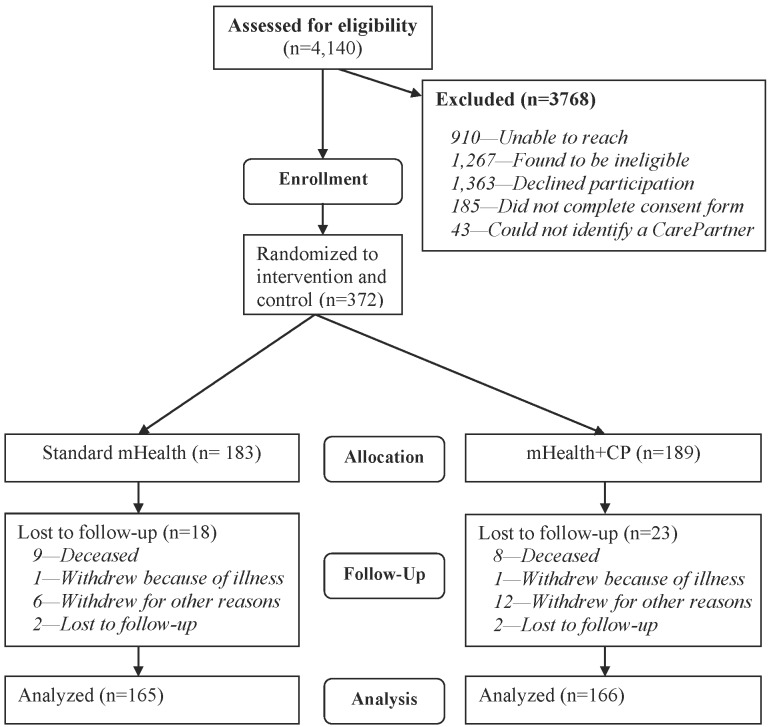
We identified 331 HF patients from Department of Veterans Affairs outpatient clinics. All patients identified a "CarePartner" outside their household. Patients randomized to "standard mHealth" (n=165) received 12 months of weekly interactive voice response (IVR) calls including questions about their health and self-management. Based on patients' responses, they received tailored self-management advice, and their clinical team received structured fax alerts regarding serious health concerns. Patients randomized to "mHealth+CP" (n=166) received an identical intervention, but with automated emails sent to their CarePartner after each IVR call, including feedback about the patient's status and suggestions for how the CarePartner could support disease care. Self-care and symptoms were measured via 6- and 12-month telephone surveys with a research associate. Self-care and symptom data also were collected through the weekly IVR assessments.

RESULTS

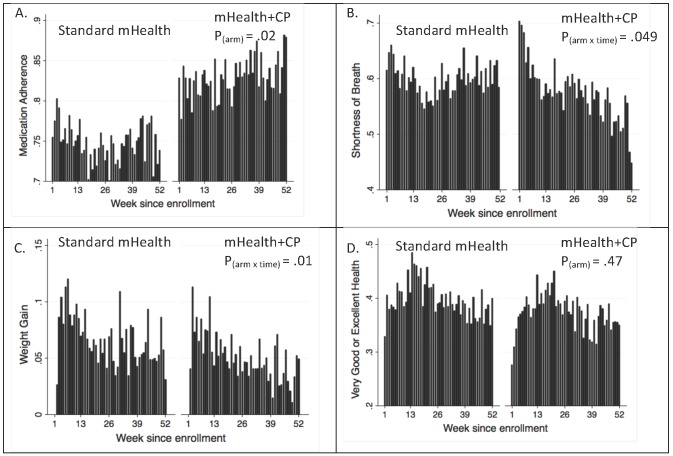
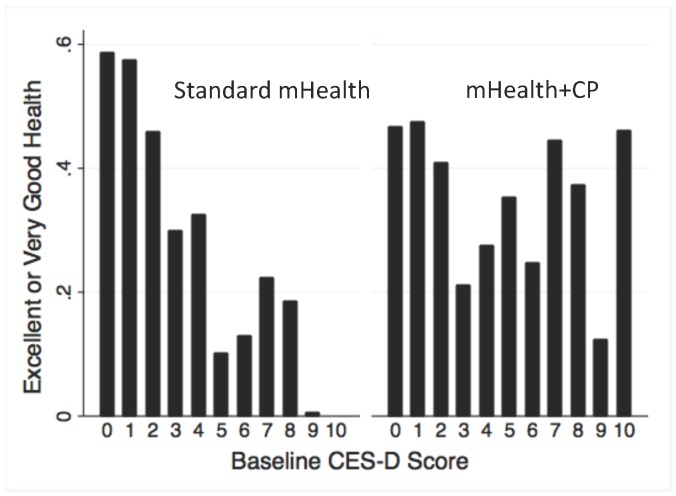
Participants were on average 67.8 years of age, 99% were male (329/331), 77% where white (255/331), and 59% were married (195/331). During 15,709 call-weeks of attempted IVR assessments, patients completed 90% of their calls with no difference in completion rates between arms. At both endpoints, composite quality of life scores were similar across arms. However, more mHealth+CP patients reported taking medications as prescribed at 6 months (8.8% more, 95% CI 1.2-16.5, P=.02) and 12 months (13.8% more, CI 3.7-23.8, P<.01), and 10.2% more mHealth+CP patients reported talking with their CarePartner at least twice per week at the 6-month follow-up (P=.048). mHealth+CP patients were less likely to report negative emotions during those interactions at both endpoints (both P<.05), were consistently more likely to report taking medications as prescribed during weekly IVR assessments, and also were less likely to report breathing problems or weight gains (all P<.05). Among patients with more depressive symptoms at enrollment, those randomized to mHealth+CP were more likely than standard mHealth patients to report excellent or very good general health during weekly IVR calls.

CONCLUSIONS

Compared to a relatively intensive model of IVR monitoring, self-management assistance, and clinician alerts, a model including automated feedback to an informal caregiver outside the household improved HF patients' medication adherence and caregiver communication. mHealth+CP may also decrease patients' risk of HF exacerbations related to shortness of breath and sudden weight gains. mHealth+CP may improve quality of life among patients with greater depressive symptoms. Weekly health and self-care monitoring via mHealth tools may identify intervention effects in mHealth trials that go undetected using typical, infrequent retrospective surveys.

TRIAL REGISTRATION

ClinicalTrials.gov NCT00555360; https://clinicaltrials.gov/ct2/show/NCT00555360 (Archived by WebCite at http://www.webcitation.org/6Z4Tsk78B).
https://cdn.ncbi.nlm.nih.gov/pmc/blobs/05d4/4526929/592c72420abf/jmir_v17i6e142_fig5.jpg
https://cdn.ncbi.nlm.nih.gov/pmc/blobs/05d4/4526929/ae88864295e9/jmir_v17i6e142_fig1.jpg
https://cdn.ncbi.nlm.nih.gov/pmc/blobs/05d4/4526929/afdde0a0de9c/jmir_v17i6e142_fig2.jpg
https://cdn.ncbi.nlm.nih.gov/pmc/blobs/05d4/4526929/fe7b24572cae/jmir_v17i6e142_fig3.jpg
https://cdn.ncbi.nlm.nih.gov/pmc/blobs/05d4/4526929/80d2ad21a92e/jmir_v17i6e142_fig4.jpg
https://cdn.ncbi.nlm.nih.gov/pmc/blobs/05d4/4526929/592c72420abf/jmir_v17i6e142_fig5.jpg
https://cdn.ncbi.nlm.nih.gov/pmc/blobs/05d4/4526929/ae88864295e9/jmir_v17i6e142_fig1.jpg
https://cdn.ncbi.nlm.nih.gov/pmc/blobs/05d4/4526929/afdde0a0de9c/jmir_v17i6e142_fig2.jpg
https://cdn.ncbi.nlm.nih.gov/pmc/blobs/05d4/4526929/fe7b24572cae/jmir_v17i6e142_fig3.jpg
https://cdn.ncbi.nlm.nih.gov/pmc/blobs/05d4/4526929/80d2ad21a92e/jmir_v17i6e142_fig4.jpg
https://cdn.ncbi.nlm.nih.gov/pmc/blobs/05d4/4526929/592c72420abf/jmir_v17i6e142_fig5.jpg
摘要

背景

移动健康(mHealth)干预可能会改善心力衰竭(HF)的自我护理,但标准模式并未满足非正式护理人员了解患者状况或如何提供帮助的信息需求。

目的

我们评估了mHealth对HF患者护理人员的支持作用,以及其相对于标准mHealth方法的额外影响。

方法

我们从退伍军人事务部门诊诊所识别出331名HF患者。所有患者均指定了一名家庭以外的“护理伙伴”。随机分配至“标准mHealth”组(n = 165)的患者接受为期12个月的每周交互式语音应答(IVR)电话,内容包括关于他们的健康和自我管理的问题。根据患者的回答,他们会收到量身定制的自我管理建议,其临床团队会收到关于严重健康问题的结构化传真警报。随机分配至“mHealth + CP”组(n = 166)的患者接受相同的干预,但每次IVR电话后会自动向其护理伙伴发送电子邮件,包括患者状况的反馈以及护理伙伴如何支持疾病护理的建议。通过与研究助理进行的6个月和12个月电话调查来测量自我护理和症状。自我护理和症状数据也通过每周的IVR评估收集。

结果

参与者的平均年龄为67.8岁,99%为男性(329/331),77%为白人(255/331),59%已婚(195/331)。在15,709个尝试进行IVR评估的呼叫周期间,患者完成了90%的呼叫,两组的完成率无差异。在两个终点,各治疗组的综合生活质量评分相似。然而,更多的mHealth + CP组患者在6个月时报告按规定服药(多8.8%,95%CI 1.2 - 16.5,P = 0.02)和12个月时(多13.8%,CI 3.7 - 23.8,P < 0.01),并且在6个月随访时,mHealth + CP组患者中多10.2%报告每周至少与护理伙伴交谈两次(P = 0.048)。在两个终点,mHealth + CP组患者在这些互动中报告负面情绪的可能性较小(均P < 0.05),在每周IVR评估期间持续更有可能报告按规定服药,并且报告呼吸问题或体重增加的可能性也较小(均P < 0.05)。在入组时抑郁症状较多的患者中,随机分配至mHealth + CP组的患者比标准mHealth组患者在每周IVR电话中更有可能报告总体健康状况为优秀或非常好。

结论

与相对密集的IVR监测、自我管理协助和临床医生警报模式相比,一种包括向家庭以外的非正式护理人员提供自动反馈的模式改善了HF患者的药物依从性和护理人员沟通。mHealth + CP还可能降低患者因呼吸急促和体重突然增加导致HF恶化的风险。mHealth + CP可能改善抑郁症状较重患者的生活质量。通过mHealth工具进行的每周健康和自我护理监测可能会识别出mHealth试验中的干预效果,而这些效果使用典型的、不频繁的回顾性调查可能无法检测到。

试验注册

ClinicalTrials.gov NCT00555360;https://clinicaltrials.gov/ct2/show/NCT00555360(由WebCite存档于http://www.webcitation.org/6Z4Tsk78B)。

相似文献

1
A Mobile Health Intervention Supporting Heart Failure Patients and Their Informal Caregivers: A Randomized Comparative Effectiveness Trial.一项支持心力衰竭患者及其非正式照料者的移动健康干预措施:一项随机比较有效性试验。
J Med Internet Res. 2015 Jun 10;17(6):e142. doi: 10.2196/jmir.4550.
2
A randomized trial of mobile health support for heart failure patients and their informal caregivers: impacts on caregiver-reported outcomes.一项针对心力衰竭患者及其非正式照护者的移动健康支持随机试验:对照护者报告结果的影响。
Med Care. 2015 Aug;53(8):692-9. doi: 10.1097/MLR.0000000000000378.
3
Structured Caregiver Feedback Enhances Engagement and Impact of Mobile Health Support: A Randomized Trial in a Lower-Middle-Income Country.结构化的照护者反馈可增强移动健康支持的参与度和影响力:在一个中低收入国家进行的随机试验
Telemed J E Health. 2016 Apr;22(4):261-8. doi: 10.1089/tmj.2015.0099. Epub 2015 Sep 9.
4
Engagement with automated patient monitoring and self-management support calls: experience with a thousand chronically ill patients.与自动化患者监测和自我管理支持电话的互动:一千名慢性病患者的经验。
Med Care. 2013 Mar;51(3):216-23. doi: 10.1097/MLR.0b013e318277ebf8.
5
Improvements in illness self-management and psychological distress associated with telemonitoring support for adults with diabetes.糖尿病成人患者远程监测支持下疾病自我管理及心理困扰的改善情况。
Prim Care Diabetes. 2015 Apr;9(2):127-34. doi: 10.1016/j.pcd.2014.06.003. Epub 2014 Jul 22.
6
Interactive Voice Response-An Innovative Approach to Post-Stroke Depression Self-Management Support.交互式语音应答——一种创新的脑卒中后抑郁自我管理支持方法。
Transl Stroke Res. 2017 Feb;8(1):77-82. doi: 10.1007/s12975-016-0481-7. Epub 2016 Jul 9.
7
Depression self-management assistance using automated telephonic assessments and social support.利用自动电话评估和社会支持进行抑郁症自我管理援助。
Am J Manag Care. 2013 Nov;19(11):892-900.
8
A Remote Medication Monitoring System for Chronic Heart Failure Patients to Reduce Readmissions: A Two-Arm Randomized Pilot Study.一种用于慢性心力衰竭患者以减少再入院率的远程药物监测系统:双臂随机试点研究。
J Med Internet Res. 2016 Apr 17;18(5):e91. doi: 10.2196/jmir.5256.
9
Folic acid supplementation and malaria susceptibility and severity among people taking antifolate antimalarial drugs in endemic areas.在流行地区,服用抗叶酸抗疟药物的人群中,叶酸补充剂与疟疾易感性和严重程度的关系。
Cochrane Database Syst Rev. 2022 Feb 1;2(2022):CD014217. doi: 10.1002/14651858.CD014217.
10
Potential Impact of Incorporating a Patient-Selected Support Person into mHealth for Depression.将患者选定的支持人员纳入抑郁症移动健康治疗中的潜在影响。
J Gen Intern Med. 2015 Jun;30(6):797-803. doi: 10.1007/s11606-015-3208-7.

引用本文的文献

1
Device-based Strategies for Monitoring Congestion and Guideline-directed Therapy in Heart Failure: The Who, When and How of Personalised Care.用于监测心力衰竭充血情况及指导治疗的基于设备的策略:个性化护理的对象、时机和方式。
Card Fail Rev. 2025 May 13;11:e11. doi: 10.15420/cfr.2025.01. eCollection 2025.
2
Maintenance of treatment gains from psychological treatments for chronic pain: what (little) we know, and the urgent need to extend it.维持慢性疼痛心理治疗的疗效:我们所了解的(甚少)情况以及拓展这方面研究的迫切需求。
Pain. 2025 Mar 11. doi: 10.1097/j.pain.0000000000003552.
3
Navigating Through Innovation in Elderly's Health: A Scoping Review of Digital Health Interventions.

本文引用的文献

1
Self-report measures of medication adherence behavior: recommendations on optimal use.药物依从性的自我报告测量方法:最佳使用建议。
Transl Behav Med. 2015 Dec;5(4):470-82. doi: 10.1007/s13142-015-0315-2. Epub 2015 Jul 9.
2
Mobile Health Devices as Tools for Worldwide Cardiovascular Risk Reduction and Disease Management.移动健康设备作为全球降低心血管疾病风险和疾病管理的工具。
Circulation. 2015 Nov 24;132(21):2012-27. doi: 10.1161/CIRCULATIONAHA.114.008723.
3
A randomized trial of mobile health support for heart failure patients and their informal caregivers: impacts on caregiver-reported outcomes.
探索老年人健康领域的创新:数字健康干预措施的范围综述
Public Health Rev. 2024 Dec 19;45:1607756. doi: 10.3389/phrs.2024.1607756. eCollection 2024.
4
Latent profile analysis of anticipatory grief in family caregivers of patients with chronic heart failure and its influencing factors.慢性心力衰竭患者家庭照顾者预期性悲伤的潜在类别分析及其影响因素
BMC Palliat Care. 2024 Dec 20;23(1):291. doi: 10.1186/s12904-024-01621-1.
5
Evaluating dyadic factors associated with self-care in patients with heart failure and their family caregivers: Using an Actor-Partner Interdependence Model.评估心力衰竭患者及其家庭照顾者自我护理相关的二元因素:使用 Actor-Partner Interdependence Model。
PLoS One. 2024 Sep 19;19(9):e0308515. doi: 10.1371/journal.pone.0308515. eCollection 2024.
6
A systematic review on eHealth technology personalization approaches.关于电子健康技术个性化方法的系统评价。
iScience. 2024 Aug 19;27(9):110771. doi: 10.1016/j.isci.2024.110771. eCollection 2024 Sep 20.
7
Care partners and consumer health information technology: A framework to guide systems-level initiatives in support of digital health equity.护理伙伴与消费者健康信息技术:一个指导系统层面举措以支持数字健康公平的框架。
Learn Health Syst. 2024 Feb 27;8(Suppl 1):e10408. doi: 10.1002/lrh2.10408. eCollection 2024 Jun.
8
Mobile Health Apps, Family Caregivers, and Care Planning: Scoping Review.移动医疗应用程序、家庭护理人员和护理计划:范围综述。
J Med Internet Res. 2024 May 23;26:e46108. doi: 10.2196/46108.
9
Rehabilitation delivery models to foster healthy ageing-a scoping review.促进健康老龄化的康复服务模式——一项范围综述
Front Rehabil Sci. 2024 Apr 5;5:1307536. doi: 10.3389/fresc.2024.1307536. eCollection 2024.
10
[Effects of a Health Partnership Program Using Mobile Health Application for Male Workers with Cardiovascular Risk Factors in Small and Medium Enterprises: A Randomized Controlled Trial].[针对中小企业中有心血管危险因素的男性员工,使用移动健康应用程序的健康伙伴关系计划的效果:一项随机对照试验]
J Korean Acad Nurs. 2024 Feb;54(1):44-58. doi: 10.4040/jkan.23090.
一项针对心力衰竭患者及其非正式照护者的移动健康支持随机试验:对照护者报告结果的影响。
Med Care. 2015 Aug;53(8):692-9. doi: 10.1097/MLR.0000000000000378.
4
Heart failure remote monitoring: evidence from the retrospective evaluation of a real-world remote monitoring program.心力衰竭远程监测:来自一项真实世界远程监测项目回顾性评估的证据
J Med Internet Res. 2015 Apr 22;17(4):e101. doi: 10.2196/jmir.4417.
5
Effects of home telemonitoring interventions on patients with chronic heart failure: an overview of systematic reviews.家庭远程监测干预对慢性心力衰竭患者的影响:系统评价概述
J Med Internet Res. 2015 Mar 12;17(3):e63. doi: 10.2196/jmir.4174.
6
Use of home telemonitoring to support multidisciplinary care of heart failure patients in Finland: randomized controlled trial.芬兰利用家庭远程监测支持心力衰竭患者的多学科护理:随机对照试验。
J Med Internet Res. 2014 Dec 11;16(12):e282. doi: 10.2196/jmir.3651.
7
The MOnitoring Resynchronization dEvices and CARdiac patiEnts (MORE-CARE) randomized controlled trial: phase 1 results on dynamics of early intervention with remote monitoring.监测再同步化设备与心脏患者(MORE-CARE)随机对照试验:早期干预远程监测动态的1期结果
J Med Internet Res. 2013 Aug 21;15(8):e167. doi: 10.2196/jmir.2608.
8
Remote monitoring after recent hospital discharge in patients with heart failure: a systematic review and network meta-analysis.近期心力衰竭出院患者的远程监测:系统评价和网络荟萃分析。
Heart. 2013 Dec;99(23):1717-26. doi: 10.1136/heartjnl-2013-303811. Epub 2013 May 16.
9
Hypertension management using mobile technology and home blood pressure monitoring: results of a randomized trial in two low/middle-income countries.利用移动技术和家庭血压监测进行高血压管理:在两个中低收入国家进行的随机试验结果。
Telemed J E Health. 2012 Oct;18(8):613-20. doi: 10.1089/tmj.2011.0271.
10
Twenty years of telemedicine in chronic disease management--an evidence synthesis.慢性病管理中的远程医疗:二十年的证据综合。
J Telemed Telecare. 2012 Jun;18(4):211-20. doi: 10.1258/jtt.2012.120219.