Chen Ting, Su Li, Yu Jiajie, Zhao Huiming, Xiao Haoran, Wang Yali
School of Nursing, North Sichuan Medical College, Nanchong, 637000, Sichuan, China.
Department of Cardiac Vascular Surgery, Affiliated Hospital of North Sichuan Medical College, Nanchong, 637000, Sichuan, China.
BMC Palliat Care. 2024 Dec 20;23(1):291. doi: 10.1186/s12904-024-01621-1.
Anticipatory grief has been shown to be highly prevalent among family caregivers of patients with advanced illness. However, there is less research on the anticipatory grief of family caregivers with chronic heart failure. Therefore, the purpose of this study was to explore the profile of anticipatory grief among family caregivers of patients with chronic heart failure and to analyze the influencing factors of different profiles.
A convenience sampling method was adopted to select 205 family caregivers of chronic heart failure patients hospitalized in a tertiary general hospital in Nanchong, China as the research subjects. A general information questionnaire, Anticipatory Grief Scale (AGS), and Fear of Progression Questionnaire-Short Form (FoP-Q-SF) were used for the survey. Latent profile analysis was conducted on the anticipatory grief of family caregivers of chronic heart failure patients, and univariate analysis and multinomial logistic regression analysis were used to explore the influencing factors of anticipatory grief in each subgroup.
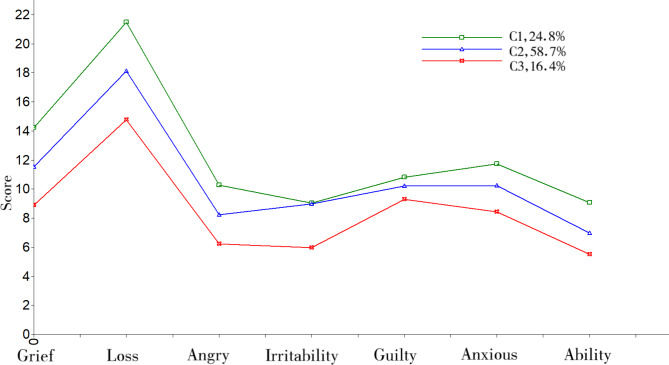
The anticipatory grief of family caregivers of chronic heart failure patients has been divided into three latent classes: low anticipatory grief class (16.4%), moderate anticipatory grief class (58.7%), and high anticipatory grief and loss class (24.8%). Gender, education, relationship with the patient, course of disease, and fear of progression were the influencing factors of the latent profile of anticipatory grief among family caregivers of chronic heart failure patients (all P < 0.05).
There were differences in the level of anticipatory grief among different subgroups of family caregivers of chronic heart failure patients. Medical staff can develop personalized intervention measures on the basis of the influencing factors of different categories to alleviate anticipatory grief of family caregivers and promote physical and mental health of caregivers in chronic heart failure patients.
预期性悲伤在晚期疾病患者的家庭照顾者中极为普遍。然而,针对慢性心力衰竭患者家庭照顾者的预期性悲伤研究较少。因此,本研究旨在探讨慢性心力衰竭患者家庭照顾者的预期性悲伤特征,并分析不同特征的影响因素。
采用便利抽样法,选取在中国南充某三级综合医院住院的205名慢性心力衰竭患者的家庭照顾者作为研究对象。使用一般信息问卷、预期性悲伤量表(AGS)和疾病进展恐惧问卷简表(FoP-Q-SF)进行调查。对慢性心力衰竭患者家庭照顾者的预期性悲伤进行潜在类别分析,并采用单因素分析和多项逻辑回归分析探讨各亚组预期性悲伤的影响因素。
慢性心力衰竭患者家庭照顾者的预期性悲伤分为三个潜在类别:低预期性悲伤类别(16.4%)、中度预期性悲伤类别(58.7%)和高预期性悲伤与失落类别(24.8%)。性别、教育程度、与患者的关系、病程和疾病进展恐惧是慢性心力衰竭患者家庭照顾者预期性悲伤潜在类别的影响因素(均P<0.05)。
慢性心力衰竭患者家庭照顾者不同亚组的预期性悲伤水平存在差异。医护人员可根据不同类别的影响因素制定个性化干预措施,以减轻家庭照顾者的预期性悲伤,促进慢性心力衰竭患者照顾者的身心健康。