Shen Te-Chun, Lin Cheng-Li, Wei Chang-Ching, Chen Chia-Hung, Tu Chih-Yen, Hsia Te-Chun, Shih Chuen-Ming, Hsu Wu-Huei, Sung Fung-Chang, Kao Chia-Hung
Graduate Institute of Clinical Medicine Science, College of Medicine, China Medical University, Taichung, Taiwan; Division of Pulmonary and Critical Care Medicine, Department of Internal Medicine, China Medical University Hospital, Taichung, Taiwan.
Management Office for Health Data, China Medical University Hospital, Taichung, Taiwan.
PLoS One. 2015 Jun 11;10(6):e0128461. doi: 10.1371/journal.pone.0128461. eCollection 2015.
There are several publications reported that obstructive sleep apnea (OSA) was associated with asthma. However, large-scaled, population-based cohort study has been limited. We aimed to examine the risk of OSA among adult patients with asthma in an Asian population.
We conducted a retrospective cohort study using data from the National Health Insurance (NHI) of Taiwan. The asthma cohort included 38,840 newly diagnosed patients between 2000 and 2010. The date of diagnosis was defined as the index date. Each patient was randomly matched with four people without asthma according to gender, age, and the index year as the comparison cohort. The occurrence of OSA was followed up until the end of 2011. The risk of OSA was estimated using the Cox proportional hazard model after adjusting for gender, age, and comorbidities.
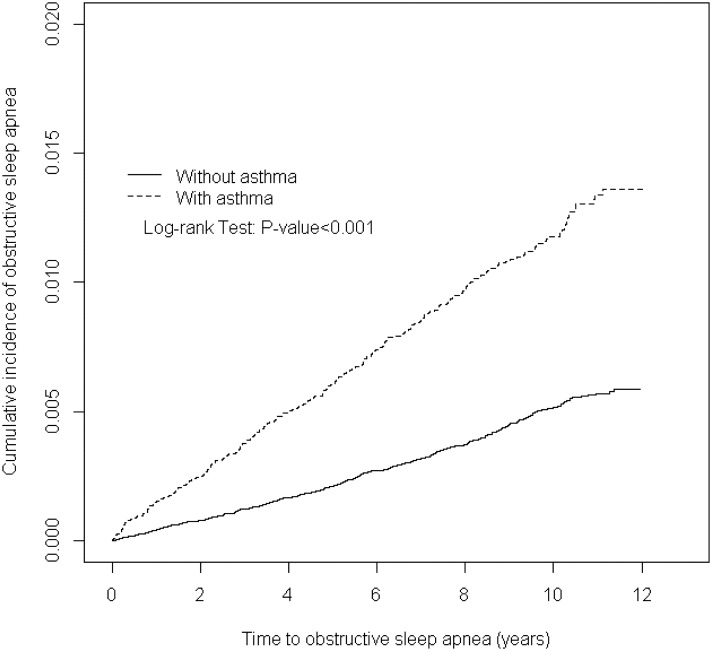
The overall incidence of OSA was 2.51-fold greater in the asthma cohort than in the comparison cohort (12.1 versus 4.84 per 1000 person-years). Compared to non-asthma subjects, the adjusted hazard ratio (aHR) of OSA increased to 1.78 for asthma patients with one or less annual emergency room (ER) visit, and 23.8 for those who visited ER more than once per year. In addition, aHR in patients with inhaled steroid treatment compared to those without steroid treatment was 1.33 (95% CI = 1.01-1.76).
Patients with asthma have a significantly higher risk of developing OSA than the general population. The results suggest that the risk of OSA is proportional to asthma control and patients with inhaled steroid treatment have a higher risk for OSA than those without steroid treatment.
有几份出版物报道阻塞性睡眠呼吸暂停(OSA)与哮喘有关。然而,大规模的、基于人群的队列研究一直很有限。我们旨在研究亚洲人群中成年哮喘患者患OSA的风险。
我们使用台湾国民健康保险(NHI)的数据进行了一项回顾性队列研究。哮喘队列包括2000年至2010年间新诊断的38840名患者。诊断日期被定义为索引日期。根据性别、年龄和索引年份,将每位患者与四名无哮喘的人随机匹配作为对照队列。对OSA的发生情况进行随访至2011年底。在调整性别、年龄和合并症后,使用Cox比例风险模型估计OSA的风险。
哮喘队列中OSA的总体发病率比对照队列高2.51倍(每1000人年12.1例对4.84例)。与非哮喘受试者相比,每年急诊室(ER)就诊次数为1次或更少的哮喘患者OSA的调整后风险比(aHR)增至1.78,而每年就诊超过1次的患者为23.8。此外,吸入类固醇治疗患者与未接受类固醇治疗患者的aHR为1.33(95%CI = 1.01 - 1.76)。
哮喘患者患OSA的风险明显高于一般人群。结果表明,OSA的风险与哮喘控制程度成正比,吸入类固醇治疗的患者患OSA的风险高于未接受类固醇治疗的患者。