Nipp R D, Currow D C, Cherny N I, Strasser F, Abernethy A P, Zafar S Y
Department of Medicine, Division of Medical Oncology, Dana-Farber/Harvard Cancer Center, Massachusetts General Hospital, 55 Fruit Street, Yawkey 7B, Boston, MA 02114, USA.
Discipline of Palliative and Supportive Services, School of Health Sciences, Flinders University, GPO Box 2100, Adelaide 5001, South Australia, Australia.
Br J Cancer. 2015 Jun 30;113(1):6-11. doi: 10.1038/bjc.2015.192. Epub 2015 Jun 11.
Best supportive care (BSC) as a control arm in clinical trials is poorly defined. We conducted a review to evaluate clinical trials' concordance with published, consensus-based framework for BSC delivery in trials.
A consensus-based Delphi panel previously identified four key domains of BSC delivery in trials: multidisciplinary care; supportive care documentation; symptom assessment; and symptom management. We reviewed trials including BSC control arms from 2002 to 2014 to assess concordance to BSC standards and to selected items from the CONSORT 2010 guidelines.
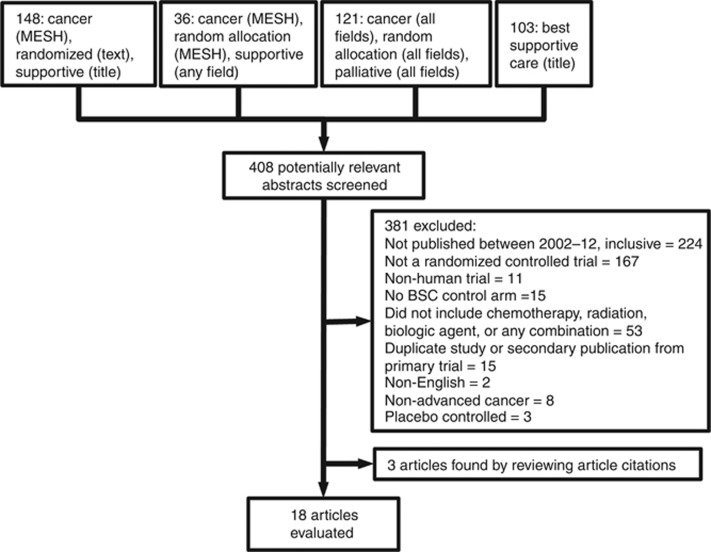
Of 408 articles retrieved, we retained 18 after applying exclusion criteria. Overall, trials conformed to the CONSORT guidelines better than the BSC standards (28% vs 16%). One-third of articles offered a detailed description of BSC, 61% reported regular symptom assessment, and 44% reported using validated symptom assessment measures. One-third reported symptom assessment at identical intervals in both arms. None documented evidence-based symptom management. No studies reported educating patients about symptom management or goals of therapy. No studies reported offering access to palliative care specialists.
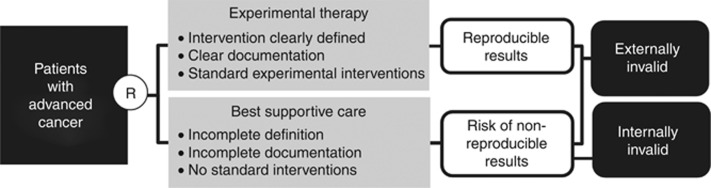
Reporting of BSC in trials is incomplete, resulting in uncertain internal and external validity. Such studies risk systematically over-estimating the net clinical effect of the comparator arms.
在临床试验中,作为对照臂的最佳支持治疗(BSC)定义不明确。我们进行了一项综述,以评估临床试验与已发表的、基于共识的试验中BSC实施框架的一致性。
一个基于共识的德尔菲小组先前确定了试验中BSC实施的四个关键领域:多学科护理;支持治疗记录;症状评估;以及症状管理。我们回顾了2002年至2014年包括BSC对照臂的试验,以评估与BSC标准以及CONSORT 2010指南中选定项目的一致性。
在检索到的408篇文章中,应用排除标准后我们保留了18篇。总体而言,试验符合CONSORT指南的程度优于BSC标准(28%对16%)。三分之一的文章对BSC进行了详细描述,61%报告了定期症状评估,44%报告使用了经过验证的症状评估措施。三分之一的文章报告双臂症状评估间隔相同。没有一篇记录了基于证据的症状管理。没有研究报告对患者进行症状管理或治疗目标的教育。没有研究报告提供姑息治疗专家的服务。
试验中BSC的报告不完整,导致内部和外部有效性不确定。此类研究有系统地高估对照臂净临床效果的风险。