Gadoev Jamshid, Asadov Damin, Tillashaykhov Mirzagolib, Tayler-Smith Katie, Isaakidis Petros, Dadu Andrei, de Colombani Pierpaolo, Gudmund Hinderaker Sven, Parpieva Nargiza, Ulmasova Dilrabo, Jalolov Avazbek, Hamraev Atadjan, Ali Engy, Boom Martin van den, Hammerich Asmus, Gozalov Ogtay, Dara Masoud
World Health Organization country office in Tashkent, Tashkent, Uzbekistan.
State Post Graduate Institute of Medical Education, Tashkent, Uzbekistan.
PLoS One. 2015 Jun 15;10(6):e0128907. doi: 10.1371/journal.pone.0128907. eCollection 2015.
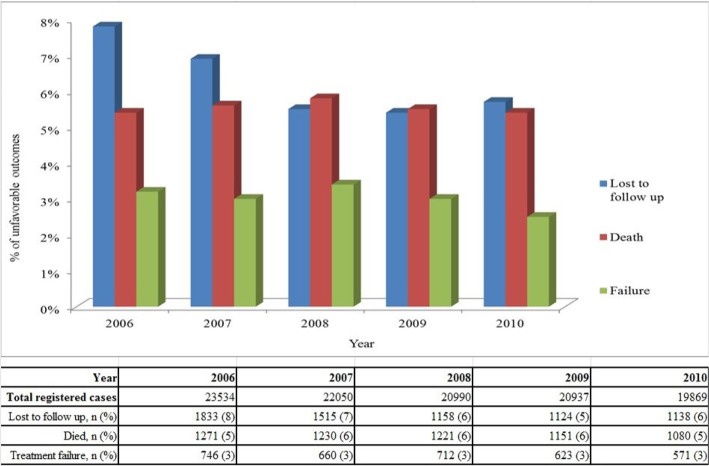
TB is one of the main health priorities in Uzbekistan and relatively high rates of unfavorable treatment outcomes have recently been reported. This requires closer analysis to explain the reasons and recommend interventions to improve the situation. Thus, by using countrywide data this study sought to determine trends in unfavorable outcomes (lost-to-follow-ups, deaths and treatment failures) and describe their associations with socio-demographic and clinical factors.
A countrywide retrospective cohort study of all new and previously treated TB patients registered in the National Tuberculosis programme between January 2006 and December 2010.
Among 107,380 registered patients, 67% were adults, with smaller proportions of children (10%), adolescents (4%) and elderly patients (19%). Sixty per cent were male, 66% lived in rural areas, 1% were HIV-infected and 1% had a history of imprisonment. Pulmonary TB (PTB) was present in 77%, of which 43% were smear-positive and 53% were smear-negative. Overall, 83% of patients were successfully treated, 6% died, 6% were lost-to-follow-up, 3% failed treatment and 2% transferred out. Factors associated with death included being above 55 years of age, HIV-positive, sputum smear positive, previously treated, jobless and living in certain provinces. Factors associated with lost-to-follow-up were being male, previously treated, jobless, living in an urban area, and living in certain provinces. Having smear-positive PTB, being an adolescent, being urban population, being HIV-negative, previously treated, jobless and residing in particular provinces were associated with treatment failure.
Overall, 83% treatment success rate was achieved. However, our study findings highlight the need to improve TB services for certain vulnerable groups and in specific areas of the country. They also emphasize the need to develop unified monitoring and evaluation tools for drug-susceptible and drug-resistant TB, and call for better TB surveillance and coordination between provinces and neighbouring countries.
结核病是乌兹别克斯坦主要的卫生重点之一,最近有报告称不利治疗结果的发生率相对较高。这需要进行更深入的分析,以解释原因并推荐改善状况的干预措施。因此,本研究通过使用全国范围的数据,试图确定不利结果(失访、死亡和治疗失败)的趋势,并描述它们与社会人口学和临床因素的关联。
对2006年1月至2010年12月在国家结核病项目中登记的所有新发病例和既往治疗过的结核病患者进行全国范围的回顾性队列研究。
在107380名登记患者中,67%为成年人,儿童(10%)、青少年(4%)和老年患者(19%)的比例较小。60%为男性,66%生活在农村地区,1%感染艾滋病毒,1%有监禁史。77%为肺结核(PTB),其中43%痰涂片阳性,53%痰涂片阴性。总体而言,83%的患者得到成功治疗,6%死亡,6%失访,3%治疗失败,2%转出。与死亡相关的因素包括年龄在55岁以上、艾滋病毒阳性、痰涂片阳性、既往接受过治疗、失业以及生活在某些省份。与失访相关的因素包括男性、既往接受过治疗、失业、生活在城市地区以及生活在某些省份。痰涂片阳性肺结核、青少年、城市人口、艾滋病毒阴性、既往接受过治疗、失业以及居住在特定省份与治疗失败相关。
总体而言,实现了83%的治疗成功率。然而,我们的研究结果突出表明,需要改善该国某些弱势群体和特定地区的结核病服务。它们还强调需要为药物敏感结核病和耐药结核病开发统一的监测和评估工具,并呼吁加强省级和邻国之间更好的结核病监测与协调。