Chen Hsueh-Fen, Lan Chung-Yu
Institute of Molecular and Cellular Biology, National Tsing Hua University, Hsinchu, 30013, Taiwan, R.O.C.
Institute of Molecular and Cellular Biology, National Tsing Hua University, Hsinchu, 30013, Taiwan, R.O.C; Department of Life Science, National Tsing Hua University, Hsinchu, 30013, Taiwan, R.O.C.
PLoS One. 2015 Jun 18;10(6):e0129903. doi: 10.1371/journal.pone.0129903. eCollection 2015.
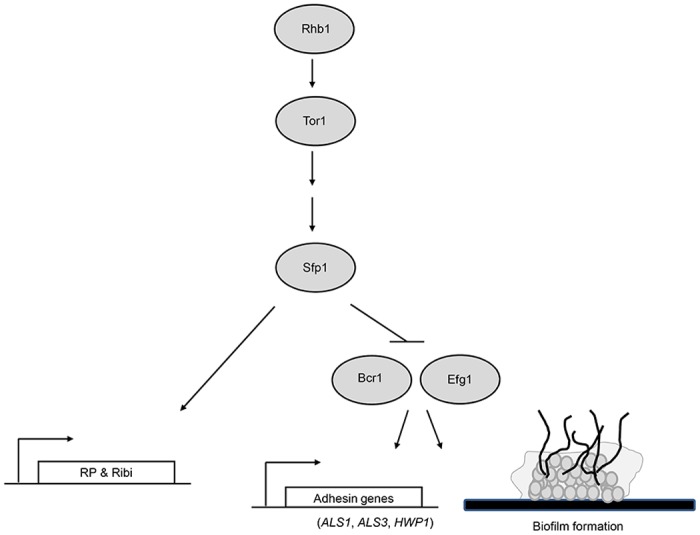
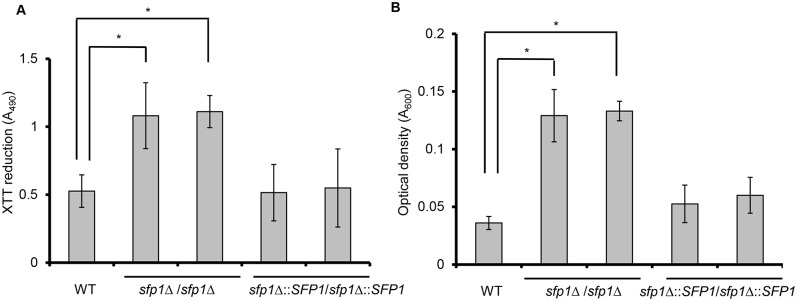
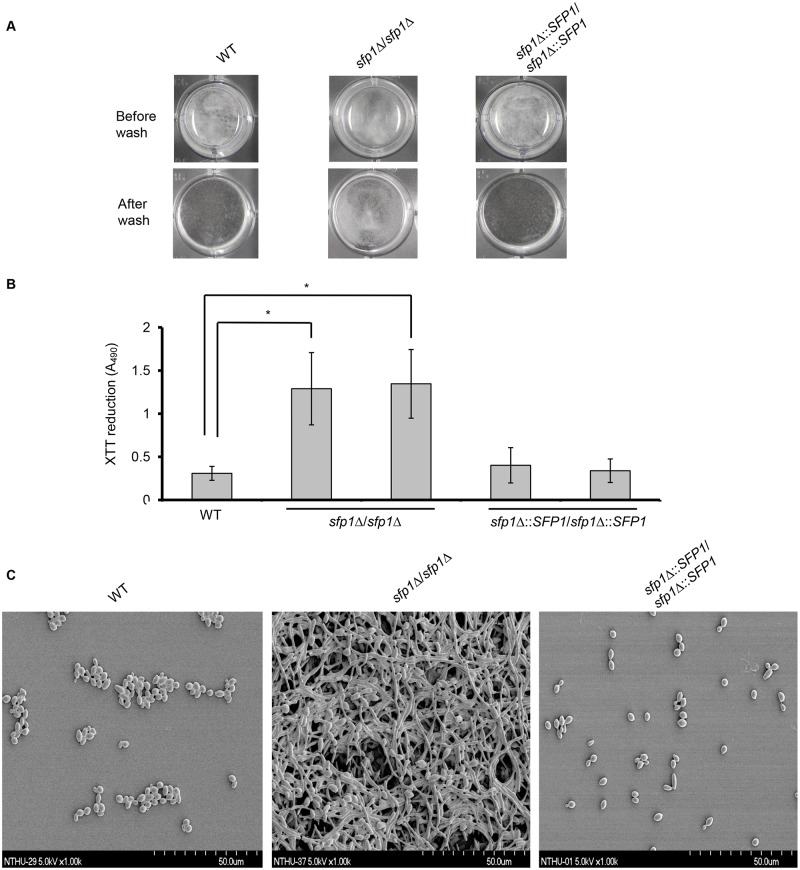
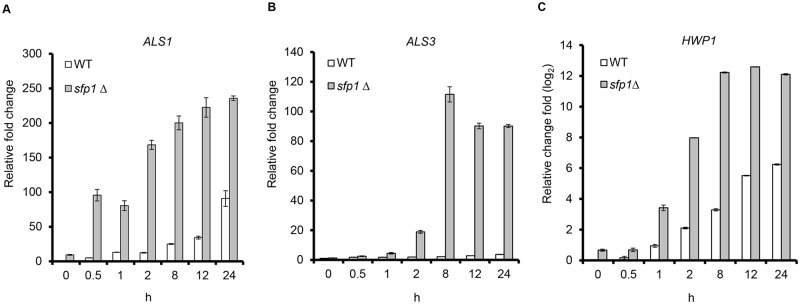
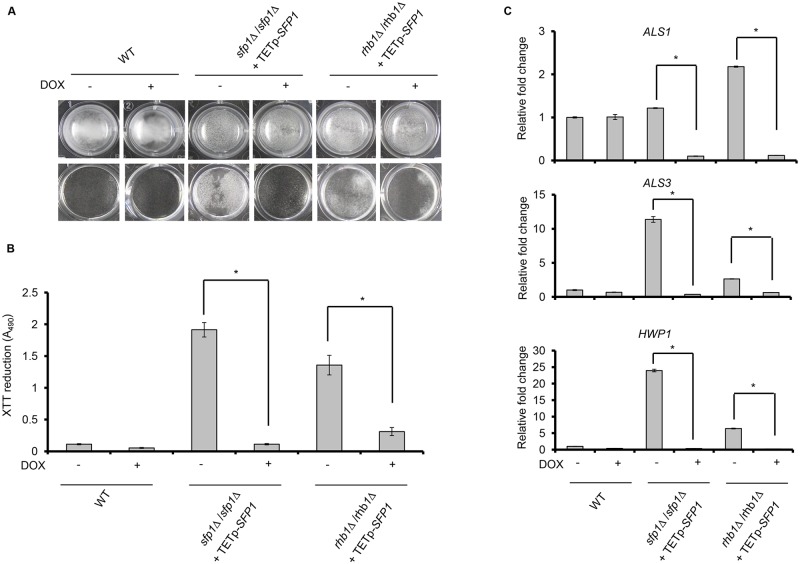
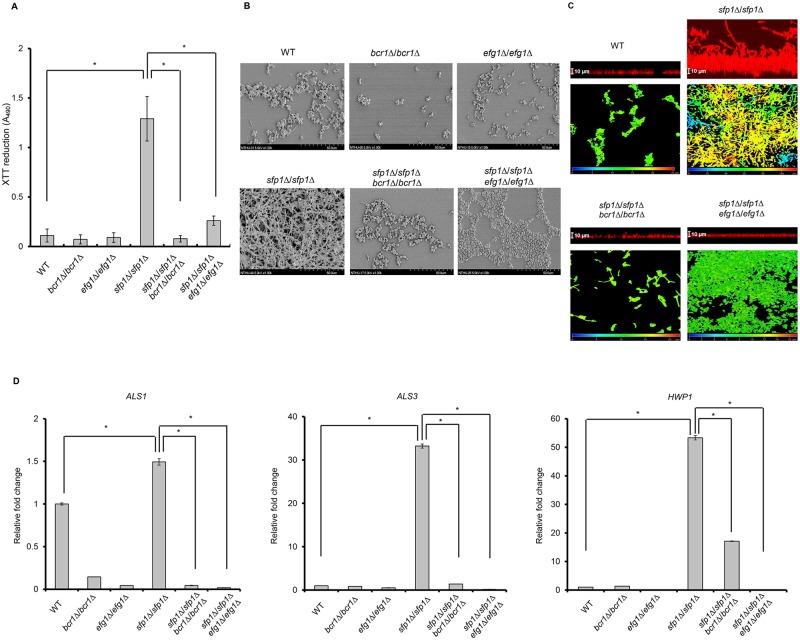
Candida albicans is a major human fungal pathogen. One of the important features of C. albicans pathogenicity is the ability to form biofilms on mucosal surfaces and indwelling medical devices. Biofilm formation involves complex processes in C. albicans, including cell adhesion, filamentous growth, extracellular matrix secretion and cell dispersion. In this work, we characterized the role of the transcription factor Sfp1, particularly with respect to its function in the regulation of biofilm formation. The deletion of the SFP1 gene enhanced cell adhesion and biofilm formation in comparison to the wild-type strain. Interestingly, the sfp1-deleted mutant also exhibited an increase in the expression of the ALS1, ALS3 and HWP1 genes, which encode adhesin proteins. In addition, Sfp1 was demonstrated to function downstream of the Rhb1-TOR signaling pathway. Bcr1 and Efg1 are transcription factors that are critical for controlling biofilm formation, and Efg1 is also required for hyphal growth. Deleting either the BCR1 or EFG1 gene in the sfp1-null background led to reduced adhesin gene expression. As a result, the bcr1/sfp1 or efg1/sfp1 double deletion mutants exhibited dramatically reduced biofilm formation. The results indicated that Sfp1 negatively regulates the ALS1, ALS3 and HWP1 adhesin genes and that the repression of these genes is mediated by the inhibition of Bcr1 and Efg1.
白色念珠菌是一种主要的人类真菌病原体。白色念珠菌致病性的一个重要特征是能够在粘膜表面和植入式医疗器械上形成生物膜。白色念珠菌中的生物膜形成涉及复杂的过程,包括细胞粘附、丝状生长、细胞外基质分泌和细胞分散。在这项工作中,我们表征了转录因子Sfp1的作用,特别是其在生物膜形成调控中的功能。与野生型菌株相比,SFP1基因的缺失增强了细胞粘附和生物膜形成。有趣的是,缺失sfp1的突变体还表现出编码粘附蛋白的ALS1、ALS3和HWP1基因的表达增加。此外,已证明Sfp1在Rhb1-TOR信号通路的下游发挥作用。Bcr1和Efg1是控制生物膜形成的关键转录因子,Efg1也是菌丝生长所必需的。在sfp1缺失的背景下删除BCR1或EFG1基因会导致粘附素基因表达降低。因此,bcr1/sfp1或efg1/sfp1双缺失突变体表现出生物膜形成显著减少。结果表明,Sfp1负调控ALS1、ALS3和HWP1粘附素基因,并且这些基因的抑制是由对Bcr1和Efg1的抑制介导的。