Stegemöller Elizabeth L, Allen David P, Simuni Tanya, MacKinnon Colum D
Department of Physical Therapy and Human Movement Sciences, Feinberg School of Medicine, Northwestern University, Chicago, IL 60611, USA; Department of Kinesiology, Iowa State University, Ames, IA 50011, USA.
Department of Physical Therapy and Human Movement Sciences, Feinberg School of Medicine, Northwestern University, Chicago, IL 60611, USA.
Clin Neurophysiol. 2016 Jan;127(1):664-674. doi: 10.1016/j.clinph.2015.05.014. Epub 2015 May 29.
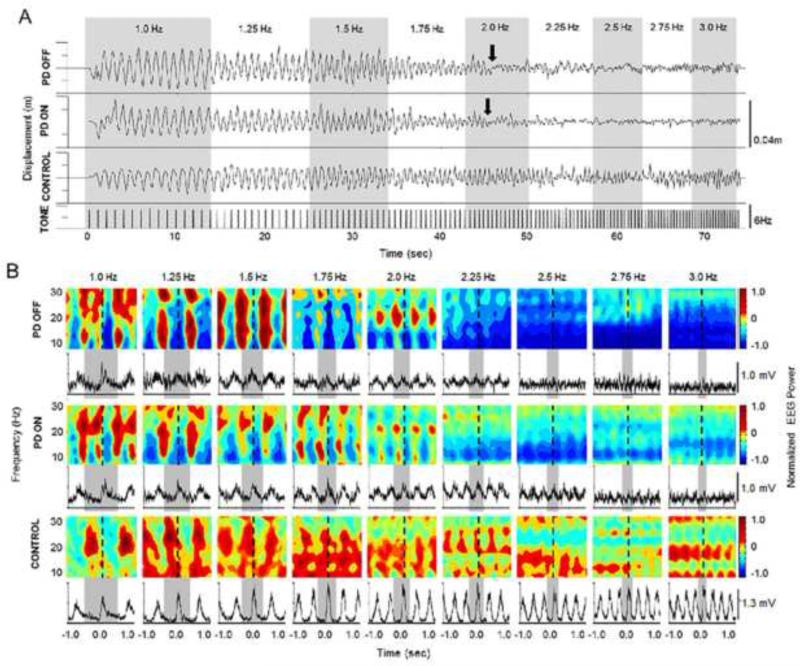
Impaired repetitive movement in persons with Parkinson's disease (PD) is associated with reduced amplitude, paradoxical hastening and hesitations or arrest at higher movement rates. This study examined the effects of movement rate and medication on movement-related cortical oscillations in persons with PD.
Nine participants with PD were studied off and on medication and compared to nine control participants. Participants performed index finger movements cued by tones from 1 to 3 Hz. Movement-related oscillations were derived from electroencephalographic recordings over the region of the contralateral sensorimotor cortex (S1/M1) during rest, listening, or synchronized movement.
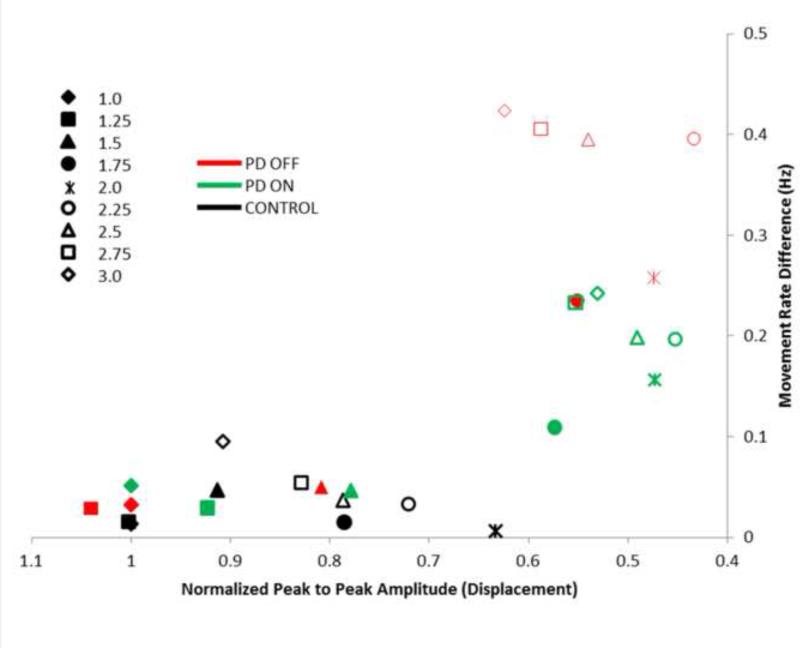
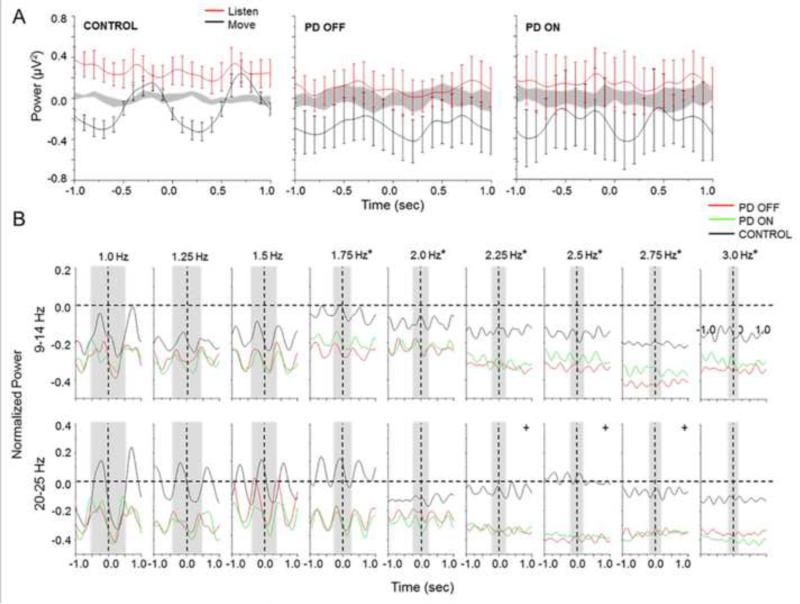
At rest, spectral power recorded over the region of the contralateral S1/M1 was increased in the alpha band and decreased in the beta band in participants with PD relative to controls. During movement, the level of alpha and beta band power relative to baseline was significantly reduced in the PD group, off and on medication, compared to controls. Reduced movement amplitude and hastening at movement rates near 2 Hz was associated with abnormally suppressed and persistent desynchronization of oscillations in alpha and beta bands.
Motor cortical oscillations in the alpha and beta bands are abnormally suppressed in PD, particularly during higher rate movements.
These findings contribute to the understanding of mechanisms underlying impaired repetitive movement in PD.
帕金森病(PD)患者的重复性运动受损与运动幅度减小、运动速度加快以及在较高运动速度下出现犹豫或停顿有关。本研究探讨了运动速度和药物治疗对PD患者与运动相关的皮层振荡的影响。
对9名PD患者在服药和未服药状态下进行研究,并与9名对照参与者进行比较。参与者根据1至3Hz的音调提示进行食指运动。在休息、聆听或同步运动期间,从对侧感觉运动皮层(S1/M1)区域的脑电图记录中获取与运动相关的振荡。
在休息时,与对照组相比,PD患者对侧S1/M1区域记录到的频谱功率在α波段增加,在β波段降低。在运动期间,与对照组相比,PD组无论服药与否,α和β波段功率相对于基线的水平均显著降低。在接近2Hz的运动速度下,运动幅度减小以及运动速度加快与α和β波段振荡的异常抑制和持续去同步化有关。
PD患者的α和β波段运动皮层振荡异常受到抑制,尤其是在较高速度运动期间。
这些发现有助于理解PD患者重复性运动受损的潜在机制。