Teklemariam Zelalem, Mitiku Habtamu, Mesfin Firehiwot
Department of Medical Laboratory Sciences, College of Health and Medical Sciences, Haramaya University, Harar, Ethiopia.
School of Nursing and Midwifery, College of Health and Medical Sciences, Haramaya University, Harar, Ethiopia.
HIV AIDS (Auckl). 2015 Jun 5;7:191-6. doi: 10.2147/HIV.S78845. eCollection 2015.
Anemia and growth retardation are common manifestations of HIV-positive children, which threaten their lives. Therefore, this study tried to assess the burden of anemia and the nutritional status of HIV-positive children receiving antiretroviral therapy (ART) in eastern Ethiopa.
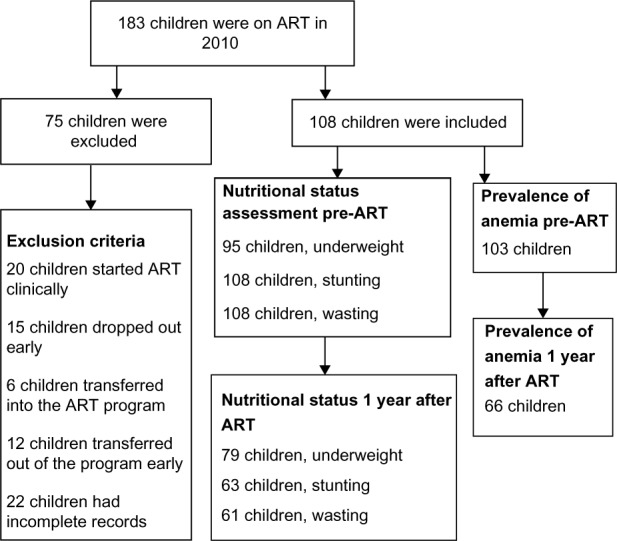
A total of 108 records of children on ART followed up in Hiwot Fana Specialized University Hospital from 2007 to 2010 were retrospectively reviewed from November 1 to November 30, 2011.
Approximately 54.4% of the children had been anemic before the initiation of their ART (at baseline): 7.8% were severely anemic and 44.7% were moderately anemic. These percentages were higher in preschool children than in school children (adjusted odds ratio [AOR]: 4.80 [95% confidence interval {CI}: 1.96, 11.75]), and were higher in males than in females (AOR: 2.61 [95% CI: 1.06, 6.45]). The prevalence of anemia was reduced to 39.2% 1 year after initiation of ART. The increasing of hemoglobin values was highly significant for both zidovudine (AZT)- and stavudine (d4T)-based ART (P<0.05). At baseline, 51.6% of the study subjects were underweight (weight-for-age Z score less than -2 standard deviation [SD]); 49.1% were stunted (height-for-age Z score less than -2 SD); and 31.5% were wasted (body mass index less than -2 SD), which, after a year on ART, declined to 8.9%, 15.9%, and 9.8%, respectively.
There was high prevalence of anemia and growth failure among HIV-infected children in the study area. However, there was a decline after initiation of ART. Therefore, adherence counseling to strengthen the uptake of ART is recommended. Moreover, large-scale, prospective studies should be done to understand the magnitude and etiology of the problems with HIV-negative control groups.
贫血和生长发育迟缓是艾滋病毒阳性儿童的常见表现,威胁着他们的生命。因此,本研究试图评估埃塞俄比亚东部接受抗逆转录病毒疗法(ART)的艾滋病毒阳性儿童的贫血负担和营养状况。
2011年11月1日至11月30日,对2007年至2010年在希沃特·法纳专科医院接受随访的108例接受抗逆转录病毒治疗的儿童记录进行了回顾性审查。
在开始接受抗逆转录病毒治疗之前(基线时),约54.4%的儿童患有贫血:7.8%为重度贫血,44.7%为中度贫血。学龄前儿童的这些比例高于学龄儿童(调整后的优势比[AOR]:4.80[95%置信区间{CI}:1.96,11.75]),男性高于女性(AOR:2.61[95%CI:1.06,6.45])。开始抗逆转录病毒治疗1年后,贫血患病率降至39.2%。基于齐多夫定(AZT)和司他夫定(d4T)的抗逆转录病毒疗法使血红蛋白值的增加非常显著(P<0.05)。基线时,51.6%的研究对象体重不足(年龄别体重Z评分低于-2标准差[SD]);49.1%发育迟缓(年龄别身高Z评分低于-2 SD);31.5%消瘦(体重指数低于-2 SD),接受抗逆转录病毒治疗一年后,这些比例分别降至8.9%、15.9%和9.8%。
研究地区艾滋病毒感染儿童中贫血和生长发育不良的患病率很高。然而,开始抗逆转录病毒治疗后有所下降。因此,建议进行依从性咨询以加强抗逆转录病毒疗法的采用。此外,应开展大规模前瞻性研究,以了解艾滋病毒阴性对照组问题的严重程度和病因。