Carey Ryan M, Workman Alan D, Chen Bei, Adappa Nithin D, Palmer James N, Kennedy David W, Lee Robert J, Cohen Noam A
Perelman School of Medicine, University of Pennsylvania, Philadelphia, PA.
Department of Otorhinolaryngology-Head and Neck Surgery, University of Pennsylvania, Perelman School of Medicine, Philadelphia, PA.
Int Forum Allergy Rhinol. 2015 Sep;5(9):808-13. doi: 10.1002/alr.21568. Epub 2015 Jun 22.
Nitric oxide (NO) is an important antibacterial defense molecule produced by upper airway (sinonasal) epithelial cells. We previously showed that a bitter taste receptor expressed in airway epithelium detects quorum-sensing molecules secreted by Gram-negative bacteria and subsequently triggers bactericidal NO production. We hypothesized that the upper airway epithelium may also be able to detect the Gram-positive aerobe Staphylococcus aureus and mount an NO response.
Human sinonasal air-liquid interface (ALI) cultures were treated with methicillin-resistant S. aureus (MRSA)-conditioned medium (CM), and NO production was measured using fluorescence imaging. Inhibitors of bitter taste receptor signaling were used to pharmacologically determine if this pathway was involved in the production of NO.
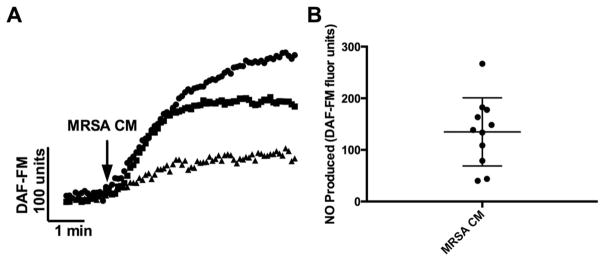
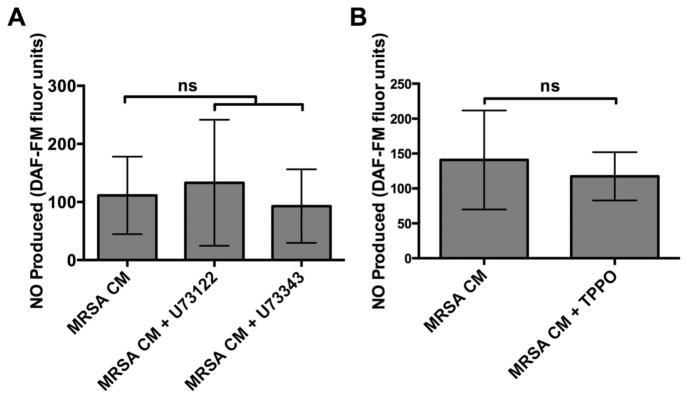
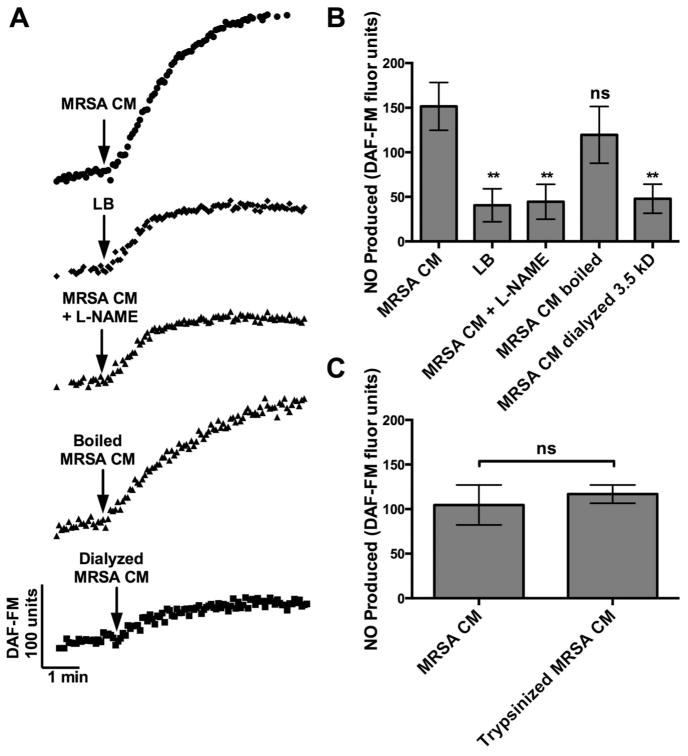
A low-molecular-weight, heat, and protease-stabile product found in MRSA CM induced differential, NO synthase (NOS)-mediated NO production. This response varied markedly between individual patients. The MRSA-stimulated NO production was not dependent on 2 important components of bitter taste signaling: phospholipase C isoform β-2 or the transient receptor potential melastatin isoform 5 (TRPM5) ion channel.
This study shows that a S. aureus product elicits an NO-mediated innate defense response in human upper airway epithelium. The active bacterial product is likely a small, nonpeptide molecule that triggers a pathway independent of bitter taste receptors. Patient variation in the NO response to MRSA product(s), potentially due to genetic differences, might play a role in pathophysiology of Gram-positive upper respiratory infections and/or pathogenesis of chronic rhinosinusitis.
一氧化氮(NO)是上呼吸道(鼻窦)上皮细胞产生的一种重要的抗菌防御分子。我们之前表明,气道上皮中表达的一种苦味受体可检测革兰氏阴性菌分泌的群体感应分子,并随后触发杀菌性NO的产生。我们推测上呼吸道上皮可能也能够检测革兰氏阳性需氧菌金黄色葡萄球菌并引发NO反应。
用耐甲氧西林金黄色葡萄球菌(MRSA)条件培养基(CM)处理人鼻窦气液界面(ALI)培养物,并使用荧光成像测量NO的产生。使用苦味受体信号传导抑制剂从药理学角度确定该途径是否参与NO的产生。
在MRSA CM中发现的一种低分子量、耐热且耐蛋白酶的产物诱导了差异性的、由一氧化氮合酶(NOS)介导的NO产生。这种反应在个体患者之间有显著差异。MRSA刺激产生的NO不依赖于苦味信号传导的两个重要成分:磷脂酶Cβ-2亚型或瞬时受体电位香草酸亚型5(TRPM5)离子通道。
本研究表明,一种金黄色葡萄球菌产物可在人上呼吸道上皮中引发由NO介导的先天性防御反应。活性细菌产物可能是一种小的非肽分子,它触发了一条独立于苦味受体的途径。患者对MRSA产物的NO反应存在差异,可能是由于基因差异,这可能在革兰氏阳性上呼吸道感染的病理生理学和/或慢性鼻窦炎的发病机制中起作用。