Kumssa Diriba B, Joy Edward J M, Ander E Louise, Watts Michael J, Young Scott D, Walker Sue, Broadley Martin R
1] School of Biosciences, University of Nottingham, Sutton Bonington Campus, Loughborough, LE12 5RD, UK [2] Centre for Environmental Geochemistry, British Geological Survey, Keyworth, Nottingham, NG12 5GG, UK [3] Crops For the Future, The University of Nottingham Malaysia Campus, Jalan Broga, 43500 Semenyih, Selangor Darul Ehsan, Malaysia.
1] School of Biosciences, University of Nottingham, Sutton Bonington Campus, Loughborough, LE12 5RD, UK [2] Centre for Environmental Geochemistry, British Geological Survey, Keyworth, Nottingham, NG12 5GG, UK.
Sci Rep. 2015 Jun 22;5:10974. doi: 10.1038/srep10974.
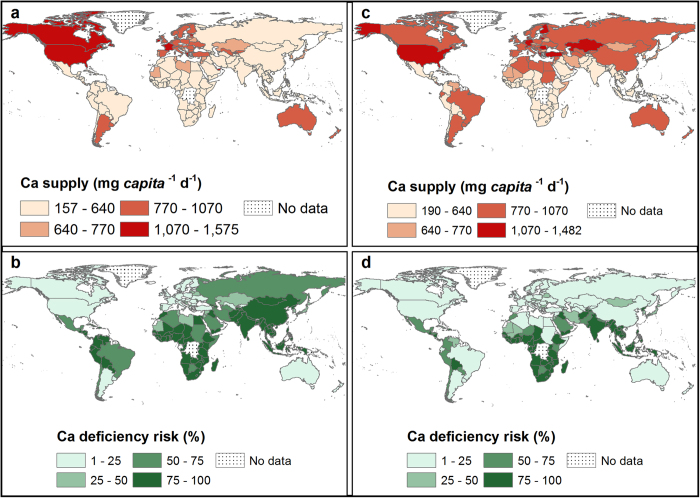
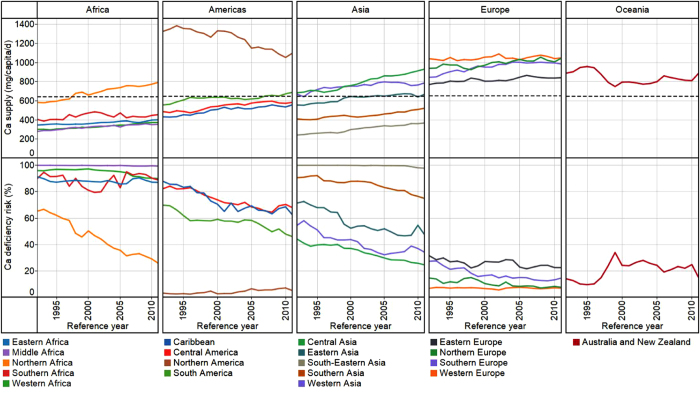
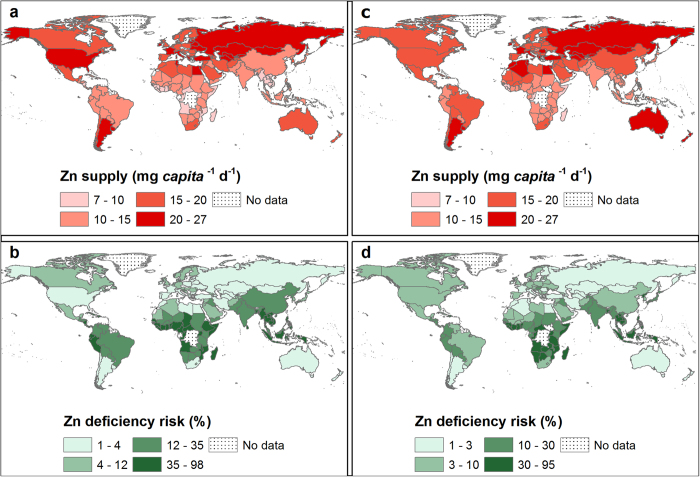
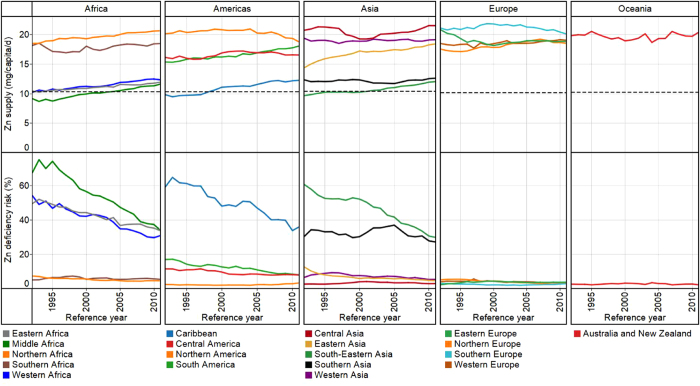
Globally, more than 800 million people are undernourished while >2 billion people have one or more chronic micronutrient deficiencies (MNDs). More than 6% of global mortality and morbidity burdens are associated with undernourishment and MNDs. Here we show that, in 2011, 3.5 and 1.1 billion people were at risk of calcium (Ca) and zinc (Zn) deficiency respectively due to inadequate dietary supply. The global mean dietary supply of Ca and Zn in 2011 was 684 ± 211 and 16 ± 3 mg capita(-1) d(-1) (± SD) respectively. Between 1992 and 2011, global risk of deficiency of Ca and Zn decreased from 76 to 51%, and 22 to 16%, respectively. Approximately 90% of those at risk of Ca and Zn deficiency in 2011 were in Africa and Asia. To our knowledge, these are the first global estimates of dietary Ca deficiency risks based on food supply. We conclude that continuing to reduce Ca and Zn deficiency risks through dietary diversification and food and agricultural interventions including fortification, crop breeding and use of micronutrient fertilisers will remain a significant challenge.
全球范围内,超过8亿人营养不良,同时有超过20亿人存在一种或多种慢性微量营养素缺乏症(MND)。全球超过6%的死亡和发病负担与营养不良和微量营养素缺乏症相关。我们在此表明,2011年,分别有35亿和11亿人因膳食供应不足面临钙(Ca)和锌(Zn)缺乏风险。2011年全球人均膳食钙和锌供应量分别为684±211和16±3毫克/(人·天)(±标准差)。1992年至2011年间,全球钙和锌缺乏风险分别从76%降至51%,以及从22%降至16%。2011年,约90%面临钙和锌缺乏风险的人位于非洲和亚洲。据我们所知,这些是基于食物供应对膳食钙缺乏风险的首次全球评估。我们得出结论,通过膳食多样化以及包括强化、作物育种和使用微量营养素肥料在内的粮食及农业干预措施继续降低钙和锌缺乏风险,仍将是一项重大挑战。