Garibyan Lilit, Cornelissen Laura, Sipprell William, Pruessner Joachim, Elmariah Sarina, Luo Tuan, Lerner Ethan A, Jung Yookyung, Evans Conor, Zurakowski David, Berde Charles B, Rox Anderson R
Wellman Center for Photomedicine, Massachusetts General Hospital; Department of Dermatology, Harvard Medical School, Boston, USA.
Department of Anesthesiology, Perioperative and Pain Medicine, Boston Children's Hospital; Department of Anesthesia, Harvard Medical School, Boston, USA.
J Invest Dermatol. 2015 Nov;135(11):2623-2631. doi: 10.1038/jid.2015.233. Epub 2015 Jun 22.
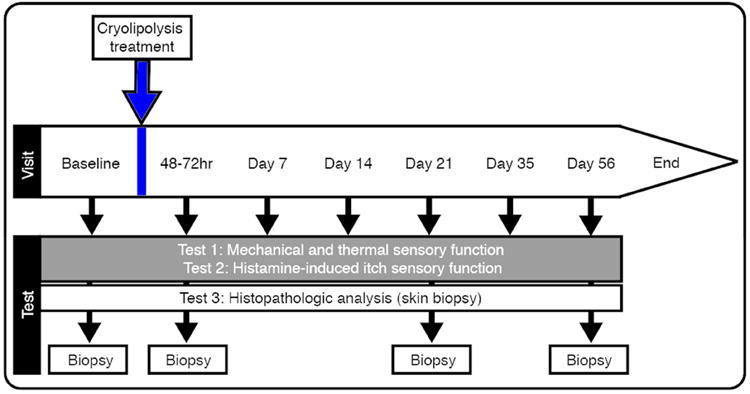
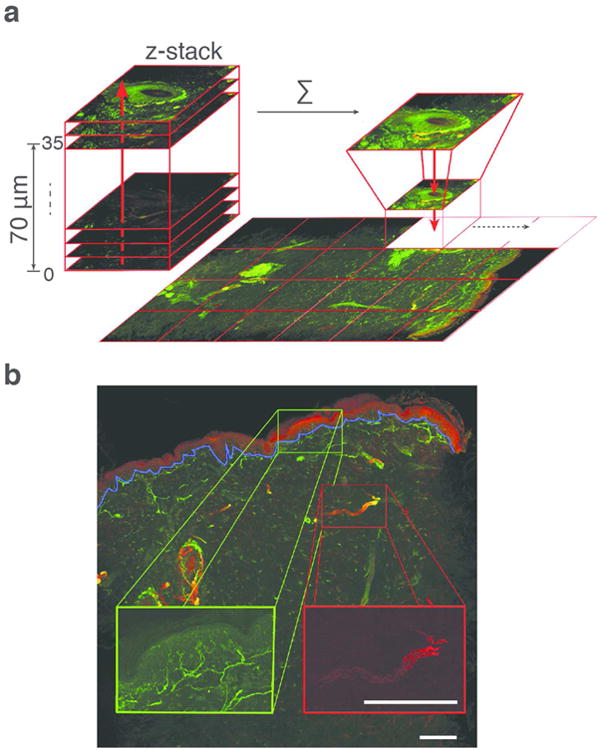
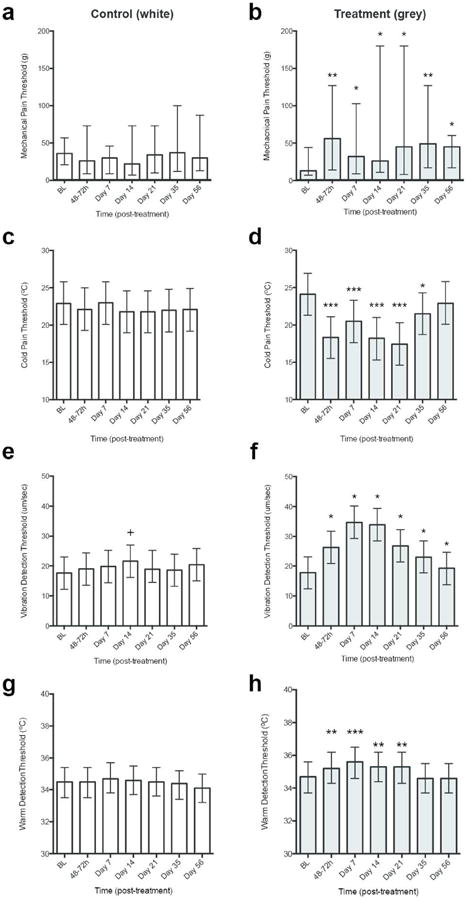
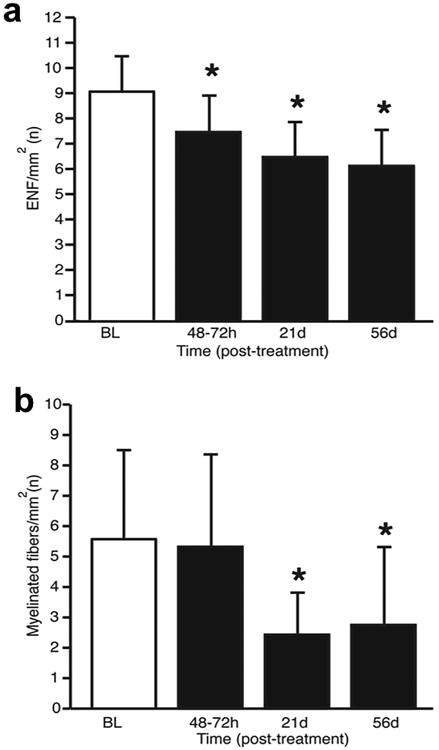
Cryolipolysis is a noninvasive, skin cooling treatment for local fat reduction that causes prolonged hypoesthesia over the treated area. We tested the hypothesis that cryolipolysis can attenuate nociception of a range of sensory stimuli, including stimuli that evoke itch. The effects of cryolipolysis on sensory phenomena were evaluated by quantitative sensory testing (QST) in 11 healthy subjects over a period of 56 days. Mechanical and thermal pain thresholds were measured on treated and contralateral untreated (control) flanks. Itch duration was evaluated following histamine iontophoresis. Unmyelinated epidermal nerve fiber and myelinated dermal nerve fiber densities were quantified in skin biopsies from six subjects. Cryolipolysis produced a marked decrease in mechanical and thermal pain sensitivity. Hyposensitivity started between two to seven days after cryolipolysis and persisted for at least thirty-five days post treatment. Skin biopsies revealed that cryolipolysis decreased epidermal nerve fiber density, as well as dermal myelinated nerve fiber density, which persisted throughout the study. In conclusion, cryolipolysis causes significant and prolonged decreases in cutaneous sensitivity. Our data suggest that controlled skin cooling to specifically target cutaneous nerve fibers has the potential to be useful for prolonged relief of cutaneous pain and might have a use as a research tool to isolate and study cutaneous itch-sensing nerves in human skin.
冷冻溶脂术是一种用于局部减脂的非侵入性皮肤冷却治疗方法,可导致治疗区域出现长时间的感觉减退。我们检验了冷冻溶脂术可减轻一系列感觉刺激(包括引起瘙痒的刺激)的伤害感受这一假设。在56天的时间里,通过定量感觉测试(QST)对11名健康受试者进行评估,以观察冷冻溶脂术对感觉现象的影响。在治疗侧和对侧未治疗(对照)的侧腹测量机械性和热性疼痛阈值。在组胺离子导入后评估瘙痒持续时间。对6名受试者的皮肤活检样本中的无髓表皮神经纤维和有髓真皮神经纤维密度进行定量分析。冷冻溶脂术使机械性和热性疼痛敏感性显著降低。感觉减退在冷冻溶脂术后两到七天开始出现,并在治疗后至少持续35天。皮肤活检显示,冷冻溶脂术降低了表皮神经纤维密度以及真皮有髓神经纤维密度,且在整个研究过程中持续存在。总之,冷冻溶脂术可导致皮肤敏感性显著且持久地降低。我们的数据表明,有针对性地控制皮肤冷却以专门作用于皮肤神经纤维,有可能用于长期缓解皮肤疼痛,并且可能作为一种研究工具来分离和研究人类皮肤中的皮肤瘙痒感觉神经。