Jantzer Vanessa, Haffner Johann, Parzer Peter, Resch Franz, Kaess Michael
Department of Child and Adolescent Psychiatry, Center for Psychosocial Medicine, University of Heidelberg, Blumenstraße 8, Heidelberg, 69115, Germany.
BMC Public Health. 2015 Jun 24;15:583. doi: 10.1186/s12889-015-1940-x.
Being a victim of bullying in school is clearly linked to various social, emotional, and behavioral problems including self-harm behavior. However, it is not known whether even occasional victimization has similar negative consequences and whether protective factors such as social support may prevent those harmful developments. The present study therefore focuses on the nonsuicidal self-injury (NSSI) and suicidal behavior (SB) in victims of bullying and the potentially moderating effect of parental monitoring.
In all, a cross-sectional sample of 647 adolescents (mean age 12.8 years) were surveyed concerning bullying experiences, NSSI and SB, and parental monitoring.
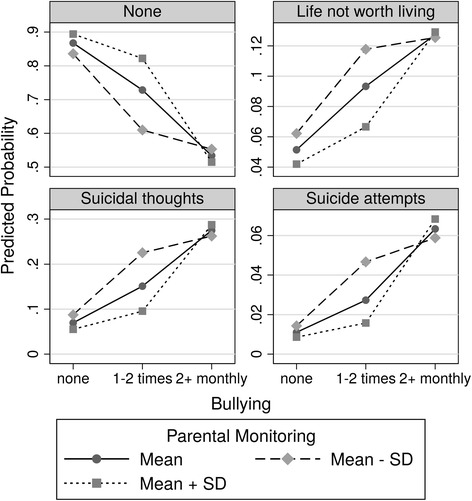
A total of 14.4% of respondents reported being a victim of frequent bullying in the past few months (with verbal and social bullying playing the most important role), which increased the risks of both NSSI (OR = 11.75) and SB (OR = 6.08). This relationship could also be shown for occasional victims of bullying (35.6%), although to a lesser extent. Parental monitoring had a significant protective effect on SB in victims of occasional bullying. However, parental monitoring did not show any protective effect in victims of repetitive bullying.
Victims of bullying show a substantial risk for engaging in self-harm behavior. Therefore, the dissemination of anti-bullying programs in schools would probably also prevent such disorders. Parental participation in school-based prevention may increase its effect; this also matches the results of the present study, showing that parental monitoring may be able to buffer the negative effects of bullying victimization, at least to a certain degree.
在学校遭受欺凌显然与各种社会、情感和行为问题有关,包括自我伤害行为。然而,尚不清楚即使是偶尔遭受欺凌是否也会产生类似的负面后果,以及诸如社会支持等保护因素是否可以预防这些有害发展。因此,本研究重点关注欺凌受害者的非自杀性自伤(NSSI)和自杀行为(SB)以及父母监督的潜在调节作用。
总共对647名青少年(平均年龄12.8岁)进行了横断面调查,涉及欺凌经历、NSSI和SB以及父母监督情况。
共有14.4%的受访者报告在过去几个月中经常遭受欺凌(言语和社交欺凌最为突出),这增加了NSSI(OR = 11.75)和SB(OR = 6.08)的风险。偶尔遭受欺凌的受害者(35.6%)也存在这种关系,尽管程度较轻。父母监督对偶尔遭受欺凌的受害者的SB有显著保护作用。然而,父母监督在反复遭受欺凌的受害者中未显示出任何保护作用。
欺凌受害者存在从事自我伤害行为的重大风险。因此,在学校推广反欺凌项目可能也会预防此类疾病。父母参与基于学校的预防可能会增强其效果;这也与本研究结果相符,表明父母监督可能至少在一定程度上能够缓冲欺凌受害的负面影响。