Kim HyoungKyu, Yoo Kwangsun, Na Duk L, Seo Sang Won, Jeong Jaeseung, Jeong Yong
Department of Bio and Brain Engineering, Korea Advanced Institute of Science and Technology Daejeon, South Korea.
Department of Neurology, Samsung Medical Center, Sungkyunkwan University School of Medicine Seoul, South Korea ; Neuroscience Center, Samsung Medical Center Seoul, South Korea.
Front Aging Neurosci. 2015 Jun 9;7:111. doi: 10.3389/fnagi.2015.00111. eCollection 2015.
Identification of stage-specific changes in brain network of patients with Alzheimer's disease (AD) is critical for rationally designed therapeutics that delays the progression of the disease. However, pathological neural processes and their resulting changes in brain network topology with disease progression are not clearly known.
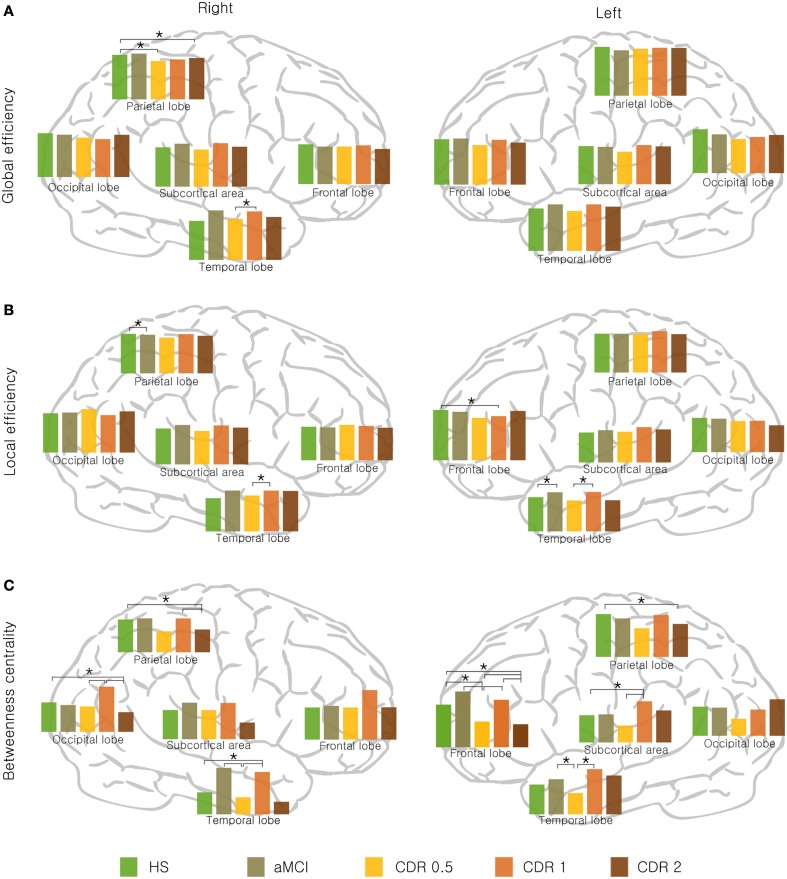
The current study was designed to investigate the alterations in network topology of resting state fMRI among patients in three different clinical dementia rating (CDR) groups (i.e., CDR = 0.5, 1, 2) and amnestic mild cognitive impairment (aMCI) and age-matched healthy subject groups. We constructed density networks from these 5 groups and analyzed their network properties using graph theoretical measures.
The topological properties of AD brain networks differed in a non-monotonic, stage-specific manner. Interestingly, local and global efficiency and betweenness of the network were rather higher in the aMCI and AD (CDR 1) groups than those of prior stage groups. The number, location, and structure of rich-clubs changed dynamically as the disease progressed.
The alterations in network topology of the brain are quite dynamic with AD progression, and these dynamic changes in network patterns should be considered meticulously for efficient therapeutic interventions of AD.
识别阿尔茨海默病(AD)患者脑网络的阶段特异性变化对于合理设计延缓疾病进展的治疗方法至关重要。然而,病理神经过程及其随疾病进展导致的脑网络拓扑结构变化尚不清楚。
本研究旨在调查三个不同临床痴呆评定量表(CDR)组(即CDR = 0.5、1、2)、遗忘型轻度认知障碍(aMCI)组和年龄匹配的健康受试者组静息态功能磁共振成像(fMRI)网络拓扑结构的改变。我们从这5组构建了密度网络,并使用图论方法分析了它们的网络特性。
AD脑网络的拓扑特性以非单调、阶段特异性的方式存在差异。有趣的是,aMCI组和AD(CDR 1)组网络的局部和全局效率以及中介中心性比前一阶段组更高。随着疾病进展,富俱乐部的数量、位置和结构动态变化。
随着AD进展,脑网络拓扑结构的改变非常动态,在对AD进行有效治疗干预时应仔细考虑这些网络模式的动态变化。