Centre for Cognitive Neuroscience, Neuroscience and Behavioural Disorders Program, Duke-National University of Singapore Medical School, Singapore, Singapore.
Department of Pharmacology, Clinical Research Centre, National University Health System, National University of Singapore, Singapore, Singapore.
Alzheimers Res Ther. 2018 Aug 18;10(1):82. doi: 10.1186/s13195-018-0413-8.
Patients with amnestic mild cognitive impairment (aMCI) and Alzheimer's disease (AD) show functional and structural connectivity alterations in the default mode network (DMN) while cerebrovascular disease (CeVD) shows functional and structural connectivity changes in the executive control network (ECN). Such disruptions are associated with memory and executive function impairment, respectively. Concurrent AD and CeVD pathology is associated with a higher rate of cognitive decline and differential neurodegenerative patterns. Together, such findings are likely reflective of different underlying pathology in AD with and without CeVD. However, few studies have examined the effect of CeVD on network functional connectivity (task-free functional magnetic resonance imaging (fMRI)) and structural connectivity (diffusion MRI) of the DMN and ECN in aMCI and AD using a hypothesis-driven multiple seed-based approach.
We examined functional and structural connectivity network changes in 39 aMCI, 50 aMCI+CeVD, 47 AD, 47 AD+CeVD, and 65 healthy controls (HCs) and their associations with cognitive impairment in the executive/attention and memory domains.
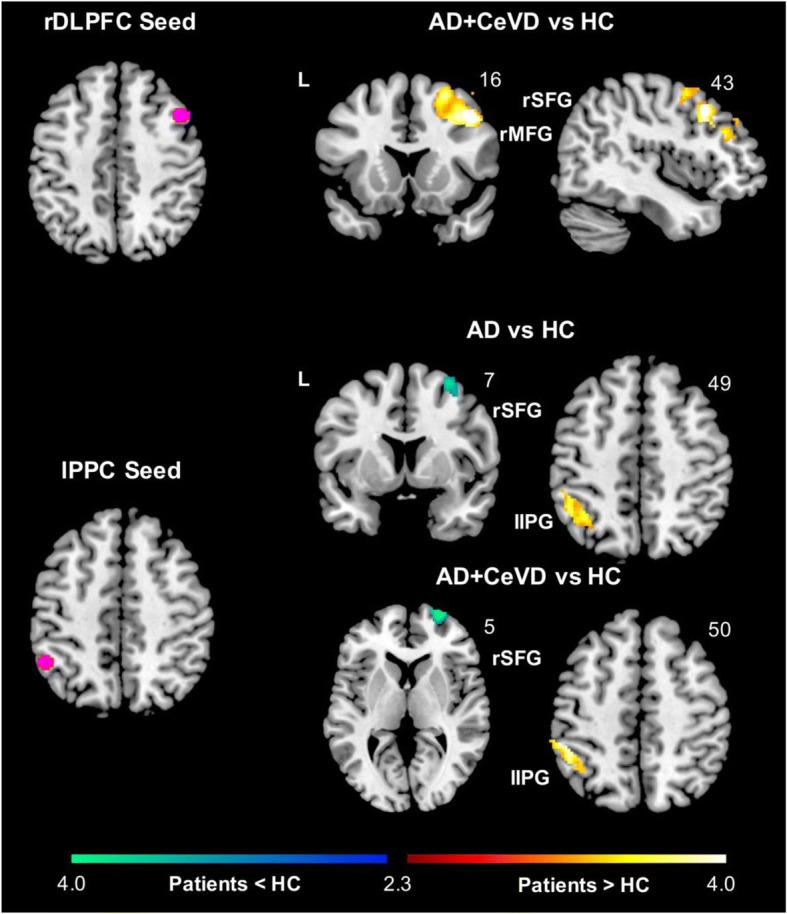
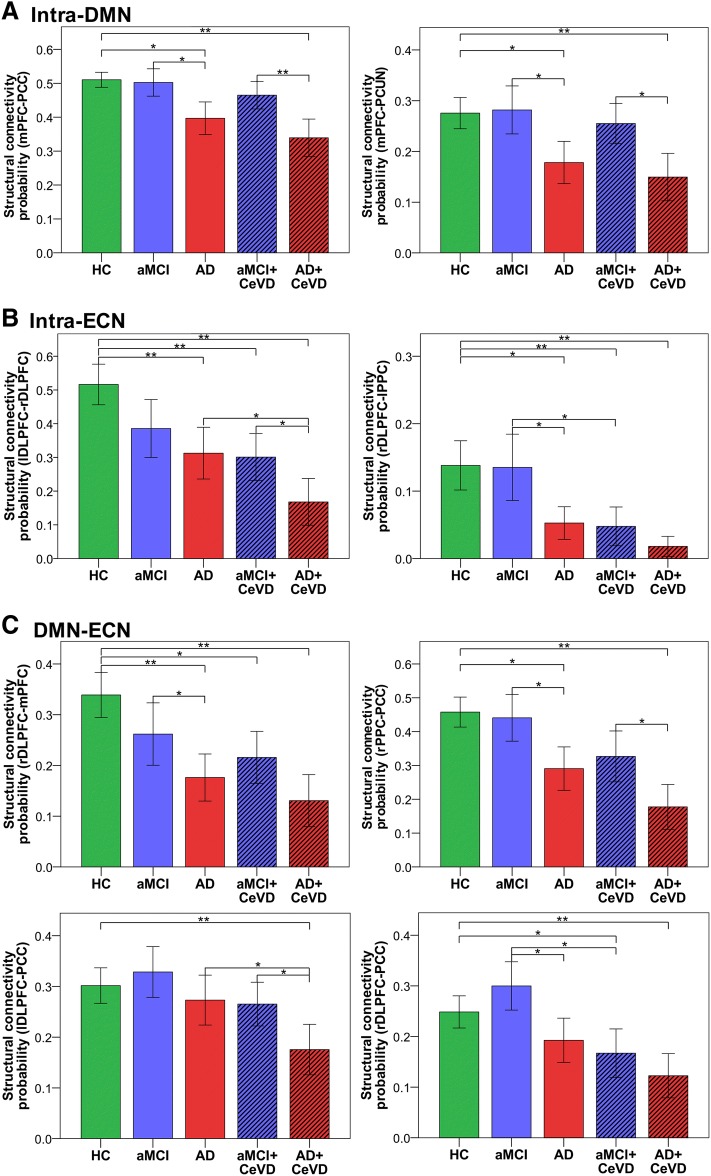
We demonstrate divergent DMN and ECN functional connectivity changes in CeVD and non-CeVD subjects. Compared with controls, intra-DMN hippocampal functional connectivity reductions were observed in both AD and AD+CeVD, while intra-DMN parietal and medial prefrontal-parietal functional connectivity was higher in AD+CeVD and aMCI+CeVD, but lower in AD. Intra-ECN frontal functional connectivity increases and fronto-parietal functional connectivity decreases occurred in CeVD but not non-CeVD subjects. Such functional connectivity alterations were related with cognitive impairment in a dissociative manner: intra-DMN functional connectivity changes were associated with worse cognition primarily in non-CeVD groups, while intra-ECN functional connectivity changes were associated with worse cognition primarily in CeVD groups. Additionally, CeVD and non-CeVD groups showed overlapping and distinct alterations in inter-network DMN-ECN functional connectivity depending on disease severity. In contrast to functional connectivity, CeVD groups had greater network structural connectivity damage compared with non-CeVD groups in both aMCI and AD patients. Network structural connectivity damage was associated with worse cognition.
We demonstrate differential functional and structural network changes between aMCI and AD patients with and without CeVD through diverging and deleterious network-based degeneration underlying domain-specific cognitive impairment.
遗忘型轻度认知障碍 (aMCI) 和阿尔茨海默病 (AD) 患者的默认模式网络 (DMN) 表现出功能和结构连接改变,而脑血管疾病 (CeVD) 则表现出执行控制网络 (ECN) 的功能和结构连接改变。这些破坏分别与记忆和执行功能障碍有关。同时患有 AD 和 CeVD 病理的患者认知衰退速度更高,且具有不同的神经退行性模式。这些发现可能反映了 AD 合并和不合并 CeVD 的不同潜在病理。然而,很少有研究使用假设驱动的多个种子为基础的方法来检查 CeVD 对 aMCI 和 AD 患者 DMN 和 ECN 的功能连接 (任务态功能磁共振成像 (fMRI)) 和结构连接 (弥散磁共振成像) 的影响。
我们检查了 39 名 aMCI、50 名 aMCI+CeVD、47 名 AD、47 名 AD+CeVD 和 65 名健康对照者 (HCs) 的功能和结构连接网络变化,并研究了它们与执行/注意力和记忆领域认知障碍的关系。
我们证明了 CeVD 和非 CeVD 患者的 DMN 和 ECN 功能连接存在差异。与对照组相比,AD 和 AD+CeVD 患者的 DMN 内海马功能连接减少,而 AD+CeVD 和 aMCI+CeVD 患者的 DMN 内顶叶和内侧前额叶-顶叶功能连接增加,而 AD 患者的功能连接减少。CeVD 患者的 ECN 内额部功能连接增加,额顶叶功能连接减少,而非 CeVD 患者则无此变化。这种功能连接改变以分离的方式与认知障碍有关:DMN 内功能连接改变与非 CeVD 组认知障碍主要相关,而 ECN 内功能连接改变与 CeVD 组认知障碍主要相关。此外,根据疾病严重程度,CeVD 和非 CeVD 组在网络间 DMN-ECN 功能连接方面存在重叠和不同的改变。与功能连接不同的是,CeVD 组的 aMCI 和 AD 患者的网络结构连接损伤均大于非 CeVD 组。网络结构连接损伤与认知障碍有关。
我们通过特定于认知域的认知障碍的潜在网络为基础的退行性变化的发散性和有害性,证明了 aMCI 和 AD 患者有和没有 CeVD 时的功能和结构网络变化的差异。