Alkhamis Mohammad A, Moore Brian R, Perez Andres M
Environmental and Life Sciences Research Center, Kuwait Institute for Scientific Research, Kuwait City, Safat 13109, Kuwait.
Department of Veterinary Population Medicine, College of Veterinary Medicine, University of Minnesota, St. Paul, MA 55108, USA.
Viruses. 2015 Jun 23;7(6):3310-28. doi: 10.3390/v7062773.
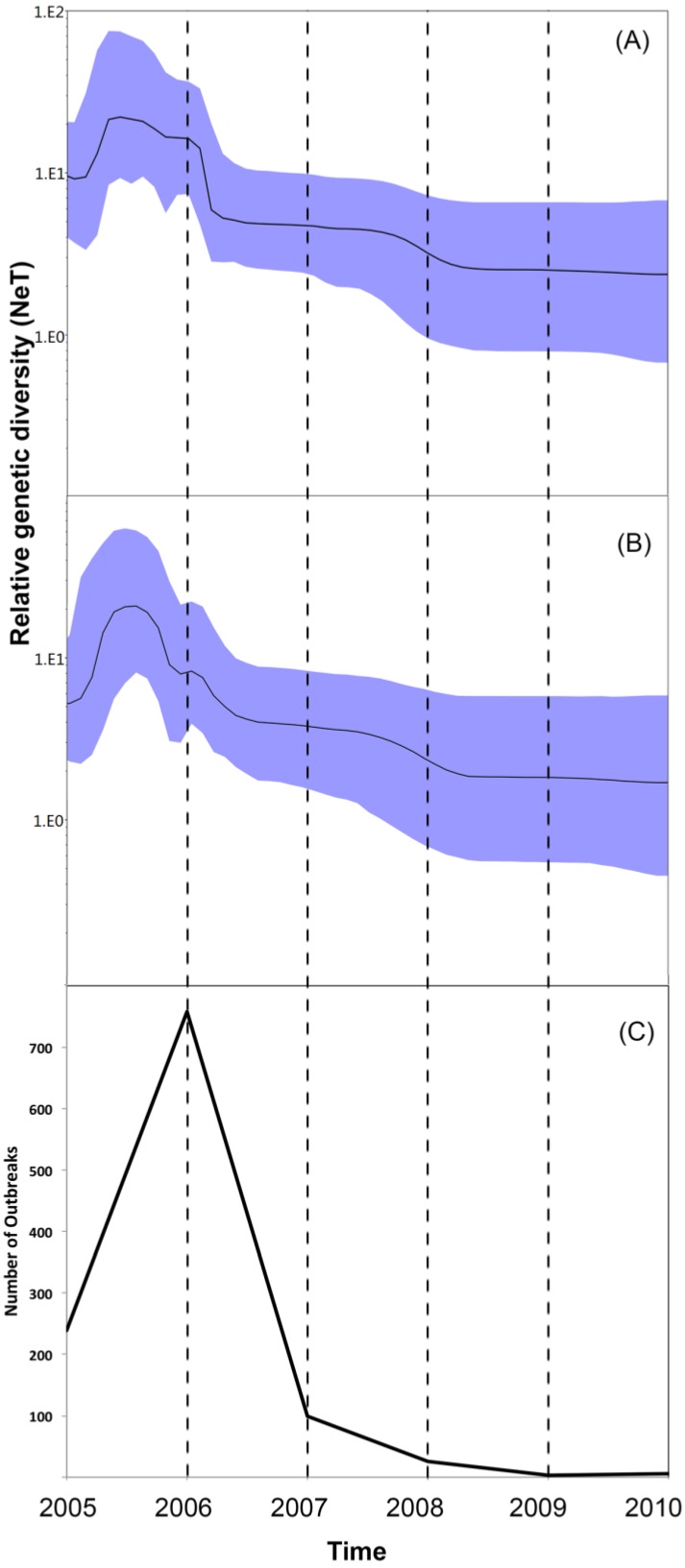
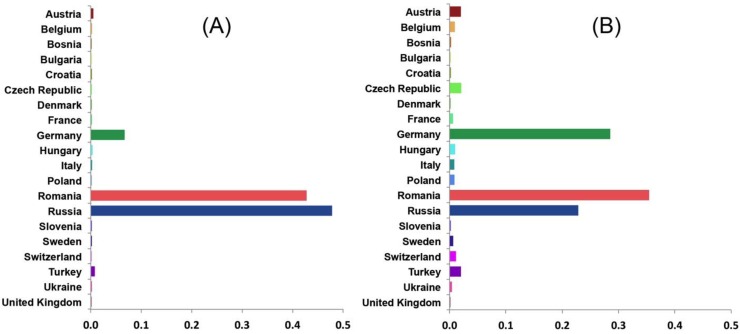
Previous Bayesian phylogeographic studies of H5N1 highly pathogenic avian influenza viruses (HPAIVs) explored the origin and spread of the epidemic from China into Russia, indicating that HPAIV circulated in Russia prior to its detection there in 2005. In this study, we extend this research to explore the evolution and spread of HPAIV within Europe during the 2005-2010 epidemic, using all available sequences of the hemagglutinin (HA) and neuraminidase (NA) gene regions that were collected in Europe and Russia during the outbreak. We use discrete-trait phylodynamic models within a Bayesian statistical framework to explore the evolution of HPAIV. Our results indicate that the genetic diversity and effective population size of HPAIV peaked between mid-2005 and early 2006, followed by drastic decline in 2007, which coincides with the end of the epidemic in Europe. Our results also suggest that domestic birds were the most likely source of the spread of the virus from Russia into Europe. Additionally, estimates of viral dispersal routes indicate that Russia, Romania, and Germany were key epicenters of these outbreaks. Our study quantifies the dynamics of a major European HPAIV pandemic and substantiates the ability of phylodynamic models to improve molecular surveillance of novel AIVs.
先前对H5N1高致病性禽流感病毒(HPAIV)的贝叶斯系统地理学研究探讨了该疫情从中国传入俄罗斯的起源和传播情况,表明HPAIV在2005年于俄罗斯被检测到之前就在该国传播。在本研究中,我们扩展了这项研究,利用在欧洲和俄罗斯疫情期间收集的血凝素(HA)和神经氨酸酶(NA)基因区域的所有可用序列,来探究2005 - 2010年疫情期间HPAIV在欧洲的进化和传播情况。我们在贝叶斯统计框架内使用离散性状系统动力学模型来探究HPAIV的进化。我们的结果表明,HPAIV的遗传多样性和有效种群大小在2005年年中至2006年初达到峰值,随后在2007年急剧下降,这与欧洲疫情的结束相吻合。我们的结果还表明,家禽是病毒从俄罗斯传播到欧洲的最可能来源。此外,病毒传播途径的估计表明,俄罗斯、罗马尼亚和德国是这些疫情的关键中心。我们的研究量化了一次主要的欧洲HPAIV大流行的动态,并证实了系统动力学模型改善新型禽流感病毒分子监测的能力。