Chen Jingqi, Fu Gang, Gai Yuanming, Zheng Ping, Zhang Dawei, Wen Jianping
Department of Biological Engineering, School of Chemical Engineering and Technology, Tianjin University, Tianjin, 300072, People's Republic of China.
Tianjin Institute of Industrial Biotechnology, Chinese Academy of Sciences, Tianjin, 300308, People's Republic of China.
Microb Cell Fact. 2015 Jun 26;14:92. doi: 10.1186/s12934-015-0282-9.
Secretory expression of valuable proteins by B. subtilis and its related species has attracted intensive work over the past three decades. Although very high yields can be achieved with homologous proteins, production of heterologous proteins by B. subtilis is unfortunately not the straight forward. The Sec pathway is the major route for protein secretion in B. subtilis. Therefore, the aim of this work was to identify the bottlenecks of the Sec pathway and improve the secretion of heterologous proteins by molecular genetic techniques.
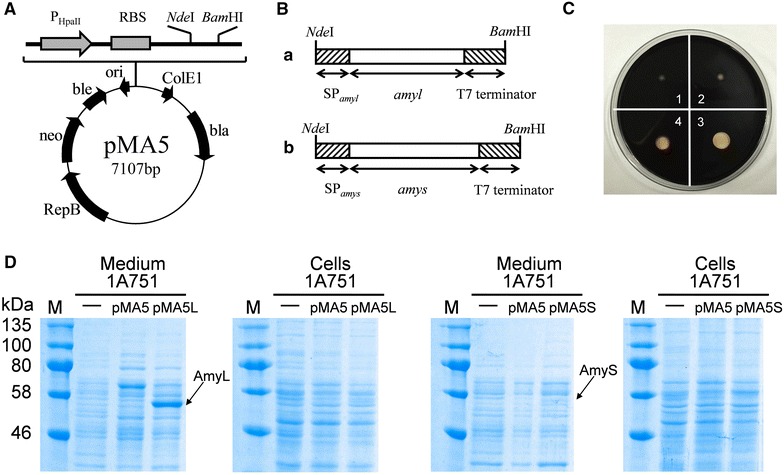
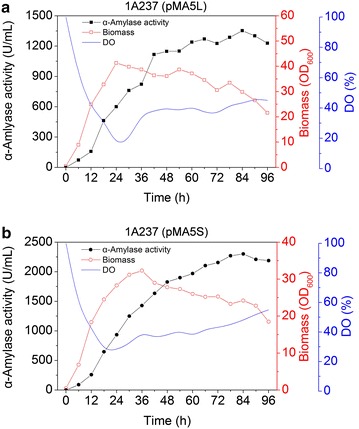
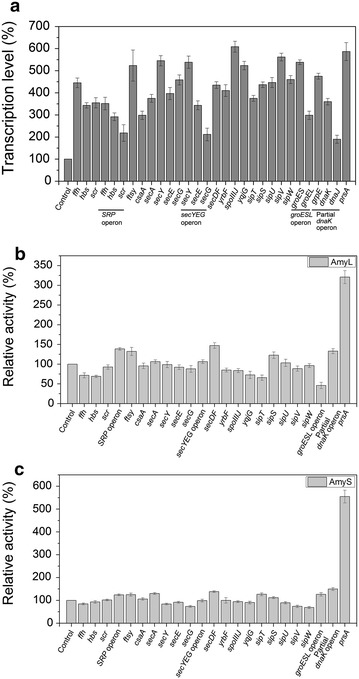
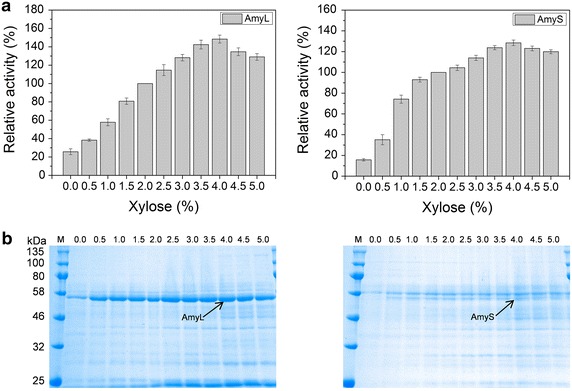
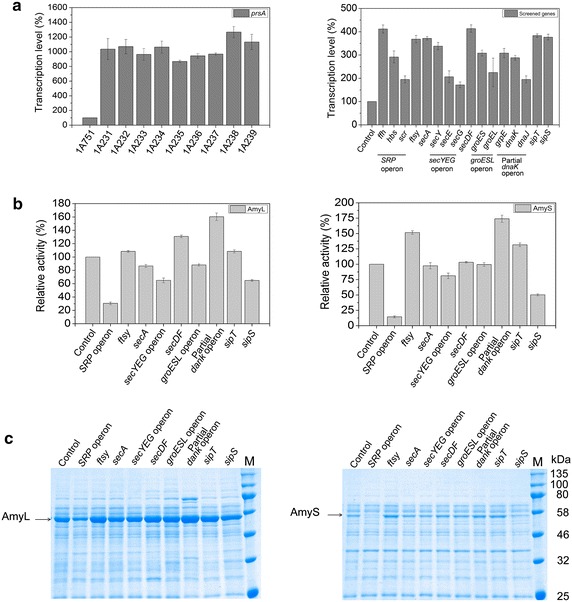
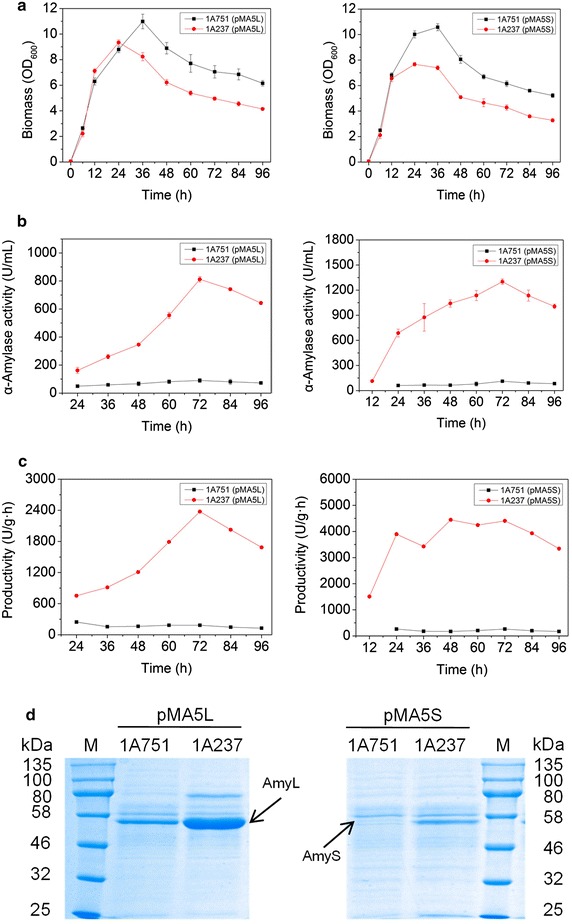
Two α-amylases (AmyL and AmyS) both under the control of the P(HpaII) promoter and equipped with their native signal peptides SP(amyl) and SP(amyS) were successfully secreted with significantly different expression levels. To improve the secretion efficiency, 23 main genes or gene operons involved in or closely related to the Sec pathway were overexpressed singly by increasing an additional copy on the chromosome, and the overexpression of prsA enhanced the production of α-amylases (AmyL and AmyS) by 3.2- and 5.5-fold, respectively. With the induction by xylose of different concentrations, prsA overexpression level was optimized and the secretion efficiency of α-amylase was further improved. Moreover, combinatorial overexpression of prsA and nine screened genes or gene operons, respectively, was performed, and the overexpression of prsA combined with partial dnaK operon improved the α-amylase activity of AmyL and AmyS by 160 and 173%, respectively, compared with the overexpression of prsA singly. Finally, the performance of the recombinant B. subtilis 1A237 was evaluated with the fed-batch fermentation in 7.5 L fermentor, and the level of secreted AmyL and AmyS reached 1,352 and 2,300 U/mL with the productivity of 16.1 U/mL h and 27.4 U/mL h, respectively.
Our systematic gene overexpression approach was designed to investigate the bottleneck of Sec pathway in B. subtilis. The deficiency of PrsA lipoprotein and chaperones of DnaK series was main rate-limiting factors for heterologous proteins secretion. Systematic and deep insight into how components of Sec pathway interact with each other may be the key to improving the yield of heterologous proteins thoroughly.
在过去三十年中,枯草芽孢杆菌及其相关菌种分泌表达有价值的蛋白质吸引了大量研究工作。尽管同源蛋白能够实现非常高的产量,但枯草芽孢杆菌分泌异源蛋白却并非易事。Sec途径是枯草芽孢杆菌中蛋白质分泌的主要途径。因此,本研究的目的是确定Sec途径的瓶颈,并通过分子遗传学技术提高异源蛋白的分泌水平。
两种α淀粉酶(AmyL和AmyS)均受P(HpaII)启动子控制,并配备其天然信号肽SP(amyl)和SP(amyS),成功实现分泌,但其表达水平存在显著差异。为提高分泌效率,通过在染色体上增加一个额外拷贝,单独过表达了23个参与Sec途径或与之密切相关的主要基因或基因操纵子,其中prsA的过表达分别使α淀粉酶(AmyL和AmyS)的产量提高了3.2倍和5.5倍。在不同浓度木糖的诱导下,优化了prsA的过表达水平,进一步提高了α淀粉酶的分泌效率。此外,分别对prsA与九个筛选出的基因或基因操纵子进行了组合过表达,与单独过表达prsA相比,prsA与部分dnaK操纵子的组合过表达使AmyL和AmyS的α淀粉酶活性分别提高了160%和173%。最后,在7.5 L发酵罐中通过补料分批发酵对重组枯草芽孢杆菌1A237的性能进行了评估,分泌的AmyL和AmyS水平分别达到1352 U/mL和2300 U/mL,生产效率分别为16.1 U/mL·h和27.4 U/mL·h。
我们的系统基因过表达方法旨在研究枯草芽孢杆菌Sec途径的瓶颈。PrsA脂蛋白和DnaK系列伴侣蛋白的缺乏是异源蛋白分泌的主要限速因素。对Sec途径各组分如何相互作用进行系统而深入的了解可能是彻底提高异源蛋白产量的关键。