Watanabe Norio, Horikoshi Masaru, Yamada Mitsuhiko, Shimodera Shinji, Akechi Tatsuo, Miki Kazuhira, Inagaki Masatoshi, Yonemoto Naohiro, Imai Hissei, Tajika Aran, Ogawa Yusuke, Takeshima Nozomi, Hayasaka Yu, Furukawa Toshi A
Department of Clinical Epidemiology, Translational Medical Center, National Center of Neurology and Psychiatry, 4-1-1 Ogawa-Higashi, Kodaira, Tokyo, 187-8551, Japan.
National Center for Cognitive Behavior Therapy and Research, National Center of Neurology and Psychiatry, 4-1-1 Ogawa-Higashi, Kodaira, Tokyo, 187-8551, Japan.
Trials. 2015 Jul 7;16:293. doi: 10.1186/s13063-015-0805-z.
Major depression is one of the most debilitating diseases in terms of quality of life. Less than half of patients suffering from depression can achieve remission after adequate antidepressant treatment. Another promising treatment option is cognitive-behavior therapy (CBT). However, the need for experienced therapists and substantive dedicated time prevent CBT from being widely disseminated. In the present study, we aim to examine the effectiveness of switching antidepressants and starting a smartphone-based CBT program at the same time, in comparison to switching antidepressants only, among patients still suffering from depression after adequate antidepressant treatment.
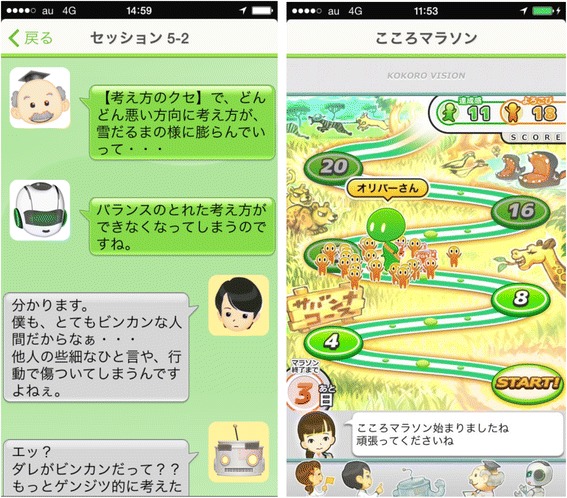
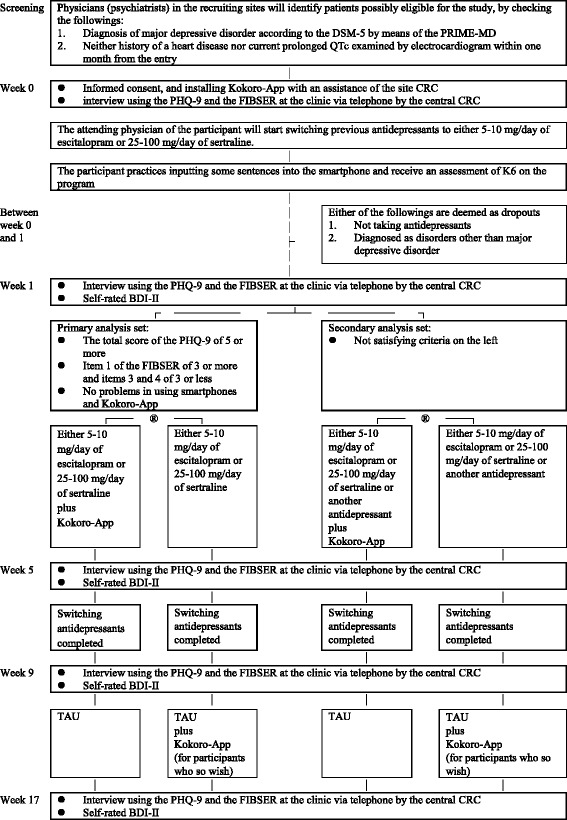
METHODS/DESIGN: A multi-center randomized trial is currently being conducted since September 2014. The smartphone-based CBT program, named the "Kokoro-App," for major depression has been developed and its feasibility has been confirmed in a previous open study. The program consists of an introduction, 6 sessions and an epilogue, and is expected to be completed within 9 weeks by patients. In the present trial, 164 patients with DSM-5 major depressive disorder and still suffering from depressive symptoms after adequate antidepressant treatment for more than 4 weeks will be allocated to the Kokoro-App plus switching antidepressant group or the switching antidepressant alone group. The participants allocated to the latter group will receive full components of the Kokoro-App after 9 weeks. The primary outcome is the change in the total score on the Patient Health Questionnaire through the 9 weeks of the program, as assessed at week 0, 1, 5 and 9 via telephone by blinded raters. The secondary outcomes include the change in the total score of the Beck Depression Inventory-II, change in side effects as assessed by the Frequency, Intensity and Burden of Side Effects Rating, and treatment satisfaction.
An effective and reachable intervention may not only lead to healthier mental status among depressed patients, but also to reduced social burden from this illness. This paper outlines the background and methods of a trial that evaluates the possible additive value of a smartphone-based CBT program for treatment-resistant depression.
UMIN-CTR: UMIN000013693 (registered on 1 June 2014).
就生活质量而言,重度抑郁症是最使人衰弱的疾病之一。接受充分抗抑郁治疗后,不到一半的抑郁症患者能够实现症状缓解。另一种有前景的治疗选择是认知行为疗法(CBT)。然而,对经验丰富的治疗师的需求以及大量专门时间投入阻碍了CBT的广泛传播。在本研究中,我们旨在比较在接受充分抗抑郁治疗后仍患有抑郁症的患者中,同时更换抗抑郁药物并启动基于智能手机的CBT程序与仅更换抗抑郁药物的有效性。
方法/设计:自2014年9月起正在进行一项多中心随机试验。已开发出针对重度抑郁症的基于智能手机的CBT程序,名为“心灵应用程序(Kokoro-App)”,并且在之前的一项开放性研究中已证实其可行性。该程序包括一个介绍、6个疗程和一个结语,预计患者将在9周内完成。在本试验中,164名患有DSM-5重度抑郁症且在接受充分抗抑郁治疗4周以上后仍有抑郁症状的患者将被分配到心灵应用程序加更换抗抑郁药物组或仅更换抗抑郁药物组。分配到后一组的参与者将在9周后接受心灵应用程序的全部内容。主要结局是在程序的9周内患者健康问卷总分的变化,由盲法评估者在第0、1、5和9周通过电话进行评估。次要结局包括贝克抑郁量表-II总分的变化、通过副作用频率、强度和负担评定法评估的副作用变化以及治疗满意度。
一种有效且可及的干预措施不仅可能使抑郁症患者的心理状态更健康,还可能减轻这种疾病带来的社会负担。本文概述了一项试验的背景和方法,该试验评估了基于智能手机的CBT程序对难治性抑郁症可能的附加价值。
UMIN-CTR:UMIN000013693(于2014年6月1日注册)。