Zimmermann Dennis, Santos Alicja, Kovar David R, Rock Ronald S
Department of Molecular Genetics and Cell Biology, The University of Chicago, 929 E. 57th Street, Chicago, IL 60637, USA.
Department of Biochemistry and Molecular Biology, The University of Chicago, 929 E. 57th Street, Chicago, IL 60637, USA.
Curr Biol. 2015 Aug 3;25(15):2057-62. doi: 10.1016/j.cub.2015.06.033. Epub 2015 Jul 16.
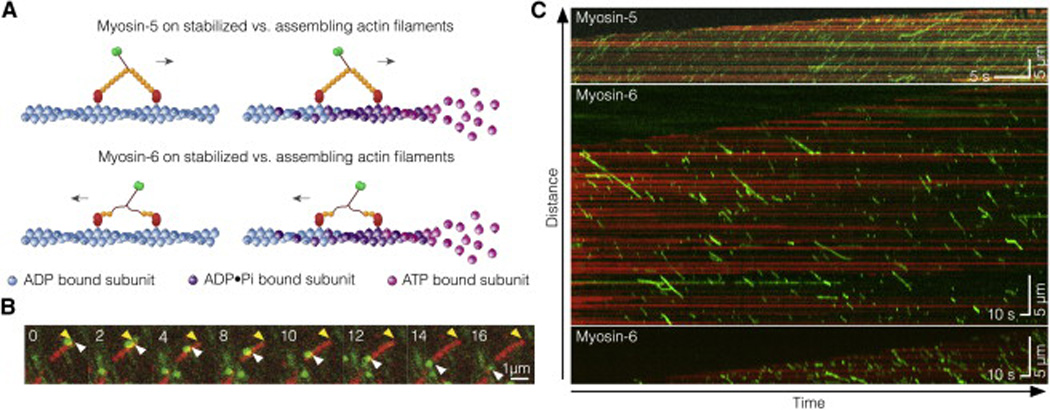
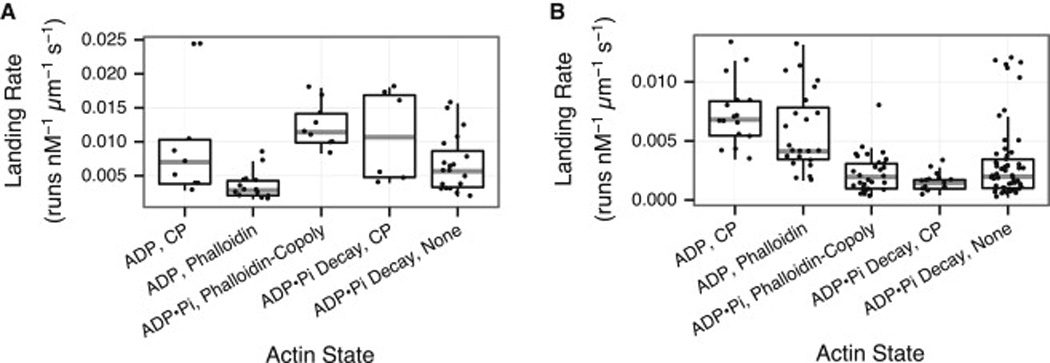
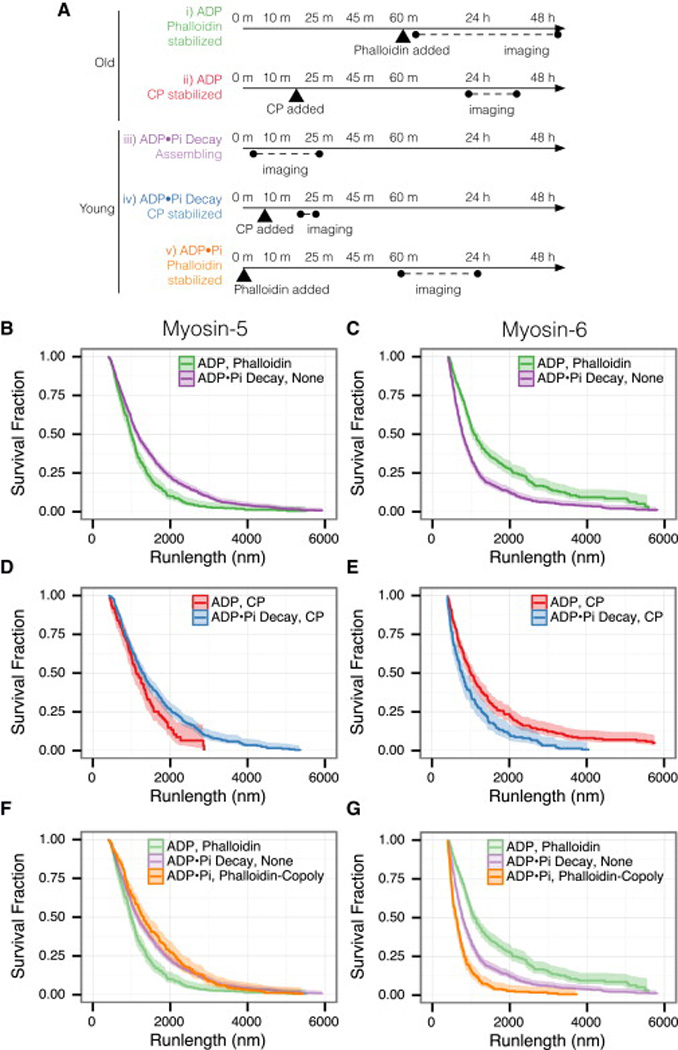
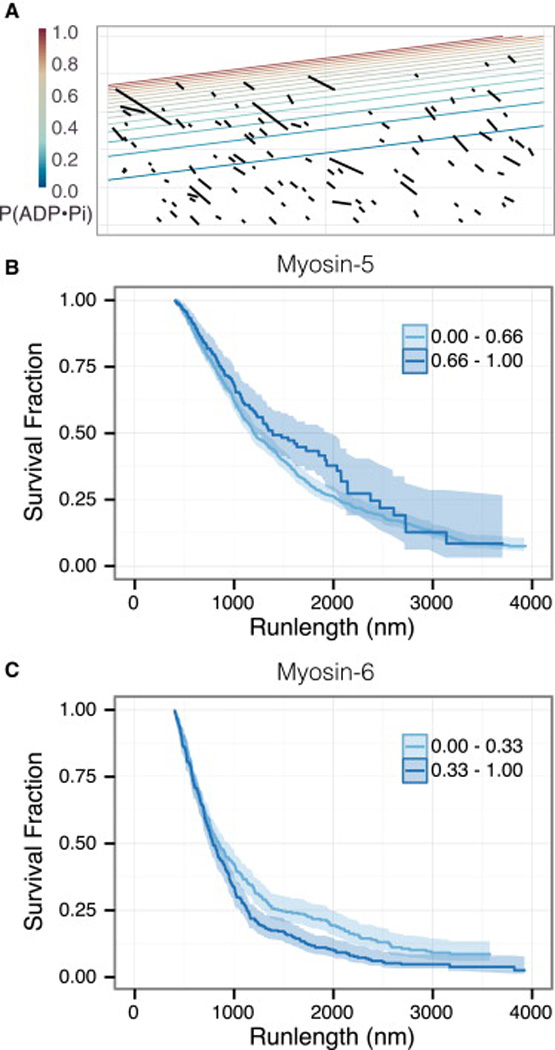
Unlike a static and immobile skeleton, the actin cytoskeleton is a highly dynamic network of filamentous actin (F-actin) polymers that continuously turn over. In addition to generating mechanical forces and sensing mechanical deformation, dynamic F-actin networks serve as cellular tracks for myosin motor traffic. However, much of our mechanistic understanding of processive myosins comes from in vitro studies in which motility was studied on pre-assembled and artificially stabilized, static F-actin tracks. In this work, we examine the role of actin dynamics in single-molecule myosin motility using assembling F-actin and two highly processive motors, myosin-5 and myosin-6. These two myosins have distinct functions in the cell and travel in opposite directions along actin filaments [1-3]. Myosin-5 walks toward the barbed ends of F-actin, traveling to sites of actin polymerization at the cell periphery [4]. Myosin-6 walks toward the pointed end of F-actin [5], traveling toward the cell center along older segments of the actin filament. We find that myosin-5 takes 1.3- to 1.5-fold longer runs on ADP•Pi (young) F-actin, whereas myosin-6 takes 1.7- to 3.6-fold longer runs along ADP (old) F-actin. These results suggest that conformational differences between ADP•Pi and ADP F-actin tailor these myosins to walk farther toward their preferred actin filament end. Taken together, these experiments define a new mechanism by which myosin traffic may sort to different F-actin networks depending on filament age.
与静态且固定不动的骨骼不同,肌动蛋白细胞骨架是由丝状肌动蛋白(F-肌动蛋白)聚合物构成的高度动态网络,不断进行更新。除了产生机械力和感知机械变形外,动态F-肌动蛋白网络还充当肌球蛋白运动的细胞轨道。然而,我们对持续性肌球蛋白过程的大部分机制理解都来自体外研究,在这些研究中,运动性是在预先组装并人工稳定的静态F-肌动蛋白轨道上进行研究的。在这项工作中,我们使用组装中的F-肌动蛋白以及两种高度持续性的马达蛋白——肌球蛋白-5和肌球蛋白-6,来研究肌动蛋白动力学在单分子肌球蛋白运动中的作用。这两种肌球蛋白在细胞中具有不同的功能,并沿肌动蛋白丝向相反方向移动[1-3]。肌球蛋白-5朝着F-肌动蛋白的带刺末端移动,前往细胞周边的肌动蛋白聚合位点[4]。肌球蛋白-6朝着F-肌动蛋白的尖端移动[5],沿着肌动蛋白丝的较老片段向细胞中心移动。我们发现,肌球蛋白-5在ADP•Pi(年轻)F-肌动蛋白上的运行时间长1.3至1.5倍,而肌球蛋白-6在ADP(老)F-肌动蛋白上的运行时间长1.7至3.6倍。这些结果表明,ADP•Pi和ADP F-肌动蛋白之间的构象差异使这些肌球蛋白能够朝着其偏好的肌动蛋白丝末端走得更远。综上所述,这些实验定义了一种新机制,通过该机制,肌球蛋白的运输可能会根据肌动蛋白丝的年龄而分选到不同的F-肌动蛋白网络。