
光依赖型有氧甲烷氧化减少了季节性分层湖泊的甲烷排放。
Light-Dependent Aerobic Methane Oxidation Reduces Methane Emissions from Seasonally Stratified Lakes.
作者信息
Oswald Kirsten, Milucka Jana, Brand Andreas, Littmann Sten, Wehrli Bernhard, Kuypers Marcel M M, Schubert Carsten J
机构信息
Department of Surface Waters-Research and Management, Eawag, Swiss Federal Institute of Aquatic Science and Technology, Kastanienbaum, Switzerland; Institute of Biogeochemistry and Pollutant Dynamics, ETH Zurich, Swiss Federal Institute of Technology, Zurich, Switzerland.
Department of Biogeochemistry, Max Planck Institute for Marine Microbiology, Bremen, Germany.
出版信息
PLoS One. 2015 Jul 20;10(7):e0132574. doi: 10.1371/journal.pone.0132574. eCollection 2015.
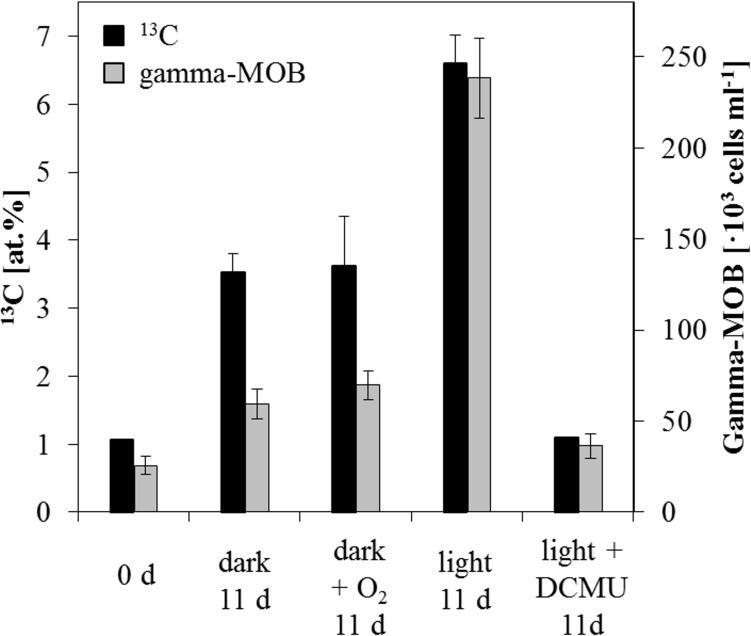
Lakes are a natural source of methane to the atmosphere and contribute significantly to total emissions compared to the oceans. Controls on methane emissions from lake surfaces, particularly biotic processes within anoxic hypolimnia, are only partially understood. Here we investigated biological methane oxidation in the water column of the seasonally stratified Lake Rotsee. A zone of methane oxidation extending from the oxic/anoxic interface into anoxic waters was identified by chemical profiling of oxygen, methane and δ13C of methane. Incubation experiments with 13C-methane yielded highest oxidation rates within the oxycline, and comparable rates were measured in anoxic waters. Despite predominantly anoxic conditions within the zone of methane oxidation, known groups of anaerobic methanotrophic archaea were conspicuously absent. Instead, aerobic gammaproteobacterial methanotrophs were identified as the active methane oxidizers. In addition, continuous oxidation and maximum rates always occurred under light conditions. These findings, along with the detection of chlorophyll a, suggest that aerobic methane oxidation is tightly coupled to light-dependent photosynthetic oxygen production both at the oxycline and in the anoxic bottom layer. It is likely that this interaction between oxygenic phototrophs and aerobic methanotrophs represents a widespread mechanism by which methane is oxidized in lake water, thus diminishing its release into the atmosphere.
湖泊是大气中甲烷的天然来源,与海洋相比,对总排放量有显著贡献。对湖泊表面甲烷排放的控制,特别是缺氧湖下层内的生物过程,目前仅得到部分了解。在此,我们研究了季节性分层的罗特湖水柱中的生物甲烷氧化作用。通过对氧气、甲烷和甲烷的δ13C进行化学分析,确定了一个从有氧/缺氧界面延伸到缺氧水域的甲烷氧化带。用13C-甲烷进行的培养实验在斜温层内产生了最高的氧化速率,在缺氧水域也测得类似的速率。尽管在甲烷氧化带内主要是缺氧条件,但已知的厌氧甲烷氧化古菌群落明显缺失。相反,需氧γ-变形菌甲烷营养菌被确定为活跃的甲烷氧化菌。此外,持续氧化和最大速率总是在光照条件下出现。这些发现,连同叶绿素a的检测结果表明,需氧甲烷氧化在斜温层和缺氧底层都与依赖光的光合产氧紧密耦合。光合自养生物与需氧甲烷营养菌之间的这种相互作用很可能是湖泊水中甲烷被氧化从而减少其向大气中释放的一种广泛机制。


 Zotero 插件