van Riet Paap Jasper, Vernooij-Dassen Myrra, Sommerbakk Ragni, Moyle Wendy, Hjermstad Marianne J, Leppert Wojciech, Vissers Kris, Engels Yvonne
Scientific Institute for Quality of Healthcare (IQ healthcare), Radboud University Medical Center, P.O. Box 9101, 6500 HB, Nijmegen, The Netherlands.
Nijmegen Alzheimer Centre, Radboud University Medical Center, P.O. Box 9101, 6500 HB, Nijmegen, The Netherlands.
Implement Sci. 2015 Jul 26;10:103. doi: 10.1186/s13012-015-0293-2.
The European population is ageing, and as a consequence, an increasing number of patients are in need of palliative care, including those with dementia. Although a growing number of new insights and best practices in palliative care have been published, they are often not implemented in daily practice. The aim of this integrative review is to provide an overview of implementation strategies that have been used to improve the organisation of palliative care.
Using an integrative literature review, we evaluated publications with strategies to improve the organisation of palliative care. Qualitative analysis of the included studies involved categorisation of the implementation strategies into subgroups, according to the type of implementation strategy.
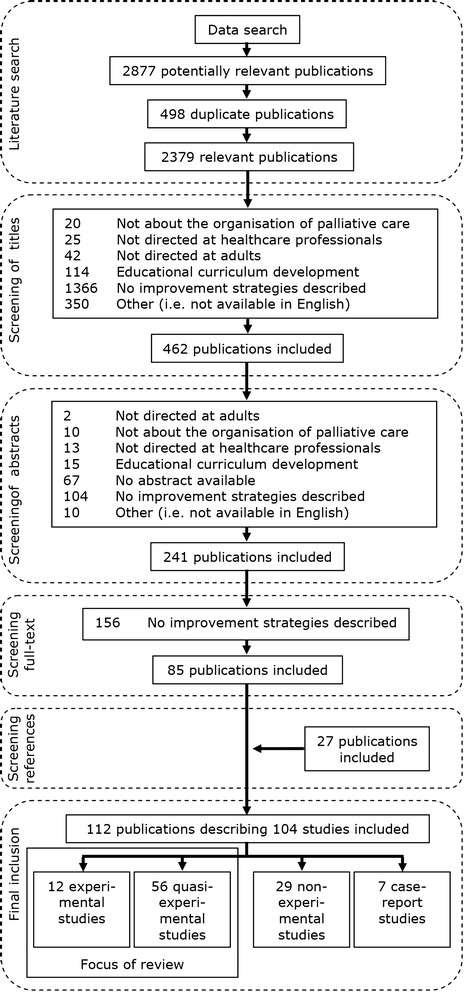
From the 2379 publications identified, 68 studies with an experimental or quasi-experimental design were included. These studies described improvements using educational strategies (n = 14), process mapping (n = 1), feedback (n = 1), multidisciplinary meetings (n = 1) and multi-faceted implementation strategies (n = 51). Fifty-three studies reported positive outcomes, 11 studies reported mixed effects and four studies showed a limited effect (two educational and two multi-faceted strategies).
This review is one of the first to provide an overview of the available literature in relation to strategies used to improve the organisation of palliative care. Since most studies reported positive results, further research is needed to identify and improve the effects of strategies aiming to improve the organisation of palliative care.
欧洲人口正在老龄化,因此,越来越多的患者需要姑息治疗,包括痴呆症患者。尽管姑息治疗领域已发表了越来越多的新见解和最佳实践,但它们在日常实践中往往未得到实施。本整合性综述的目的是概述用于改善姑息治疗组织的实施策略。
我们采用整合性文献综述方法,评估了有关改善姑息治疗组织策略的出版物。对纳入研究的定性分析包括根据实施策略的类型将实施策略分类为子组。
在识别出的2379篇出版物中,纳入了68项采用实验性或准实验性设计的研究。这些研究描述了使用教育策略(n = 14)、流程映射(n = 1)、反馈(n = 1)、多学科会议(n = 1)和多方面实施策略(n = 51)所取得的改善。53项研究报告了积极结果,11项研究报告了混合效果,4项研究显示效果有限(两项教育策略和两项多方面策略)。
本综述是首批概述与用于改善姑息治疗组织的策略相关的现有文献的综述之一。由于大多数研究报告了积极结果,因此需要进一步研究以确定并改善旨在改善姑息治疗组织的策略的效果。