Almagro Pere, Lapuente Anna, Pareja Julia, Yun Sergi, Garcia Maria Estela, Padilla Ferrán, Heredia Josep L I, De la Sierra Alex, Soriano Joan B
Department of Internal Medicine, Mutua de Terrassa University Hospital, Terrassa, Spain.
Pneumology Service, Mutua de Terrassa University Hospital, Terrassa, Spain.
Int J Chron Obstruct Pulmon Dis. 2015 Jul 16;10:1353-61. doi: 10.2147/COPD.S84482. eCollection 2015.
Retrospective studies based on clinical data and without spirometric confirmation suggest a poorer prognosis of patients with ischemic heart disease (IHD) and chronic obstructive pulmonary disease (COPD) following percutaneous coronary intervention (PCI). The impact of undiagnosed COPD in these patients is unknown. We aimed to evaluate the prognostic impact of COPD - previously or newly diagnosed - in patients with IHD treated with PCI.
Patients with IHD confirmed by PCI were consecutively included. After PCI they underwent forced spirometry and evaluation for cardiovascular risk factors. All-cause mortality, new cardiovascular events, and their combined endpoint were analyzed.
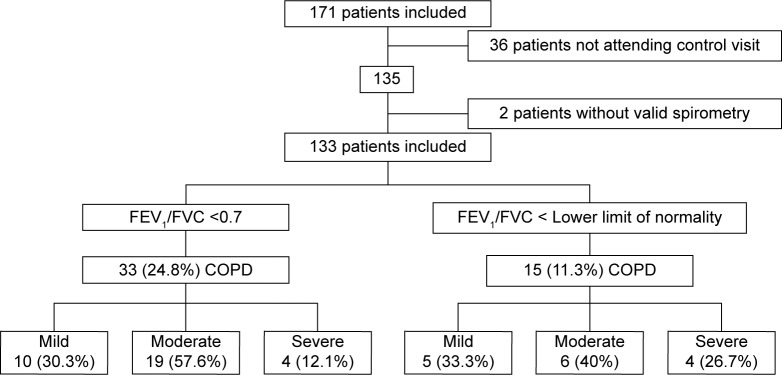
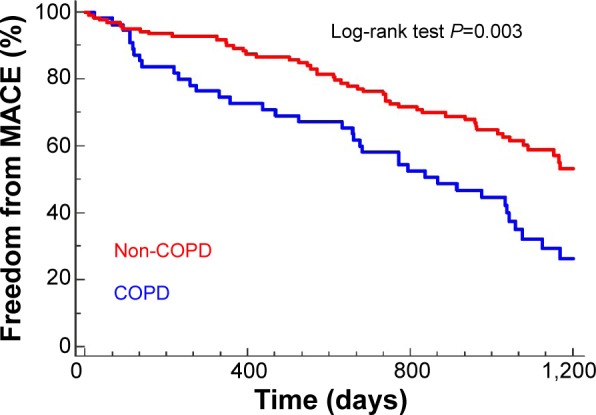
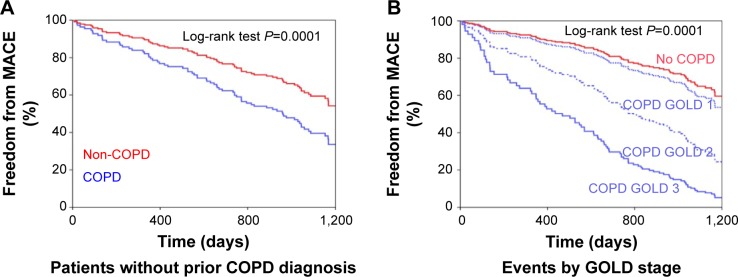
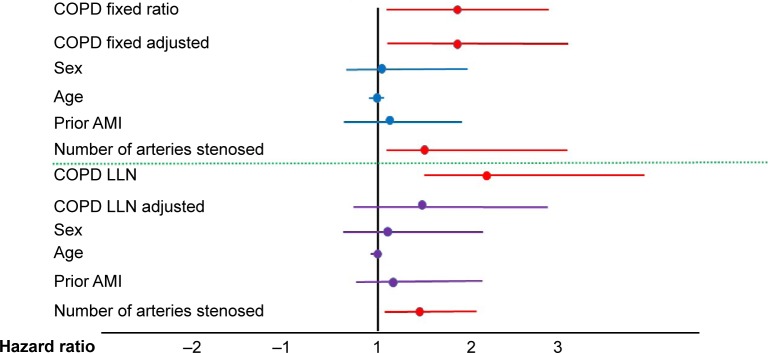
A total of 133 patients (78%) male, with a mean (SD) age of 63 (10.12) years were included. Of these, 33 (24.8%) met the spirometric criteria for COPD, of whom 81.8% were undiagnosed. IHD patients with COPD were older, had more coronary vessels affected, and a greater history of previous myocardial infarction. Median follow-up was 934 days (interquartile range [25%-75%]: 546-1,160). COPD patients had greater mortality (P=0.008; hazard ratio [HR]: 8.85; 95% confidence interval [CI]: 1.76-44.47) and number of cardiovascular events (P=0.024; HR: 1.87; 95% CI: 1.04-3.33), even those without a previous diagnosis of COPD (P=0.01; HR: 1.78; 95% CI: 1.12-2.83). These differences remained after adjustment for sex, age, number of coronary vessels affected, and previous myocardial infarction (P=0.025; HR: 1.83; 95% CI: 1.08-3.1).
Prevalence and underdiagnosis of COPD in patients with IHD who undergo PCI are both high. These patients have an independent greater mortality and a higher number of cardiovascular events during follow-up.
基于临床数据且未经肺功能测定证实的回顾性研究表明,缺血性心脏病(IHD)和慢性阻塞性肺疾病(COPD)患者经皮冠状动脉介入治疗(PCI)后的预后较差。这些患者中未诊断出的COPD的影响尚不清楚。我们旨在评估既往或新诊断的COPD对接受PCI治疗的IHD患者的预后影响。
连续纳入经PCI确诊的IHD患者。PCI术后,他们接受了肺功能测定和心血管危险因素评估。分析全因死亡率、新发心血管事件及其联合终点。
共纳入133例患者,其中男性78%,平均(标准差)年龄63(10.12)岁。其中,33例(24.8%)符合COPD的肺功能标准,其中81.8%未被诊断。患有COPD的IHD患者年龄更大,受影响的冠状动脉血管更多,既往心肌梗死病史更长。中位随访时间为934天(四分位间距[25%-75%]:546-1160)。COPD患者的死亡率更高(P=0.008;风险比[HR]:8.85;95%置信区间[CI]:1.76-44.47),心血管事件数量更多(P=0.024;HR:1.87;95%CI:1.04-3.33),即使是那些既往未诊断出COPD的患者也是如此(P=0.01;HR:1.78;95%CI:1.12-2.83)。在对性别、年龄、受影响的冠状动脉血管数量和既往心肌梗死进行调整后,这些差异仍然存在(P=0.025;HR:1.83;95%CI:1.08-3.1)。
接受PCI治疗的IHD患者中COPD的患病率和漏诊率都很高。这些患者在随访期间有更高的独立死亡率和更多的心血管事件。