Zhang Tianwei, Zhang Lin, Fan Shuqiong, Zhang Meizhuo, Fu Haihua, Liu Yuanjie, Yin Xiaolu, Chen Hao, Xie Liang, Zhang Jingchuan, Gavine Paul R, Gu Yi, Ni Xingzhi, Su Xinying
Asia & Emerging Markets iMed, AstraZeneca R&D, Shanghai, P.R. China.
Research and Development Information, AstraZeneca R&D, Shanghai, P.R. China.
PLoS One. 2015 Jul 28;10(7):e0134493. doi: 10.1371/journal.pone.0134493. eCollection 2015.
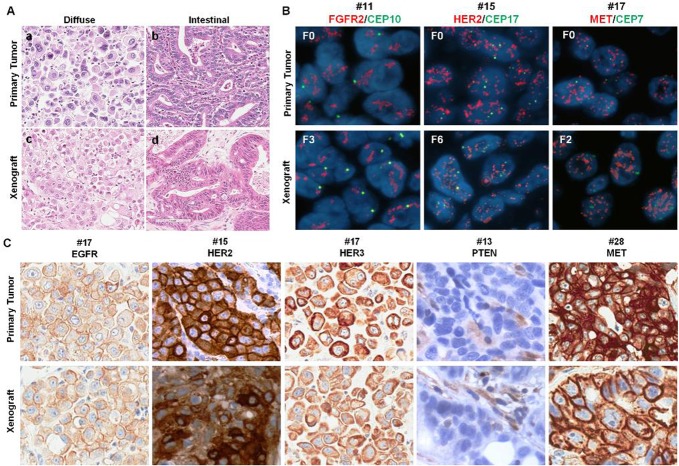
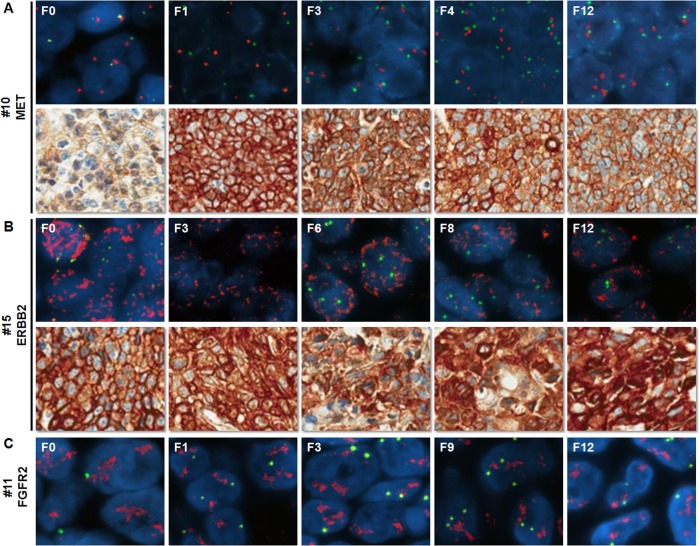
Patient-derived cancer xenografts (PDCX) generally represent more reliable models of human disease in which to evaluate a potential drugs preclinical efficacy. However to date, only a few patient-derived gastric cancer xenograft (PDGCX) models have been reported. In this study, we aimed to establish additional PDGCX models and to evaluate whether these models accurately reflected the histological and genetic diversities of the corresponding patient tumors. By engrafting fresh patient gastric cancer (GC) tissues into immune-compromised mice (SCID and/or nude mice), thirty two PDGCX models were established. Histological features were assessed by a qualified pathologist based on H&E staining. Genomic comparison was performed for several biomarkers including ERBB1, ERBB2, ERBB3, FGFR2, MET and PTEN. These biomarkers were profiled to assess gene copy number by fluorescent in situ hybridization (FISH) and/or protein expression by immunohistochemistry (IHC). All 32 PDGCX models retained the histological features of the corresponding human tumors. Furthermore, among the 32 models, 78% (25/32) highly expressed ERBB1 (EGFR), 22% (7/32) were ERBB2 (HER2) positive, 78% (25/32) showed ERBB3 (HER3) high expression, 66% (21/32) lost PTEN expression, 3% (1/32) harbored FGFR2 amplification, 41% (13/32) were positive for MET expression and 16% (5/32) were MET gene amplified. Between the PDGCX models and their parental tumors, a high degree of similarity was observed for FGFR2 and MET gene amplification, and also for ERBB2 status (agreement rate = 94100%; kappa value = 0.811). Protein expression of PTEN and MET also showed moderate agreement (agreement rate = 78%; kappa value = 0.460.56), while ERBB1 and ERBB3 expression showed slight agreement (agreement rate = 5975%; kappa value = 0.18~0.19). ERBB2 positivity, FGFR2 or MET gene amplification was all maintained until passage 12 in mice. The stability of the molecular profiles observed across subsequent passages within the individual models provides confidence in the utility and translational significance of these models for in vivo testing of personalized therapies.
患者来源的癌症异种移植模型(PDCX)通常是评估潜在药物临床前疗效的更可靠的人类疾病模型。然而,迄今为止,仅报道了少数患者来源的胃癌异种移植模型(PDGCX)。在本研究中,我们旨在建立更多的PDGCX模型,并评估这些模型是否准确反映了相应患者肿瘤的组织学和基因多样性。通过将新鲜的患者胃癌(GC)组织移植到免疫缺陷小鼠(SCID和/或裸鼠)中,建立了32个PDGCX模型。由合格的病理学家基于苏木精-伊红染色评估组织学特征。对包括ERBB1、ERBB2、ERBB3、FGFR2、MET和PTEN在内的几种生物标志物进行基因组比较。通过荧光原位杂交(FISH)分析这些生物标志物以评估基因拷贝数,和/或通过免疫组织化学(IHC)分析蛋白质表达。所有32个PDGCX模型均保留了相应人类肿瘤的组织学特征。此外,在这32个模型中,78%(25/32)高表达ERBB1(表皮生长因子受体),22%(7/32)为ERBB2(人表皮生长因子受体2)阳性,78%(25/32)显示ERBB3(人表皮生长因子受体3)高表达,66%(21/32)失去PTEN表达,3%(1/32)存在FGFR2扩增,41%(13/32)MET表达阳性,16%(5/32)MET基因扩增。在PDGCX模型与其亲代肿瘤之间,观察到FGFR2和MET基因扩增以及ERBB2状态具有高度相似性(一致率=94%100%;kappa值=0.811)。PTEN和MET的蛋白质表达也显示出中度一致性(一致率=78%;kappa值=0.460.56),而ERBB1和ERBB3表达显示出轻度一致性(一致率=59%75%;kappa值=0.18~0.19)。ERBB2阳性、FGFR2或MET基因扩增在小鼠传代至第12代时均得以维持。在各个模型中观察到的后续传代过程中分子谱的稳定性为这些模型在体内测试个性化疗法的实用性和转化意义提供了信心。