Chang Hae Ryung, Park Hee Seo, Ahn Young Zoo, Nam Seungyoon, Jung Hae Rim, Park Sungjin, Lee Sang Jin, Balch Curt, Powis Garth, Ku Ja-Lok, Kim Yon Hui
New Experimental Therapeutics Branch, National Cancer Center of Korea, Ilsan, Goyang-si, Gyeonggi-do, Republic of Korea.
Cancer Biology Research Laboratory, Institut Pasteur Korea, Bundang, Seongnam-si, Gyeonggi-do, Republic of Korea.
BMC Cancer. 2016 Mar 9;16:200. doi: 10.1186/s12885-016-2232-2.
"Biomarker-driven targeted therapy," the practice of tailoring patients' treatment to the expression/activity levels of disease-specific genes/proteins, remains challenging. For example, while the anti-ERBB2 monoclonal antibody, trastuzumab, was first developed using well-characterized, diverse in vitro breast cancer models (and is now a standard adjuvant therapy for ERBB2-positive breast cancer patients), trastuzumab approval for ERBB2-positive gastric cancer was largely based on preclinical studies of a single cell line, NCI-N87. Ensuing clinical trials revealed only modest patient efficacy, and many ERBB2-positive gastric cancer (GC) patients failed to respond at all (i.e., were inherently recalcitrant), or succumbed to acquired resistance.
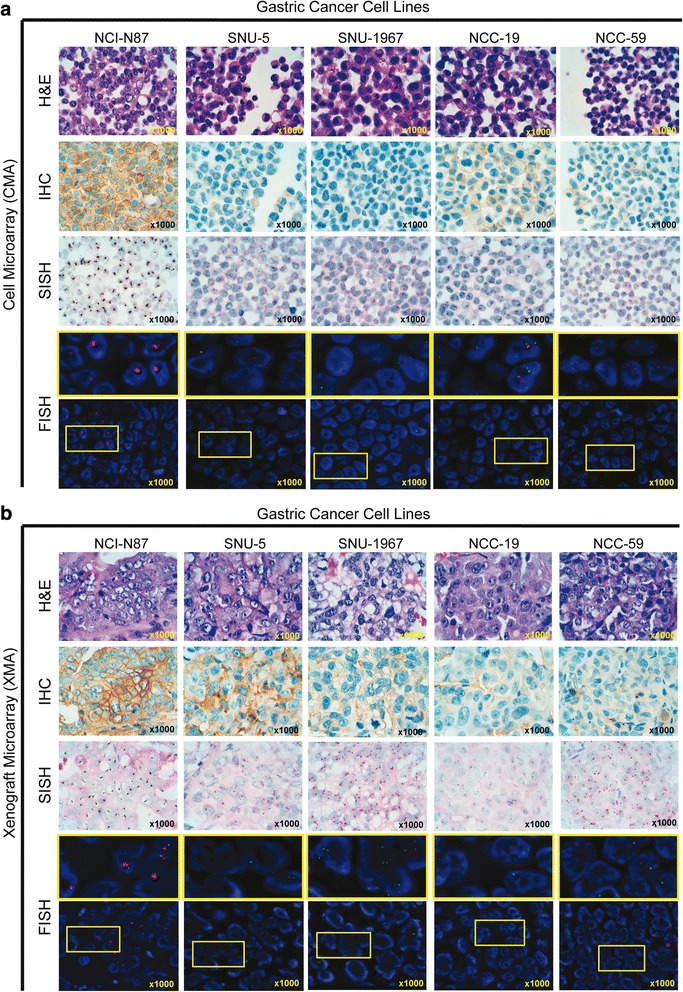
To assess mechanisms underlying GC insensitivity to ERBB2 therapies, we established a diverse panel of GC cells, differing in ERBB2 expression levels, for comprehensive in vitro and in vivo characterization. For higher throughput assays of ERBB2 DNA and protein levels, we compared the concordance of various laboratory quantification methods, including those of in vitro and in vivo genetic anomalies (FISH and SISH) and xenograft protein expression (Western blot vs. IHC), of both cell and xenograft (tissue-sectioned) microarrays.
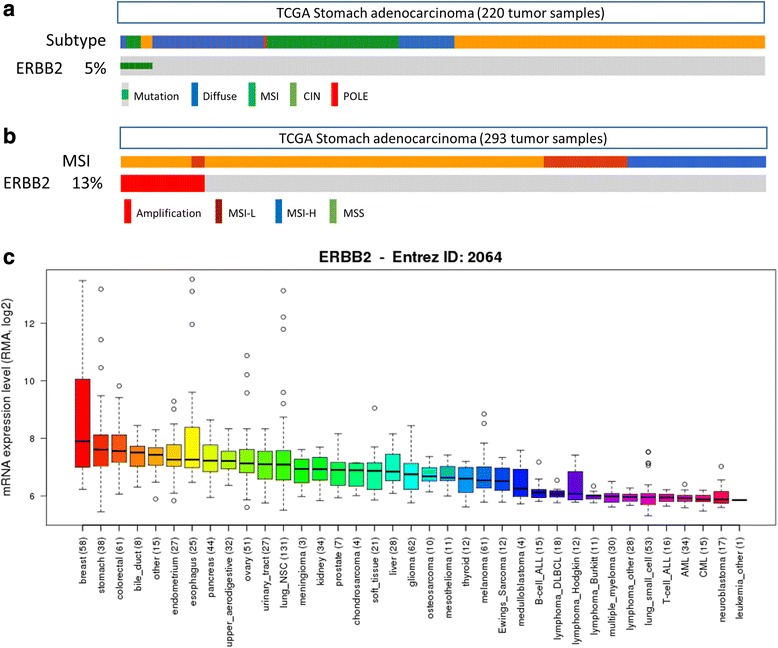
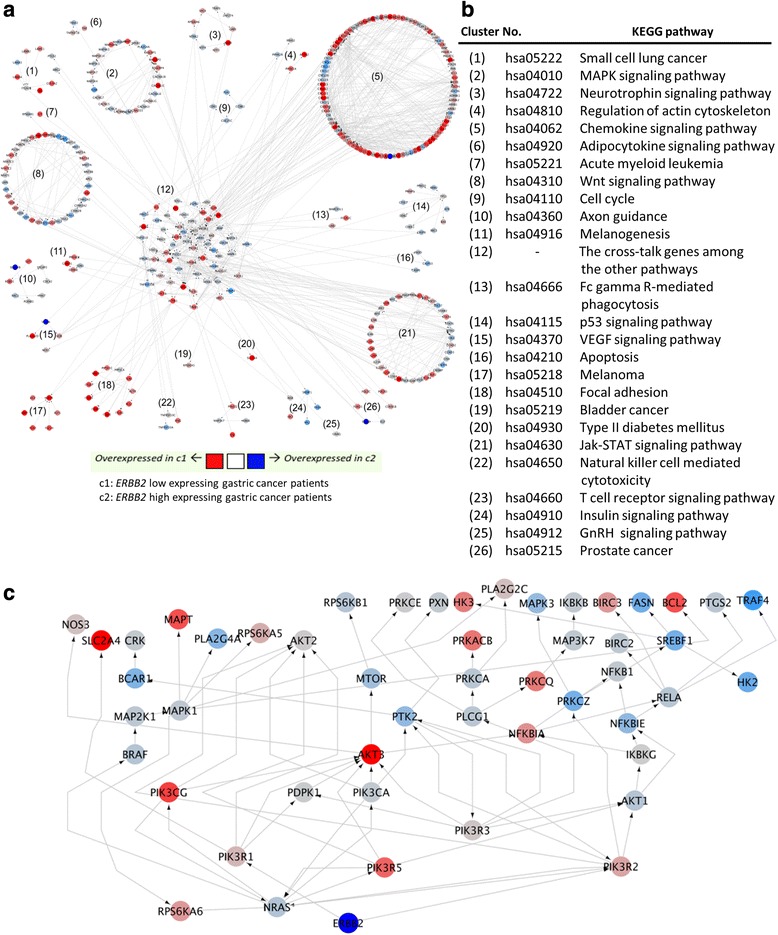
The biomarker assessment methods strongly agreed, as did correlation between RNA and protein expression. However, although ERBB2 genomic anomalies showed good in vitro vs. in vivo correlation, we observed striking differences in protein expression between cultured cells and mouse xenografts (even within the same GC cell type). Via our unique pathway analysis, we delineated a signaling network, in addition to specific pathways/biological processes, emanating from the ERBB2 signaling cascade, as a potential useful target of clinical treatment. Integrated analysis of public data from gastric tumors revealed frequent (10 - 20 %) amplification of the genes NFKBIE, PTK2, and PIK3CA, each of which resides in an ERBB2-derived subpathway network.
Our comprehensive bioinformatics analyses of highly heterogeneous cancer cells, combined with tumor "omics" profiles, can optimally characterize the expression patterns and activity of specific tumor biomarkers. Subsequent in vitro and in vivo validation, of specific disease biomarkers (using multiple methodologies), can improve prediction of patient stratification according to drug response or nonresponse.
“生物标志物驱动的靶向治疗”,即根据疾病特异性基因/蛋白质的表达/活性水平为患者量身定制治疗方案的做法,仍然具有挑战性。例如,抗ERBB2单克隆抗体曲妥珠单抗最初是使用特征明确、多样的体外乳腺癌模型开发的(现在是ERBB2阳性乳腺癌患者的标准辅助治疗药物),而曲妥珠单抗用于ERBB2阳性胃癌的批准主要基于对单一细胞系NCI-N87的临床前研究。随后的临床试验显示患者疗效有限,许多ERBB2阳性胃癌(GC)患者根本没有反应(即本质上具有抗性),或者出现获得性耐药。
为了评估GC对ERBB2治疗不敏感的潜在机制,我们建立了一组ERBB2表达水平不同的GC细胞,用于全面的体外和体内特征分析。为了对ERBB2的DNA和蛋白质水平进行更高通量的检测,我们比较了各种实验室定量方法的一致性,包括体外和体内基因异常(FISH和SISH)以及异种移植蛋白质表达(蛋白质印迹法与免疫组化法)在细胞和异种移植(组织切片)微阵列中的情况。
生物标志物评估方法高度一致,RNA和蛋白质表达之间的相关性也是如此。然而,尽管ERBB2基因组异常在体外和体内显示出良好的相关性,但我们观察到培养细胞和小鼠异种移植之间(即使是同一GC细胞类型内)蛋白质表达存在显著差异。通过我们独特的通路分析,除了特定的通路/生物学过程外,我们还描绘了一个源自ERBB2信号级联的信号网络,作为临床治疗的潜在有用靶点。对胃癌肿瘤公共数据的综合分析显示,NFKBIE、PTK2和PIK3CA基因频繁(10%-20%)扩增,每个基因都位于一个源自ERBB2的子通路网络中。
我们对高度异质性癌细胞进行的全面生物信息学分析,结合肿瘤“组学”图谱,能够最佳地表征特定肿瘤生物标志物的表达模式和活性。随后对特定疾病生物标志物(使用多种方法)进行体外和体内验证,可以改善根据药物反应或无反应对患者分层的预测。