Abtroun Lilia, Bunouf Pierre, Gendreau Roger M, Vitton Olivier
*Ariana Pharmaceuticals, Paris †Laboratoires Pierre Fabre, Labege, France ‡Gendreau Consulting, LLC, Poway, California.
Clin J Pain. 2016 May;32(5):435-40. doi: 10.1097/AJP.0000000000000284.
Minalcipran has been approved for the treatment of fibromyalgia in several countries including Australia. Australian agency considered that the overall efficacy is moderate, although clinically significant, and could be translated into a real and strong improvement in some patients. The determination of the characteristics of patients who could benefit the most from milnacipran (MLN) is the primary objective of this manuscript.
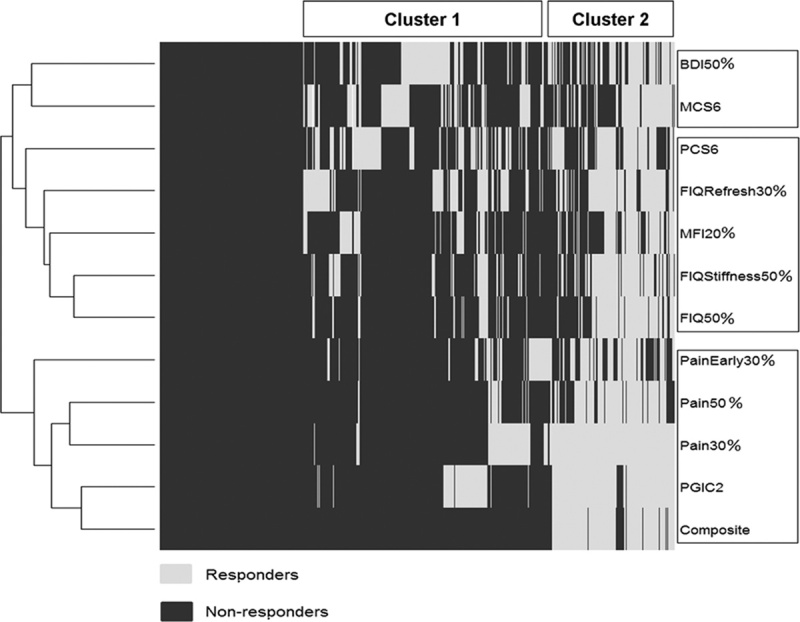
Data from the 3 pivotal phase 3 clinical trials of the Australian submission dossier were assembled into a database. A clustering method was implemented to exhibit natural groupings of homogeneous observations into clusters of efficacy outcomes and individual patients. Next, baseline characteristics were investigated using a data-mining method to determine the clinical features that may be predictive of a substantially improved effect of MLN on a set of efficacy outcomes.
The clustering analysis reveals 3 symptom domains: "Pain and global," "Mood and central status," and "Function." We show that improvement in "Fatigue" goes with improvement in "Function." Furthermore, the predictive data-mining analysis exhibits 4 single baseline characteristics that are associated with a substantially improved effect of MLN on efficacy outcomes. These are high pain intensity, low anxiety or catastrophizing level, absence of major sleeping problems, and physical limitations in the daily life effort.
Clustering and predictive data-mining methods provide additional insight about fibromyalgia, its symptoms, and treatment. The information is useful to physicians to optimize prescriptions in the daily practice and to regulatory bodies to refine indications.
米那普明已在包括澳大利亚在内的多个国家被批准用于治疗纤维肌痛。澳大利亚机构认为,尽管总体疗效具有临床意义,但程度适中,且在部分患者中可转化为切实且显著的改善。确定最能从米那普明(MLN)治疗中获益的患者特征是本论文的主要目标。
将澳大利亚提交档案中的3项关键3期临床试验数据汇总到一个数据库中。采用聚类方法将同类观察结果自然分组为疗效结果簇和个体患者簇。接下来,使用数据挖掘方法研究基线特征,以确定可能预测MLN对一组疗效结果有显著改善作用的临床特征。
聚类分析揭示了3个症状领域:“疼痛与整体状况”、“情绪与中枢状态”以及“功能”。我们发现“疲劳”的改善与“功能”的改善相伴。此外,预测性数据挖掘分析显示了4个单一基线特征,这些特征与MLN对疗效结果有显著改善作用相关。它们分别是高疼痛强度、低焦虑或灾难化水平、无严重睡眠问题以及日常生活活动存在身体限制。
聚类和预测性数据挖掘方法为纤维肌痛、其症状及治疗提供了更多见解。这些信息对医生在日常实践中优化处方以及监管机构完善适应证很有用。