Kern David M, Davis Jill, Williams Setareh A, Tunceli Ozgur, Wu Bingcao, Hollis Sally, Strange Charlie, Trudo Frank
HealthCore, Inc., Wilmington, DE, USA.
AstraZeneca Pharmaceuticals, Wilmington, DE, USA.
Int J Chron Obstruct Pulmon Dis. 2015 Jul 23;10:1417-25. doi: 10.2147/COPD.S83135. eCollection 2015.
To estimate the accuracy of claims-based pneumonia diagnoses in COPD patients using clinical information in medical records as the reference standard.
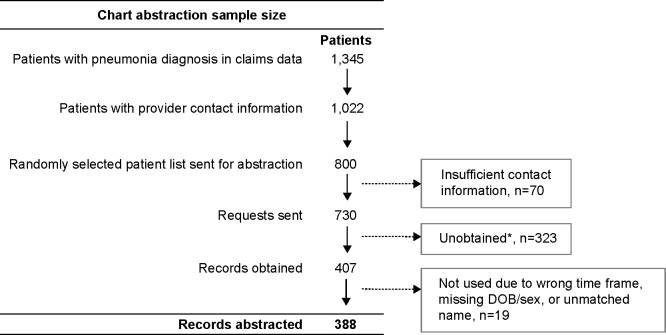
Selecting from a repository containing members' data from 14 regional United States health plans, this validation study identified pneumonia diagnoses within a group of patients initiating treatment for COPD between March 1, 2009 and March 31, 2012. Patients with ≥1 claim for pneumonia (International Classification of Diseases Version 9-CM code 480.xx-486.xx) were identified during the 12 months following treatment initiation. A subset of 800 patients was randomly selected to abstract medical record data (paper based and electronic) for a target sample of 400 patients, to estimate validity within 5% margin of error. Positive predictive value (PPV) was calculated for the claims diagnosis of pneumonia relative to the reference standard, defined as a documented diagnosis in the medical record.
A total of 388 records were reviewed; 311 included a documented pneumonia diagnosis, indicating 80.2% (95% confidence interval [CI]: 75.8% to 84.0%) of claims-identified pneumonia diagnoses were validated by the medical charts. Claims-based diagnoses in inpatient or emergency departments (n=185) had greater PPV versus outpatient settings (n=203), 87.6% (95% CI: 81.9%-92.0%) versus 73.4% (95% CI: 66.8%-79.3%), respectively. Claims-diagnoses verified with paper-based charts had similar PPV as the overall study sample, 80.2% (95% CI: 71.1%-87.5%), and higher PPV than those linked to electronic medical records, 73.3% (95% CI: 65.5%-80.2%). Combined paper-based and electronic records had a higher PPV, 87.6% (95% CI: 80.9%-92.6%).
Administrative claims data indicating a diagnosis of pneumonia in COPD patients are supported by medical records. The accuracy of a medical record diagnosis of pneumonia remains unknown. With increased use of claims data in medical research, COPD researchers can study pneumonia with confidence that claims data are a valid tool when studying the safety of COPD therapies that could potentially lead to increased pneumonia susceptibility or severity.
以病历中的临床信息作为参考标准,评估基于索赔数据对慢性阻塞性肺疾病(COPD)患者肺炎诊断的准确性。
本验证研究从包含美国14个地区医保计划参保人员数据的数据库中选取2009年3月1日至2012年3月31日期间开始接受COPD治疗的一组患者中的肺炎诊断信息。在开始治疗后的12个月内,识别出有≥1次肺炎索赔记录(国际疾病分类第9版临床修正版编码480.xx - 486.xx)的患者。随机抽取800名患者中的一个子集,提取400名目标样本患者的病历数据(纸质和电子病历),以在5%的误差范围内估计有效性。相对于参考标准(定义为病历中有记录的诊断),计算肺炎索赔诊断的阳性预测值(PPV)。
共审查了388份记录;其中311份包含有记录的肺炎诊断,这表明80.2%(95%置信区间[CI]:75.8%至84.0%)的索赔确诊的肺炎诊断经病历证实。住院或急诊科基于索赔的诊断(n = 185)的PPV高于门诊环境(n = 203),分别为87.6%(95% CI:81.9% - 92.0%)和73.4%(95% CI:66.8% - 79.3%)。经纸质病历核实的索赔诊断的PPV与总体研究样本相似,为80.2%(95% CI:71.1% - 87.5%),且高于与电子病历相关的诊断,后者为73.3%(95% CI:65.5% - 80.2%)。纸质和电子病历相结合时PPV更高,为87.6%(95% CI:80.9% - 92.6%)。
表明COPD患者肺炎诊断的行政索赔数据得到病历支持。病历诊断肺炎的准确性尚不清楚。随着索赔数据在医学研究中的使用增加,COPD研究人员在研究可能导致肺炎易感性或严重程度增加的COPD治疗安全性时,可以放心地使用索赔数据作为有效工具来研究肺炎。