Altaf Mohammed, Zubedi Ayesha Mubeen, Nazneen Fareesa, Kareemulla Shaik, Ali Syed Amir, Aleemuddin N M, Hannan Hazari Md Abdul
Department of Pharmacy Practice and PharmD, Deccan School of Pharmacy, Jawaharlal Nehru Technological University, Hyderabad, Telangana, India.
Department of Pulmonology, Deccan College of Medical Sciences, Hyderabad, Telangana, India.
Perspect Clin Res. 2015 Jul-Sep;6(3):150-8. doi: 10.4103/2229-3485.159940.
This study aims at simplifying the practical patient management and offers some general indications for pharmacotherapeutic choice by the implementation of (Global Initiative for Chronic Lung Disease) guidelines. This study was designed to evaluate the clinical and economic consequences of salmeterol/fluticasone (SF), formoterol/budesonide (FB), and formoterol/fluticasone (FF) in severe and very severe chronic obstructive pulmonary disease (COPD) patients.
The aim was to find out the most cost-effective drug combination between the three combinations (SF/FB/FF) in COPD patients.
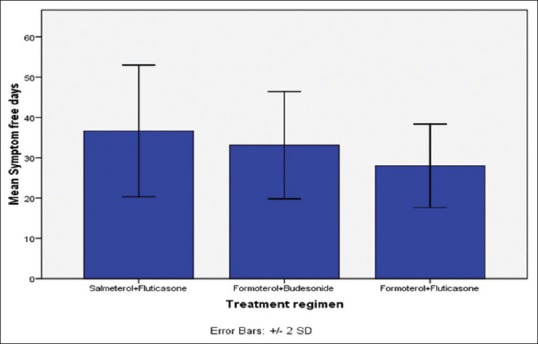
A prospective observational comparative study (cost-effectiveness analysis), in which 90 severe (30 ≤ forced expiratory volume in 1 s [FEV1] <50% predicted) and very severe (FEV1 < 30% predicted) COPD patients (outpatients/inpatients) who are prescribed with any one of the following combinations (SF/FB/FF) were selected. In our study, we have divided 90 COPD patients into three groups (Group I, Group II, and Group III) each group consisting of 30 patients. Group I was prescribed with medication SF, Group II with medication FB, and Group III with medication FF. We used five different parameters such as spirometry test (mean FEV1 initial and final visit), number of symptom-free days (SFDs), number of moderate and severe exacerbations, Number of days of hospitalization and direct, indirect, and total cost to assess the cost-effectiveness of SF/FB/FF. Comparison of cost and effects was done during the period of 6 months of using SF/FB/FF.
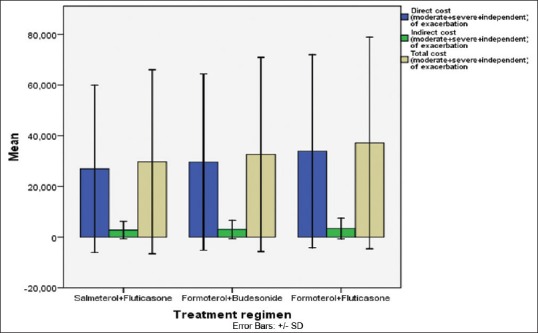
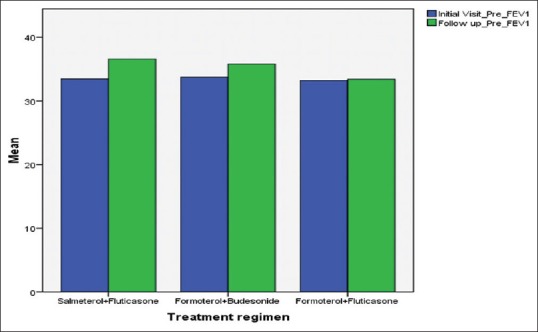
The average FEV1 for Group I, Group II, and Group III subjects at initial visit was 33.47%, 33.73%, and 33.20% and was increased to 36.60%, 35.8%, and 33.4%, respectively. A 3% increment in FEV1 was reported for Group I subjects (SF) and was highly significant statistically (t = -8.833, P = 0.000) at 95% CI. For Group II subjects (FB), a 2% increment in FEV1 was reported and was highly significant statistically (t = -9.001, P = 0.000) at 95% CI. For Group III (FF) subjects 0.2% increment in FEV1. The overall mean total cost for Group I, Group II, and Group III subjects during the 6 months period was found to be Rs. 29,725/-, Rs. 32,602/- and Rs. 37,155/-. Incremental cost-effectiveness of FB versus SF was Rs. 37,781/- per avoided exacerbation and Rs. 661/-per SFD.
This study highlights the favorable therapeutic performance of combined inhaled bronchodilators and corticosteroids (SF/FB/FF), thus suggesting that healthcare costs would be also affected positively. Results from our study showed that SF and FB were the most effective strategies in the treatment of COPD, with a slight clinical superiority of SF. The FF strategy was not much effective (i.e. associated with fewer outcomes and higher costs).
本研究旨在通过实施慢性阻塞性肺疾病全球倡议(GOLD)指南简化实际患者管理,并为药物治疗选择提供一些一般指导。本研究旨在评估沙美特罗/氟替卡松(SF)、福莫特罗/布地奈德(FB)和福莫特罗/氟替卡松(FF)对重度和极重度慢性阻塞性肺疾病(COPD)患者的临床和经济影响。
旨在找出慢性阻塞性肺疾病(COPD)患者三种联合用药方案(SF/FB/FF)中最具成本效益的药物组合。
一项前瞻性观察性比较研究(成本效益分析),选取90例重度(1秒用力呼气容积[FEV1]占预计值的30%≤FEV1<50%)和极重度(FEV1<预计值的30%)慢性阻塞性肺疾病患者(门诊/住院患者),这些患者正在使用以下任何一种联合用药方案(SF/FB/FF)。在我们的研究中,将90例慢性阻塞性肺疾病患者分为三组(第一组、第二组和第三组),每组30例。第一组患者使用SF药物,第二组患者使用FB药物,第三组患者使用FF药物。我们使用了五个不同参数,如肺量计测试(首次和末次就诊时的平均FEV1)、无症状天数(SFD)、中度和重度急性加重次数、住院天数以及直接、间接和总成本,以评估SF/FB/FF的成本效益。在使用SF/FB/FF的6个月期间对成本和效果进行比较。
第一组、第二组和第三组受试者首次就诊时的平均FEV1分别为33.47%、33.73%和33.20%,分别增加到36.60%、35.8%和33.4%。第一组受试者(SF)的FEV1增加了3%,在95%置信区间具有高度统计学意义(t=-8.833,P=0.000)。第二组受试者(FB)的FEV1增加了2%,在95%置信区间具有高度统计学意义(t=-9.001,P=0.000)。第三组(FF)受试者的FEV1增加了0.2%。在6个月期间,第一组、第二组和第三组受试者的总体平均总成本分别为29,725卢比、32,602卢比和37,155卢比。FB相对于SF的增量成本效益为每次避免急性加重37,781卢比,每增加一个无症状天数661卢比。
本研究强调了联合吸入支气管扩张剂和皮质类固醇(SF/FB/FF)的良好治疗效果,因此表明医疗成本也将受到积极影响。我们的研究结果表明,SF和FB是治疗慢性阻塞性肺疾病最有效的策略,SF在临床方面略有优势。FF策略效果不太显著(即疗效较差且成本较高)。