Zhang Yang, Wang Faxuan, Lan Yajia, Zhou Dinglun, Ren Xiaohui, Zhao Liqiang, Zhang Qin
Department of Occupational and Environmental Medicine, West China School of Public Health, Sichuan University, Chengdu, Sichuan 610041, P.R. China.
Department of Occupational and Environmental Medicine, School of Public Health, Ningxia Medical University, Yinchuan, Ningxia 750004, P.R. China.
Mol Med Rep. 2015 Oct;12(4):5587-93. doi: 10.3892/mmr.2015.4083. Epub 2015 Jul 16.
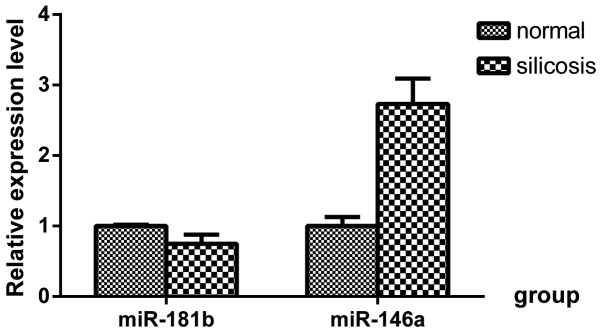
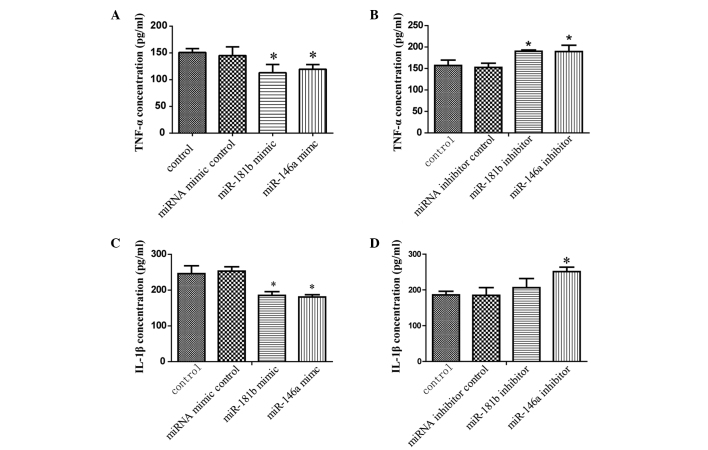
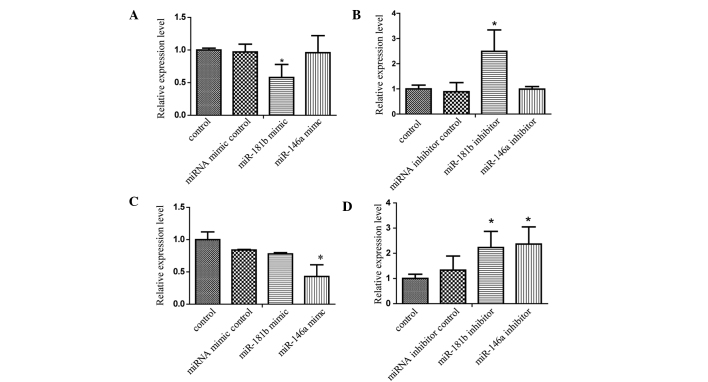
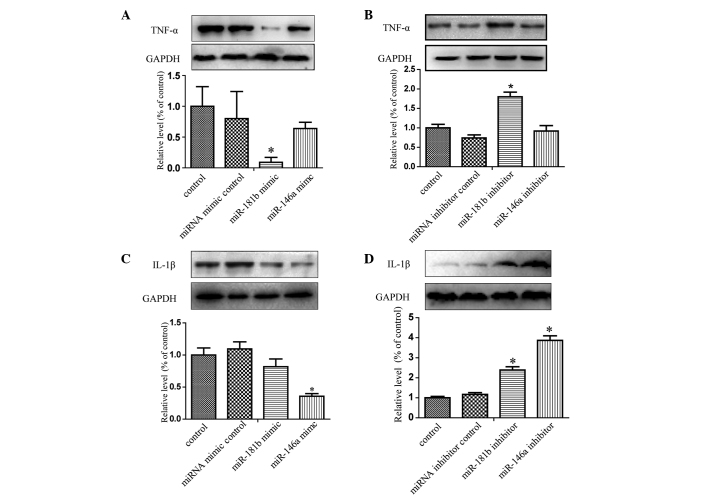
Despite increasing evidence to suggest that microRNA (miR)-146a and miR-181b are involved in the regulation of immune responses and tumor progression, their roles in silicosis remain to be fully elucidated. Therefore, the present study examined the roles of miR‑146a and miR‑181b in inflammatory responses, and their effect on the expression of the tumor necrosis factor‑α (TNF‑α) and interleukin‑1β (IL‑1β) inflammatory chemokines in silicon dioxide (SiO2)‑induced NR8383 rat macrophages. Alterations in the expression levels of miR‑146a and miR‑181b in rats with silicosis have been previously investigated using miRNA arrays. In the present study, the expression levels of miR‑146a and miR‑181b were assessed using reverse transcription‑quantitative polymerase chain reaction (RT‑qPCR). The NR8383 cells were transfected with miRNA‑146a and miR‑181b mimics or inhibitors, and the cells and culture supernatants were collected following SiO2 treatment for 12 h. The expression levels of TNF‑α and IL‑1β were detected using western blotting, RT‑qPCR and ELISA. Analysis of variance and Student's two‑tailed t‑test were used to perform statistical analyses. The expression level of miR‑146a was significantly increased, while the expression level of miR‑181b was significantly decreased in the fibrotic lungs of the rats with silicosis, compared with the levels in the normal rats. It was observed that, following treatment of the NR8383 cells with SiO2 for 12 h, the levels of TNF‑α were significantly increased following miR‑181b knockdown and the levels of IL‑1β were significantly increased following miR‑146a knockdown, compared with the inhibitor‑treated controls (P<0.05). By contrast, miR‑181b mimic transfection led to a significant reduction in the levels of TNF‑α (P<0.05), and miR‑146a mimics were responsible for the decrease in IL-1β (P<0.05). The results of the present study provide evidence supporting the roles of miR‑146a and miR‑181b in the pathogenesis of silicosis, and suggest that they may be candidate therapeutic target in this disease.
尽管越来越多的证据表明,微小RNA(miR)-146a和miR-181b参与免疫反应调节和肿瘤进展,但其在矽肺中的作用仍有待充分阐明。因此,本研究探讨了miR-146a和miR-181b在炎症反应中的作用,以及它们对二氧化硅(SiO2)诱导的NR8383大鼠巨噬细胞中肿瘤坏死因子-α(TNF-α)和白细胞介素-1β(IL-1β)炎性趋化因子表达的影响。先前已使用miRNA阵列研究了矽肺大鼠中miR-146a和miR-181b表达水平的变化。在本研究中,使用逆转录定量聚合酶链反应(RT-qPCR)评估miR-146a和miR-181b的表达水平。用miRNA-146a和miR-181b模拟物或抑制剂转染NR8383细胞,在SiO2处理12小时后收集细胞和培养上清液。使用蛋白质印迹法、RT-qPCR和酶联免疫吸附测定(ELISA)检测TNF-α和IL-1β的表达水平。采用方差分析和学生双尾t检验进行统计分析。与正常大鼠相比,矽肺大鼠纤维化肺组织中miR-146a的表达水平显著升高,而miR-181b的表达水平显著降低。观察到,在NR8383细胞用SiO2处理12小时后,与抑制剂处理的对照组相比,miR-181b敲低后TNF-α水平显著升高,miR-146a敲低后IL-1β水平显著升高(P<0.05)。相比之下,miR-181b模拟物转染导致TNF-α水平显著降低(P<0.05),miR-146a模拟物导致IL-1β水平降低(P<0.05)。本研究结果为支持miR-146a和miR-181b在矽肺发病机制中的作用提供了证据,并表明它们可能是该疾病的候选治疗靶点。