Mota Eduardo Ferreira, Rosario Diele Magno, Silva Veiga Andreza Socorro, Brasil Davi Do Socorro Barros, Silveira Fernando Tobias, Dolabela Maria Fâni
Post Graduation in Biology of Infectious and parasitary Agents, Institute of Biological Sciences, Federal University of Para, Guama, Brazil.
Faculty of Pharmaceutical Sciences, Institute of Health Sciences, Federal University of Para, Guama, Brazil.
Pharmacogn Mag. 2015 Jul-Sep;11(43):601-6. doi: 10.4103/0973-1296.160449.
Different species of Croton are used in traditional Amazonian medicine. Among the popular uses are treatment of bacterial diseases, poorly healing wounds and fevers.
This study evaluated the antileishmanial, antiplasmodial and antimicrobial activities of the extracts and diterpenes of Croton palanostigma Klotzsch (Euphorbiaceae).
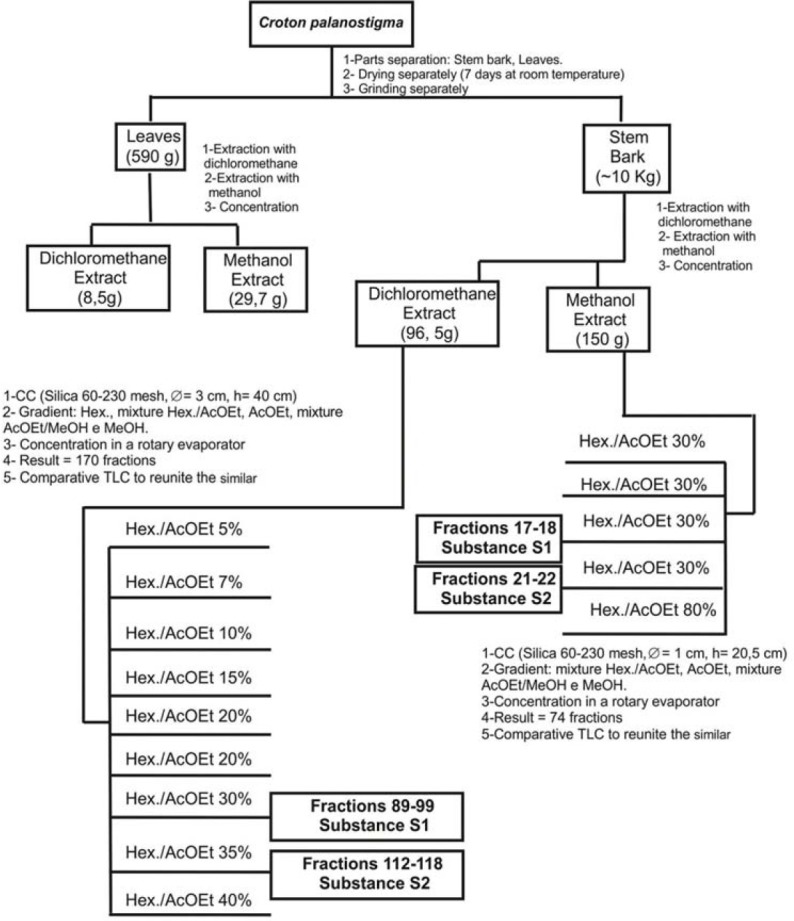
Leaves and bark were extracted with dichloromethane and methanol. The bark dichloromethane extract (BDE) was chromatographed on a column, obtaining cordatin and aparisthman. The extracts and diterpenes were assayed thought agar disk diffusion method and their bactericidal or fungicidal effects were evaluated by minimum bactericidal or fungicidal concentration. The antiplasmodial activity was evaluated after 24 and 72 h of exposition. The antileishmanial activity was performed on promastigotes forms of Leishmania amazonensis.
The bark methanol extract (BME) and cordatin were not active against any microbial strains tested; BDE and leaves methanol extract (LME) were positive for Pseudomonas aeruginosa and aparisthman was positive for Candida albicans. In the determination of the minimum bactericidal concentration, neither of them were active in the highest concentration tested. The extracts and diterpenes were inactive in Plasmodium falciparum, except the LME in 72 h. Any extract was shown to be active in promastigote forms of L. amazonensis.
These results indicate that the BDE and LME did not inhibit the bacterial growth, then they probably had bacteriostatic effect. LME presented activity in P. falciparum.
不同种类的巴豆属植物被用于传统的亚马逊医学。其常见用途包括治疗细菌性疾病、伤口愈合不良和发烧。
本研究评估了巴豆(大戟科)提取物和二萜类化合物的抗利什曼原虫、抗疟原虫和抗菌活性。
用二氯甲烷和甲醇提取叶片和树皮。树皮二氯甲烷提取物(BDE)经柱色谱分离,得到可多丁和阿帕斯特曼。采用琼脂平板扩散法对提取物和二萜类化合物进行测定,并通过最低杀菌或杀真菌浓度评估其杀菌或杀真菌效果。在暴露24小时和72小时后评估抗疟原虫活性。对亚马逊利什曼原虫的前鞭毛体形式进行抗利什曼原虫活性检测。
树皮甲醇提取物(BME)和可多丁对所测试的任何微生物菌株均无活性;BDE和叶片甲醇提取物(LME)对铜绿假单胞菌呈阳性,阿帕斯特曼对白色念珠菌呈阳性。在最低杀菌浓度测定中,它们在测试的最高浓度下均无活性。提取物和二萜类化合物对恶性疟原虫均无活性,72小时时的LME除外。任何提取物对亚马逊利什曼原虫的前鞭毛体形式均无活性。
这些结果表明,BDE和LME没有抑制细菌生长,那么它们可能具有抑菌作用。LME对恶性疟原虫有活性。