J Neuroimaging. 2016 Mar-Apr;26(2):232-9. doi: 10.1111/jon.12278.
To evaluate whether breath-holding (BH) blood oxygenation level-dependent (BOLD) fMRI can quantify differences in vascular reactivity (VR), as there is a need for improved contrast mechanisms in gliomas.
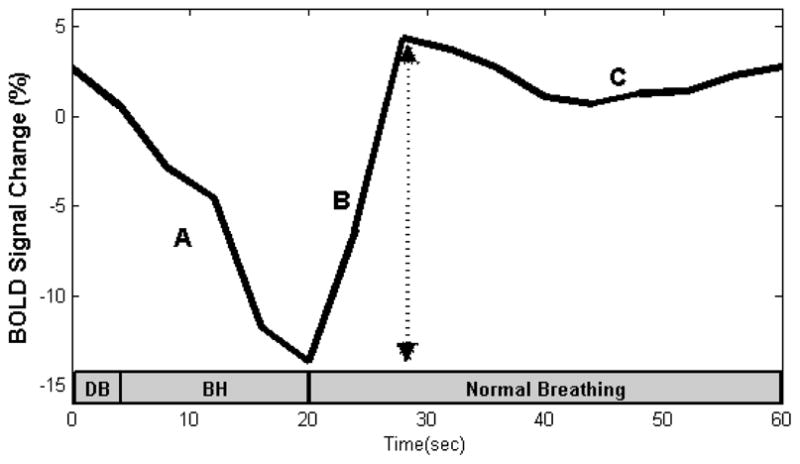
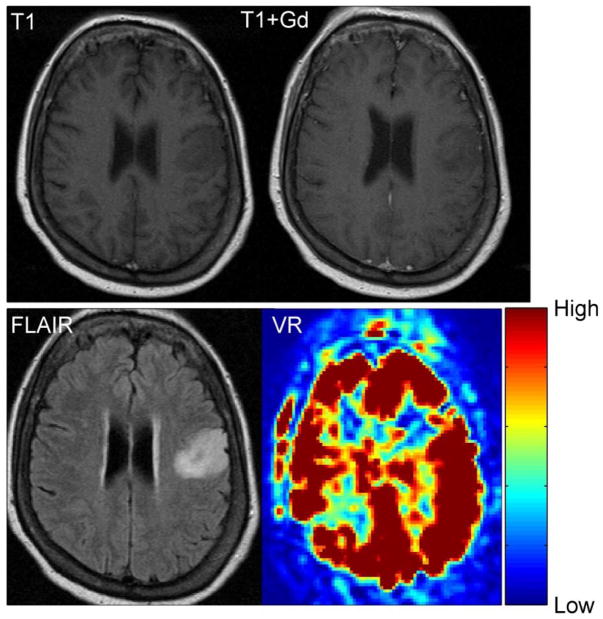
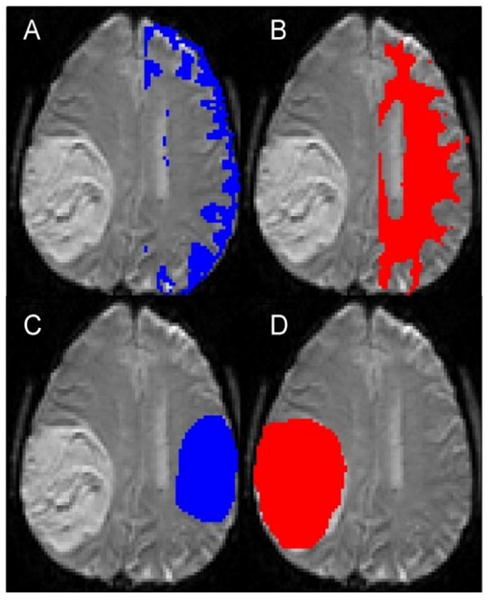
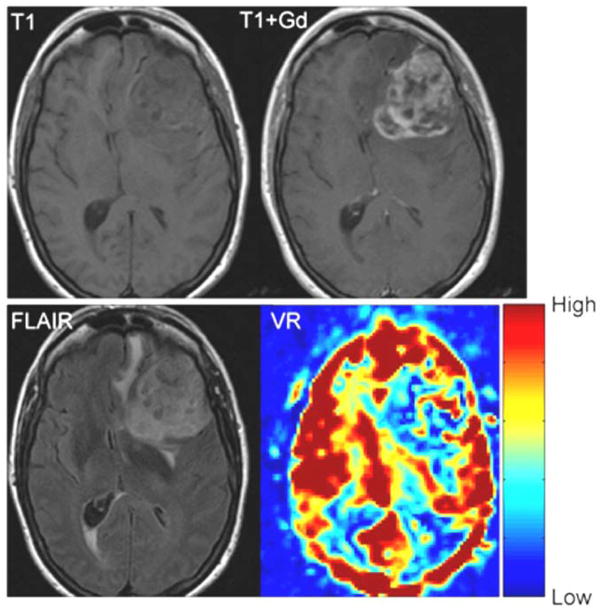
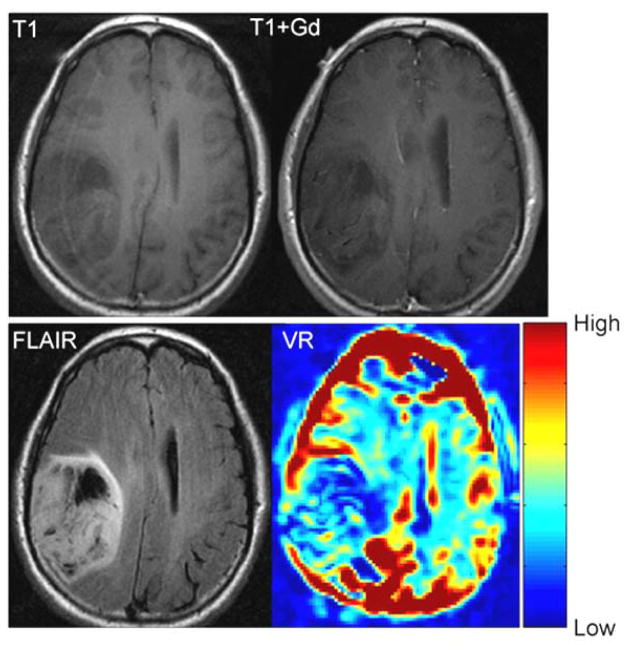
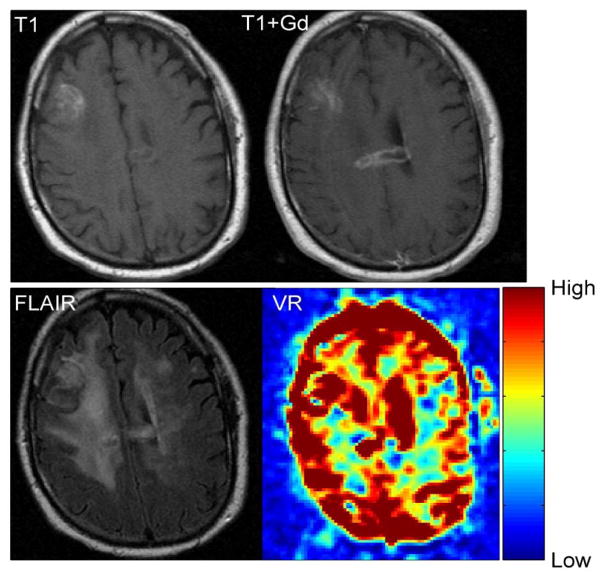
16 patients (gliomas, grade II = 5, III = 2, IV = 9) were evaluated using the BH paradigm: 4-second single deep breath followed by 16 seconds of BH and 40 seconds of regular breathing for five cycles. VR was defined as the difference in BOLD signal between the minimal signal seen at the end of the deep breath and maximal signal seen at the end of BH (peak-to-trough). VR was measured for every voxel and compared for gray versus white matter and tumor versus normal contralateral brain. VR maps were compared to the areas of enhancement and FLAIR/T2 abnormality.
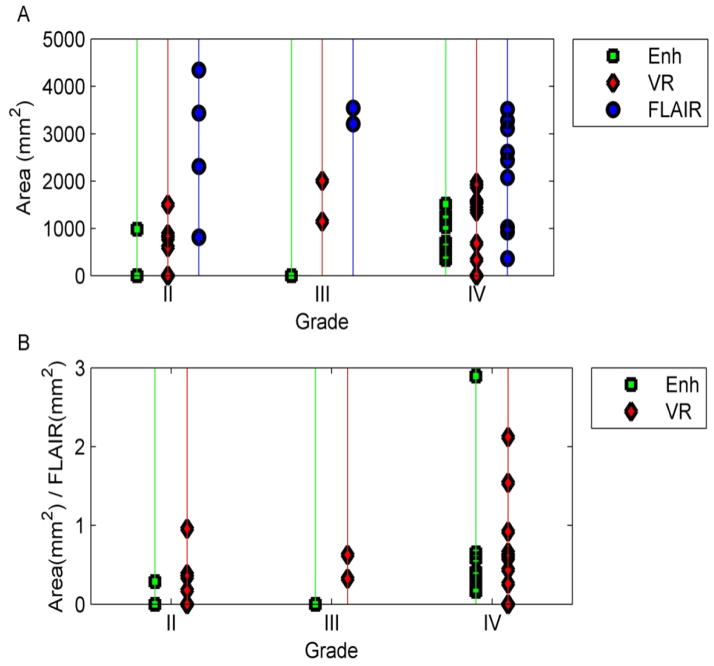
VR was significantly lower in normal white matter than gray matter (P < .05) and in tumors compared to the normal, contralateral brain (P < 0.002). The area of abnormal VR (1103 ± 659 mm²) was significantly greater (P = .019) than the enhancement (543 ± 530 mm²), but significantly smaller (P = .0011) than the FLAIR abnormality (2363 ± 1232 mm²). However, the variability in the areas of gadolinium contrast enhancement versus VR abnormality indicates that the contrast mechanism elicited by BH (caused by abnormal arteriolar smooth muscles) appears to be fundamentally different from the contrast mechanism of gadolinium enhancement (caused by the presence of "leaky" gap junctions).
BH maps based on peak-to-trough can be used to characterize VR in brain tumors. VR maps in brain tumor patients appear to be caused by a different mechanism than gadolinium enhancement.
评估屏气(BH)血氧水平依赖(BOLD) fMRI 是否可定量测量血管反应性(VR)的差异,因为需要改善脑肿瘤的对比机制。
16 例患者(脑胶质瘤,2 级=5 例,3 级=2 例,4 级=9 例)接受 BH 范式评估:4 秒深吸气后进行 16 秒 BH 和 40 秒常规呼吸,共 5 个周期。VR 定义为在深呼气结束时看到的最小信号与 BH 结束时看到的最大信号(峰-谷)之间的 BOLD 信号差异。为每个体素测量 VR,并比较灰白质和肿瘤与对侧正常脑之间的差异。VR 图与增强和 FLAIR/T2 异常区域进行比较。
正常白质的 VR 明显低于灰质(P<0.05),肿瘤的 VR 明显低于对侧正常脑(P<0.002)。异常 VR 区域(1103±659 mm²)明显大于增强区域(543±530 mm²)(P=0.019),但明显小于 FLAIR 异常区域(2363±1232 mm²)(P=0.0011)。然而,钆对比增强与 VR 异常区域的面积变异性表明,BH 引起的对比机制(由异常的小动脉平滑肌引起)似乎与钆增强的对比机制(由“渗漏”的缝隙连接的存在引起)在根本上不同。
基于峰-谷的 BH 图可用于表征脑肿瘤的 VR。脑肿瘤患者的 VR 图似乎是由不同于钆增强的机制引起的。