Tuhina-Khatun Mst, Hanafi Mohamed M, Rafii Yusop Mohd, Wong M Y, Salleh Faezah M, Ferdous Jannatul
Laboratory of Food Crops, Institute of Tropical Agriculture, Universiti Putra Malaysia (UPM), 43400 Serdang, Selangor, Malaysia ; Bangladesh Rice Research Institute, Gazipur 1701, Bangladesh.
Laboratory of Plantation Crops, Institute of Tropical Agriculture, Universiti Putra Malaysia (UPM), 43400 Serdang, Selangor, Malaysia ; Department of Land Management, Institute of Tropical Agriculture, Universiti Putra Malaysia (UPM), 43400 Serdang, Selangor, Malaysia.
Biomed Res Int. 2015;2015:290861. doi: 10.1155/2015/290861. Epub 2015 Jul 15.
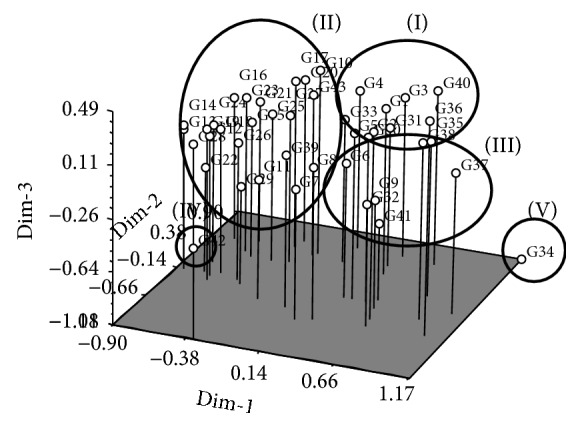
Upland rice is important for sustainable crop production to meet future food demands. The expansion in area of irrigated rice faces limitations due to water scarcity resulting from climate change. Therefore, this research aimed to identify potential genotypes and suitable traits of upland rice germplasm for breeding programmes. Forty-three genotypes were evaluated in a randomised complete block design with three replications. All genotypes exhibited a wide and significant variation for 22 traits. The highest phenotypic and genotypic coefficient of variation was recorded for the number of filled grains/panicle and yields/plant (g). The highest heritability was found for photosynthetic rate, transpiration rate, stomatal conductance, intercellular CO₂, and number of filled grains/panicle and yields/plant (g). Cluster analysis based on 22 traits grouped the 43 rice genotypes into five clusters. Cluster II was the largest and consisted of 20 genotypes mostly originating from the Philippines. The first four principle components of 22 traits accounted for about 72% of the total variation and indicated a wide variation among the genotypes. The selected best trait of the number of filled grains/panicle and yields/plant (g), which showed high heritability and high genetic advance, could be used as a selection criterion for hybridisation programmes in the future.
陆稻对于实现可持续作物生产以满足未来粮食需求至关重要。由于气候变化导致水资源短缺,灌溉水稻种植面积的扩大面临限制。因此,本研究旨在确定陆稻种质资源的潜在基因型和适合育种计划的性状。采用随机区组设计对43个基因型进行评估,重复三次。所有基因型在22个性状上均表现出广泛且显著的变异。每穗实粒数和单株产量(克)的表型和基因型变异系数最高。光合速率、蒸腾速率、气孔导度、胞间二氧化碳浓度、每穗实粒数和单株产量(克)的遗传力最高。基于22个性状的聚类分析将43个水稻基因型分为5个类群。类群II最大,由20个基因型组成,大多来自菲律宾。22个性状的前四个主成分占总变异的约72%,表明基因型间存在广泛变异。所选的每穗实粒数和单株产量(克)这两个最佳性状,具有高遗传力和高遗传进展,可作为未来杂交育种计划的选择标准。