Cai Xiaoni, Gao Kunshan
State Key Laboratory of Marine Environmental Science, Xiamen University, Xiamen, Fujian, China.
PLoS One. 2015 Aug 10;10(8):e0135401. doi: 10.1371/journal.pone.0135401. eCollection 2015.
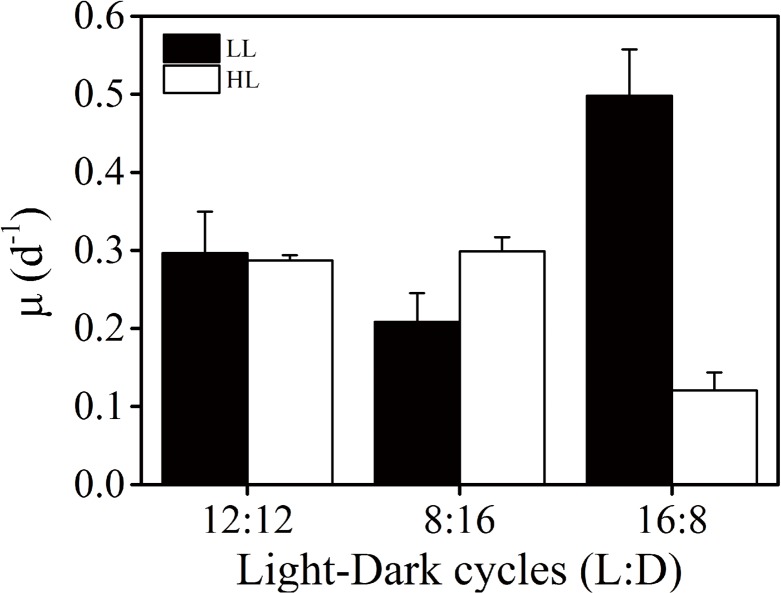
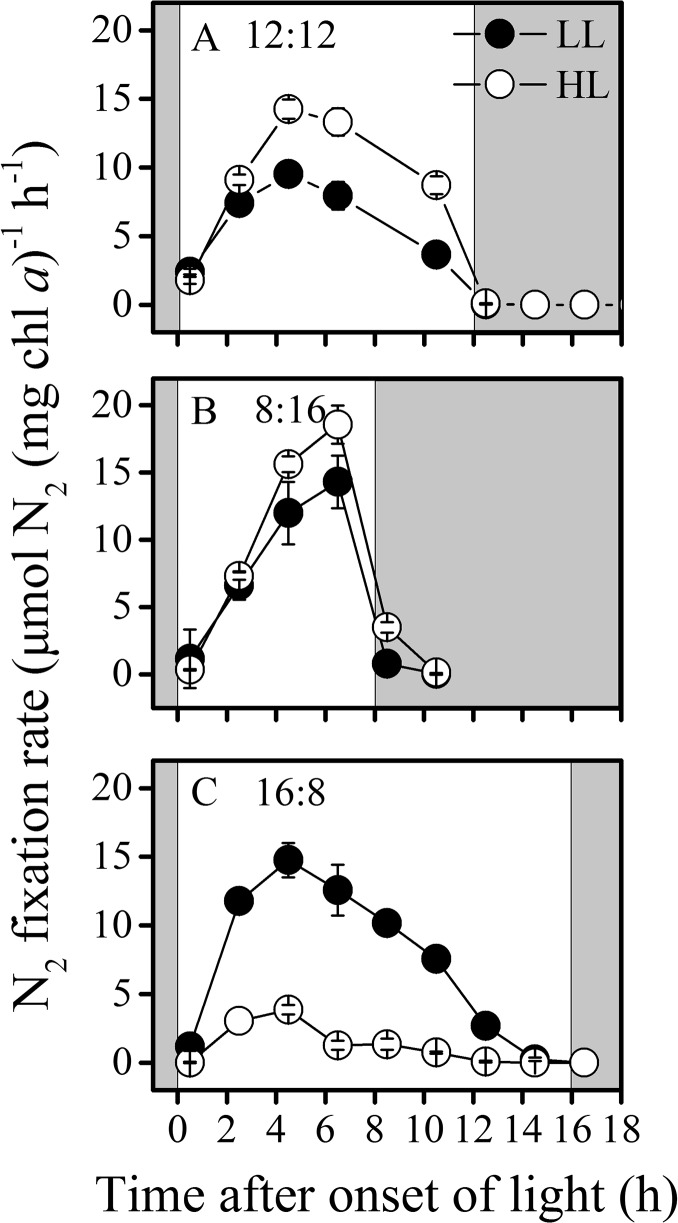
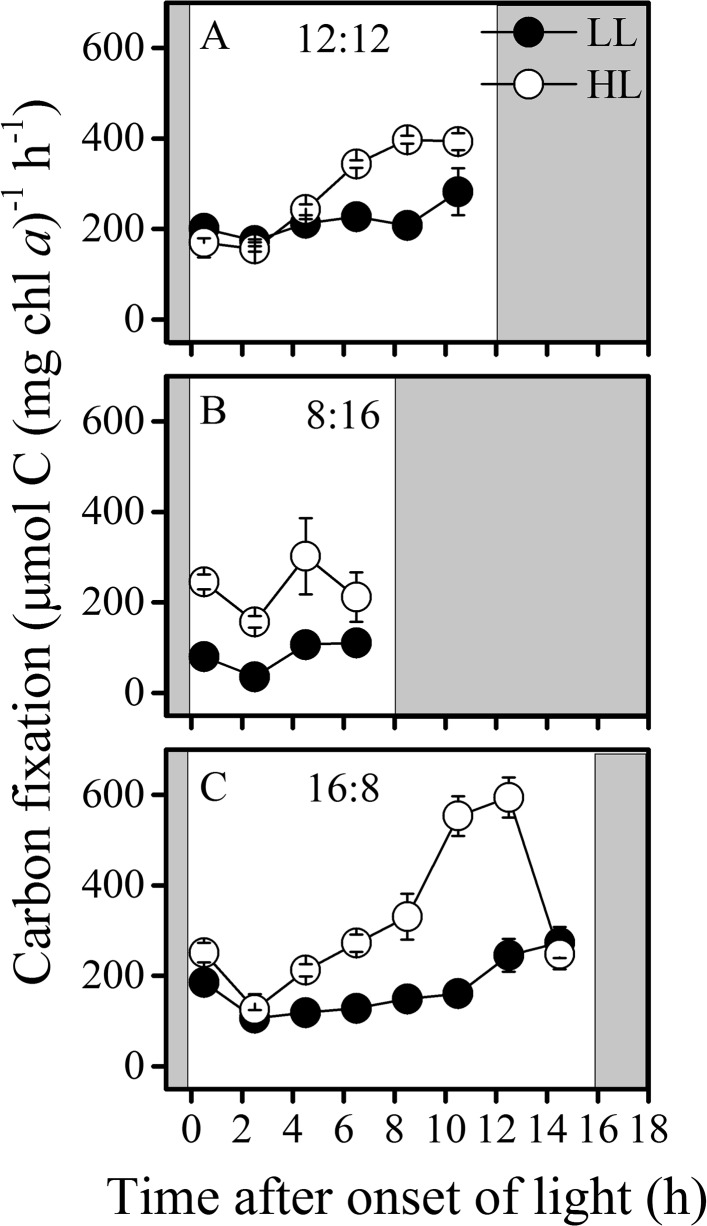
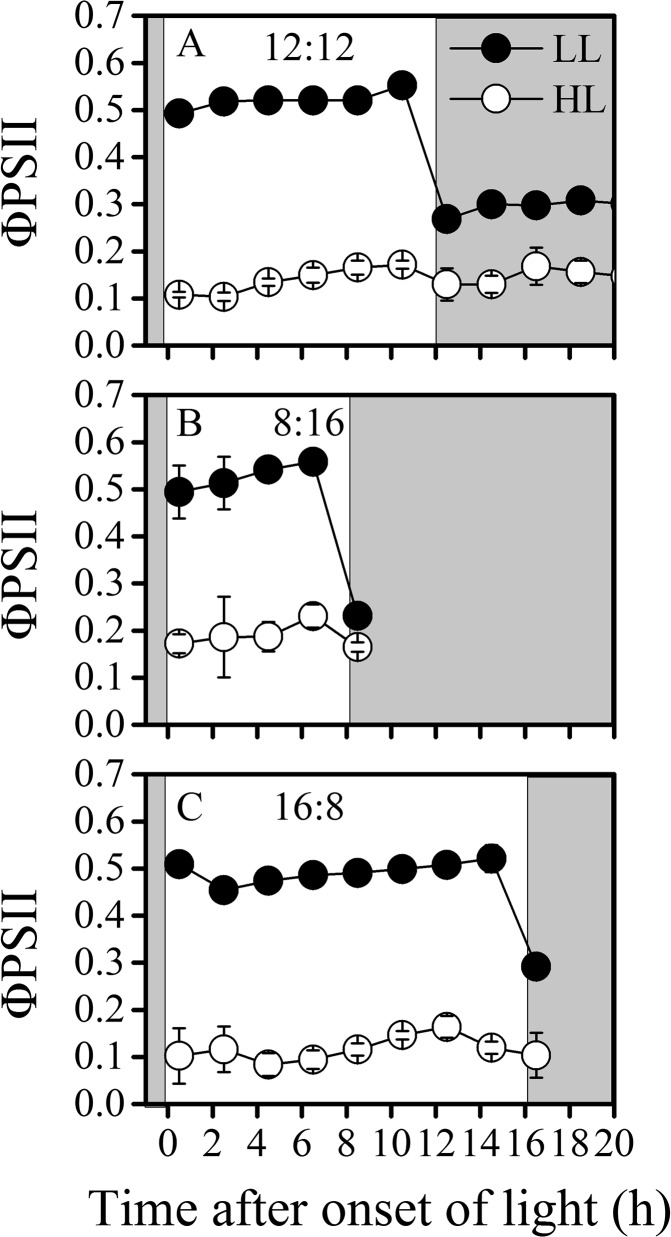
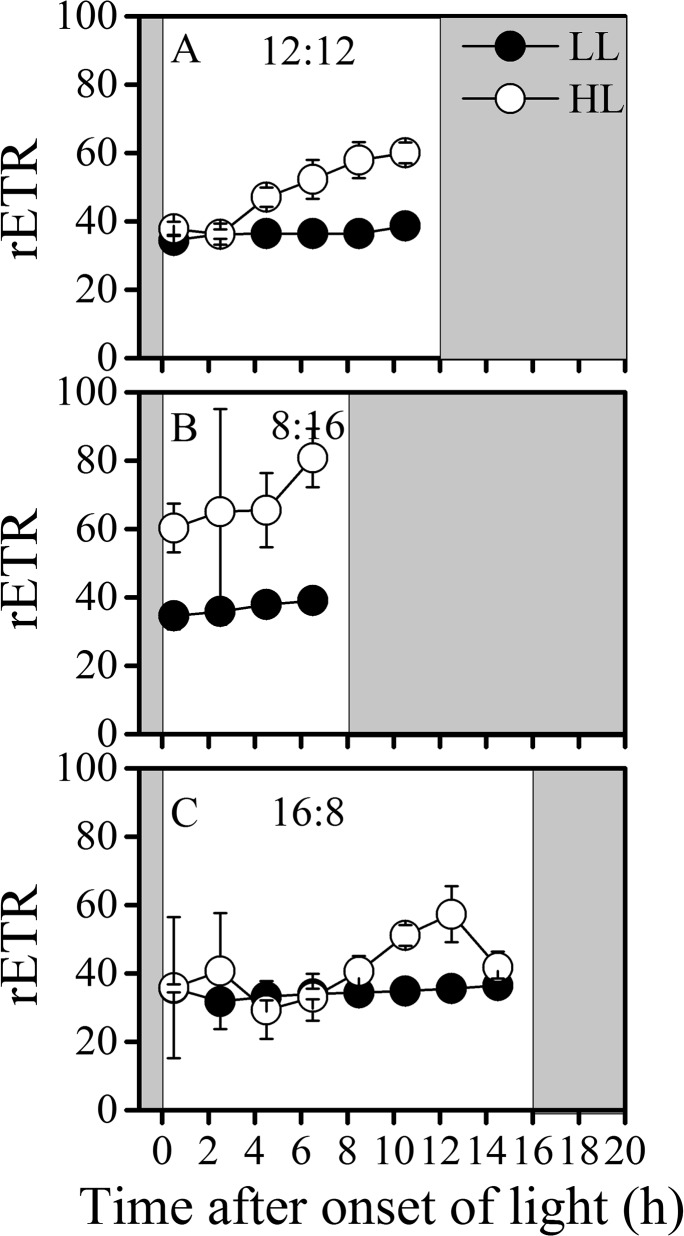
While the diazotrophic cyanobacterium Trichodesmium is known to display inverse diurnal performances of photosynthesis and N2 fixation, such a phenomenon has not been well documented under different day-night (L-D) cycles and different levels of light dose exposed to the cells. Here, we show differences in growth, N2 fixation and photosynthetic carbon fixation as well as photochemical performances of Trichodesmium IMS101 grown under 12L:12D, 8L:16D and 16L:8D L-D cycles at 70 μmol photons m-2 s-1 PAR (LL) and 350 μmol photons m-2 s-1 PAR (HL). The specific growth rate was the highest under LL and the lowest under HL under 16L:8D, and it increased under LL and decreased under HL with increased levels of daytime light doses exposed under the different light regimes, respectively. N2 fixation and photosynthetic carbon fixation were affected differentially by changes in the day-night regimes, with the former increasing directly under LL with increased daytime light doses and decreased under HL over growth-saturating light levels. Temporal segregation of N2 fixation from photosynthetic carbon fixation was evidenced under all day-night regimes, showing a time lag between the peak in N2 fixation and dip in carbon fixation. Elongation of light period led to higher N2 fixation rate under LL than under HL, while shortening the light exposure to 8 h delayed the N2 fixation peaking time (at the end of light period) and extended it to night period. Photosynthetic carbon fixation rates and transfer of light photons were always higher under HL than LL, regardless of the day-night cycles. Conclusively, diel performance of N2 fixation possesses functional plasticity, which was regulated by levels of light energy supplies either via changing light levels or length of light exposure.
虽然已知固氮蓝藻束毛藻表现出光合作用和固氮作用相反的昼夜表现,但在不同的昼夜(L-D)循环以及细胞暴露于不同光剂量水平下,这种现象尚未得到充分记录。在此,我们展示了在70 μmol光子 m-2 s-1光合有效辐射(LL)和350 μmol光子 m-2 s-1光合有效辐射(HL)条件下,生长于12L:12D、8L:16D和16L:8D L-D循环中的束毛藻IMS101在生长、固氮和光合碳固定以及光化学性能方面的差异。在16L:8D条件下,比生长速率在LL时最高,在HL时最低,并且在不同光照条件下,随着白天光照剂量水平的增加,比生长速率在LL时升高,在HL时降低。固氮和光合碳固定受昼夜节律变化的影响不同,前者在LL条件下随着白天光照剂量的增加而直接增加,在高于生长饱和光水平的HL条件下则降低。在所有昼夜节律条件下,都证明了固氮与光合碳固定在时间上的分离,表明固氮峰值与碳固定下降之间存在时间滞后。光照期延长导致LL条件下的固氮率高于HL条件下的固氮率,而将光照时间缩短至8小时则延迟了固氮峰值时间(在光照期结束时)并将其延长至夜间。无论昼夜循环如何,HL条件下的光合碳固定率和光量子传递总是高于LL条件下的。总之,固氮的昼夜表现具有功能可塑性,其通过改变光照水平或光照时间来调节光能供应水平。