Boatman Tobias G, Lawson Tracy, Geider Richard J
School of Biological Sciences, University of Essex, Colchester, United Kingdom.
PLoS One. 2017 Jan 12;12(1):e0168796. doi: 10.1371/journal.pone.0168796. eCollection 2017.
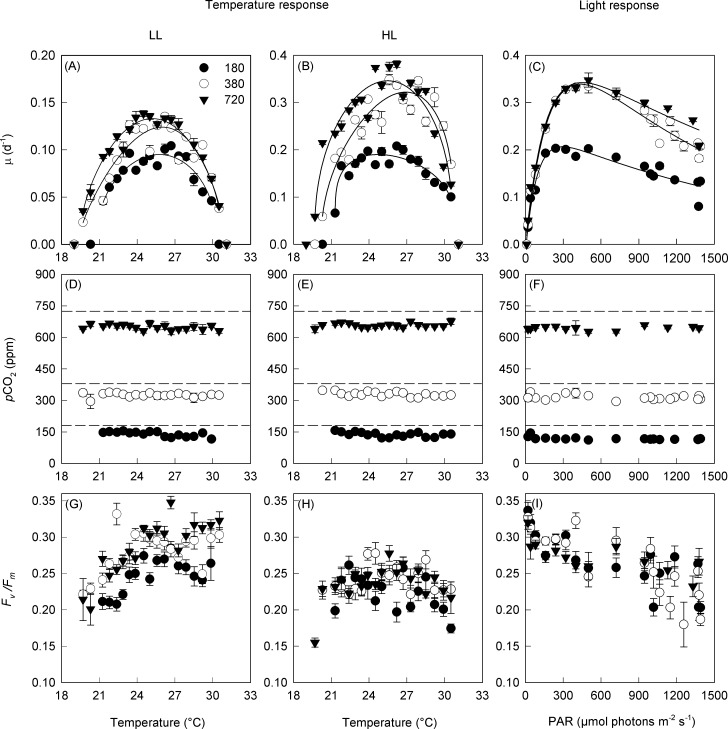
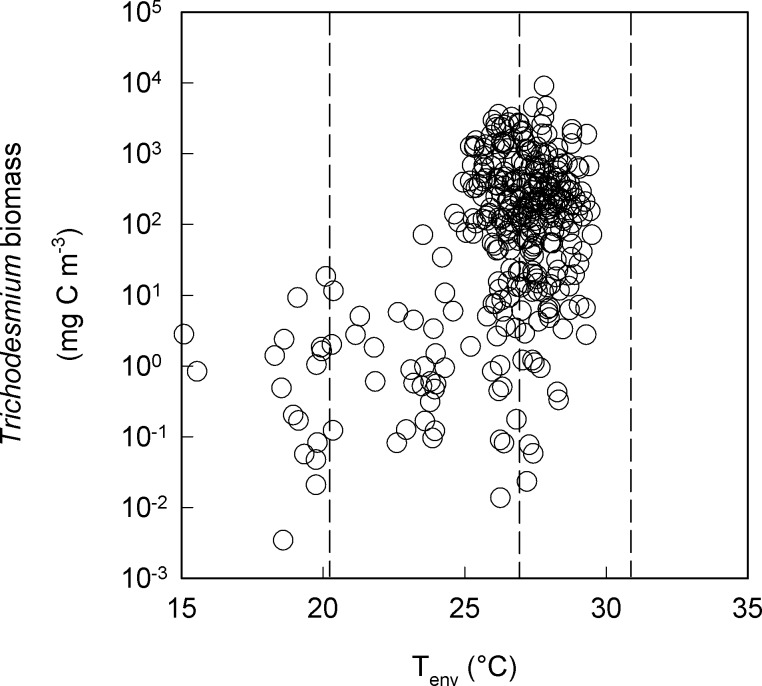
Trichodesmium is a globally important marine diazotroph that accounts for approximately 60 - 80% of marine biological N2 fixation and as such plays a key role in marine N and C cycles. We undertook a comprehensive assessment of how the growth rate of Trichodesmium erythraeum IMS101 was directly affected by the combined interactions of temperature, pCO2 and light intensity. Our key findings were: low pCO2 affected the lower temperature tolerance limit (Tmin) but had no effect on the optimum temperature (Topt) at which growth was maximal or the maximum temperature tolerance limit (Tmax); low pCO2 had a greater effect on the thermal niche width than low-light; the effect of pCO2 on growth rate was more pronounced at suboptimal temperatures than at supraoptimal temperatures; temperature and light had a stronger effect on the photosynthetic efficiency (Fv/Fm) than did CO2; and at Topt, the maximum growth rate increased with increasing CO2, but the initial slope of the growth-irradiance curve was not affected by CO2. In the context of environmental change, our results suggest that the (i) nutrient replete growth rate of Trichodesmium IMS101 would have been severely limited by low pCO2 at the last glacial maximum (LGM), (ii) future increases in pCO2 will increase growth rates in areas where temperature ranges between Tmin to Topt, but will have negligible effect at temperatures between Topt and Tmax, (iii) areal increase of warm surface waters (> 18°C) has allowed the geographic range to increase significantly from the LGM to present and that the range will continue to expand to higher latitudes with continued warming, but (iv) continued global warming may exclude Trichodesmium spp. from some tropical regions by 2100 where temperature exceeds Topt.
束毛藻是一种在全球具有重要意义的海洋固氮生物,约占海洋生物固氮量的60%-80%,因此在海洋氮和碳循环中起着关键作用。我们全面评估了红海束毛藻IMS101的生长速率如何受到温度、pCO₂和光照强度综合相互作用的直接影响。我们的主要发现如下:低pCO₂影响了较低温度耐受极限(Tmin),但对生长达到最大值时的最适温度(Topt)或最高温度耐受极限(Tmax)没有影响;低pCO₂对热生态位宽度的影响大于低光照;pCO₂对生长速率的影响在次优温度下比在超优温度下更显著;温度和光照对光合效率(Fv/Fm)的影响比CO₂更强;在Topt时,最大生长速率随CO₂增加而增加,但生长-辐照度曲线的初始斜率不受CO₂影响。在环境变化的背景下,我们的结果表明:(i)在末次盛冰期(LGM),低pCO₂会严重限制红海束毛藻IMS101在营养充足时的生长速率;(ii)未来pCO₂的增加将提高温度在Tmin至Topt之间区域的生长速率,但在Topt和Tmax之间的温度下影响可忽略不计;(iii)温暖表层水(>18°C)的面积增加使地理分布范围从LGM到现在显著扩大,并且随着持续变暖,该范围将继续向更高纬度扩展;但(iv)持续的全球变暖可能到2100年将束毛藻属从一些温度超过Topt的热带地区排除。