Rehabilitation Medicine Department, Clinical Center, National Institutes of Health Bethesda, Maryland.
Neurogenetics Branch, National Institute of Neurological Disorders and Stroke Bethesda, Maryland.
Ann Clin Transl Neurol. 2015 Jul;2(7):739-47. doi: 10.1002/acn3.208. Epub 2015 May 7.
To determine the safety and efficacy of a home-based functional exercise program in spinal and bulbar muscular atrophy (SBMA).
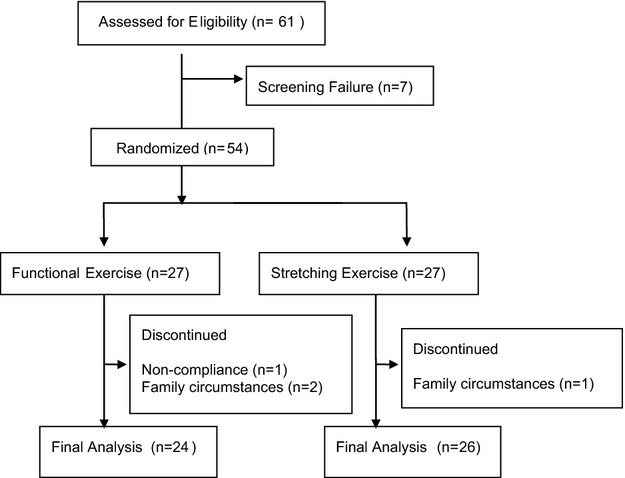
Subjects were randomly assigned to participate in 12 weeks of either functional exercises (intervention) or a stretching program (control) at the National Institutes of Health in Bethesda, MD. A total of 54 subjects enrolled, and 50 completed the study with 24 in the functional exercise group and 26 in the stretching control group. The primary outcome measure was the Adult Myopathy Assessment Tool (AMAT) total score, and secondary measures included total activity by accelerometry, muscle strength, balance, timed up and go, sit-to-stand test, health-related quality of life, creatine kinase, and insulin-like growth factor-1.
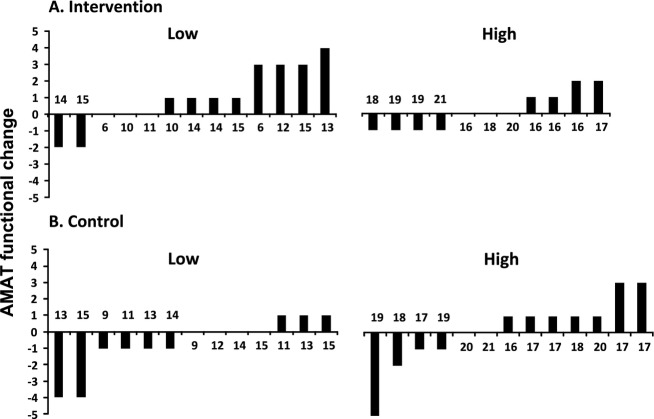
Functional exercise was well tolerated but did not lead to significant group differences in the primary outcome measure or any of the secondary measures. The functional exercise did not produce significantly more adverse events than stretching, and was not perceived to be difficult. To determine whether a subset of the subjects may have benefited, we divided them into high and low functioning based on baseline AMAT scores and performed a post hoc subgroup analysis. Low-functioning individuals receiving the intervention increased AMAT functional subscale scores compared to the control group.
Although these trial results indicate that functional exercise had no significant effect on total AMAT scores or on mobility, strength, balance, and quality of life, post hoc findings indicate that low-functioning men with SBMA may respond better to functional exercises, and this warrants further investigation with appropriate exercise intensity.
确定基于家庭的功能锻炼计划在脊髓和延髓肌萎缩症(SBMA)中的安全性和有效性。
受试者随机分配到位于马里兰州贝塞斯达的美国国立卫生研究院参加为期 12 周的功能锻炼(干预组)或拉伸计划(对照组)。共有 54 名受试者入组,50 名完成了研究,其中 24 名在功能锻炼组,26 名在拉伸对照组。主要结局测量指标是成人肌病评估工具(AMAT)总分,次要测量指标包括加速度计测量的总活动量、肌肉力量、平衡、起立行走测试、坐站测试、健康相关生活质量、肌酸激酶和胰岛素样生长因子-1。
功能锻炼耐受良好,但在主要结局测量指标或任何次要测量指标上均未导致显著的组间差异。功能锻炼并未比拉伸产生更多的不良事件,且未被认为难以实施。为了确定是否有一部分受试者可能受益,我们根据基线 AMAT 评分将他们分为高功能和低功能亚组,并进行了事后亚组分析。低功能个体接受干预后 AMAT 功能子量表评分较对照组升高。
尽管这些试验结果表明,功能锻炼对 AMAT 总分或移动性、力量、平衡和生活质量没有显著影响,但事后发现,SBMA 的低功能男性可能对功能锻炼的反应更好,这需要进一步研究适当的运动强度。