Hijikata Yasuhiro, Katsuno Masahisa, Suzuki Keisuke, Hashizume Atsushi, Araki Amane, Yamada Shinichiro, Inagaki Tomonori, Ito Daisuke, Hirakawa Akihiro, Kinoshita Fumie, Gosho Masahiko, Sobue Gen
Department of Neurology, Nagoya University Graduate School of Medicine, Nagoya, Japan.
Innovation Center for Clinical Research, National Center for Geriatnics and Gerontology, Obu, Japan.
JMIR Res Protoc. 2018 Mar 5;7(3):e69. doi: 10.2196/resprot.8655.
Although spinal and bulbar muscular atrophy (SBMA) has been classified as a motor neuron disease, several reports have indicated the primary involvement of skeletal muscle in the pathogenesis of this devastating disease. Recent studies reported decreased intramuscular creatine levels in skeletal muscles in both patients with SBMA and transgenic mouse models of SBMA, which appears to contribute to muscle weakness.
The present study aimed to examine the efficacy and safety of oral creatine supplementation to improve motor function in patients with SBMA.
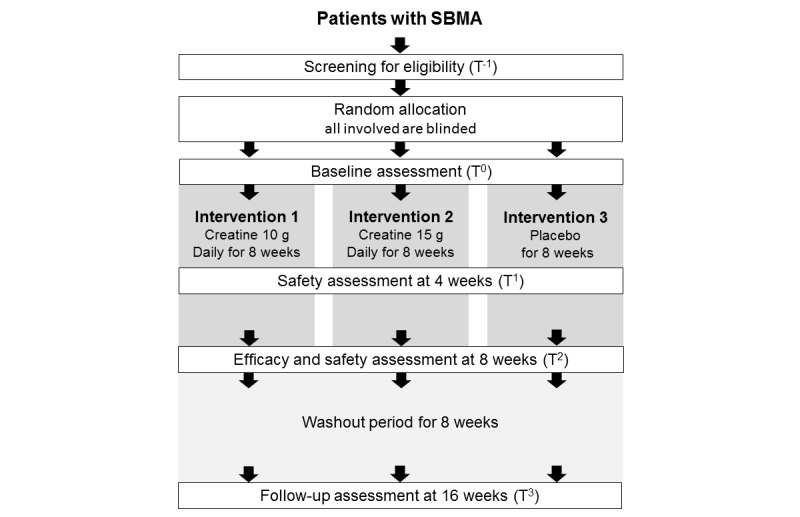
A randomized, double-blind, placebo-controlled, three-armed clinical trial was conducted to assess the safety and efficacy of creatine therapy in patients with SBMA. Patients with SBMA eligible for this study were assigned randomly in a 1:1:1 ratio to each group of placebo, 10 g, or 15 g daily dose of creatine monohydrate in a double-blind fashion. Participants took creatine or placebo orally 3 times a day for 8 weeks. Outcome measurements were results of neurological assessments, examinations, and questionnaires collected at baseline and at weeks 4, 8, and 16 after a washout period. The primary endpoint was the change in handgrip strength values from baseline to week 8. The secondary endpoints included the following: results of maximum voluntary isometric contraction tests of extremities; tongue pressure; results of the 15-foot timed walk test and the rise from bed test; modified quantitative myasthenia gravis score; respiratory function test results; activities of daily living assessed with the Revised Amyotrophic Lateral Sclerosis Functional Rating Scale and the Spinal and Bulbar Muscular Atrophy Functional Rating Scale; skeletal muscle mass measured with dual-energy X-ray absorptiometry; urinary 8-hydroxydeoxyguanosine levels; and questionnaires examining the quality of life, swallowing function, and fatigue.
Participant enrollment in the trial started from June 2014 and follow-up was completed in July 2015. The study is currently being analyzed.
This is the first clinical trial evaluating creatine therapy in SBMA. Given that creatine serves as an energy source in skeletal muscles, recovery of intramuscular creatine concentration is expected to improve muscle strength.
University Hospital Medical Information Network Clinical Trials Registry UMIN000012503; https://upload.umin.ac.jp/cgi-open-bin/ctr_e/ctr_view.cgi?recptno=R000014611 (Archived by WebCite at http://www.webcitation.org/6xOlbPkg3).
尽管脊髓延髓肌萎缩症(SBMA)已被归类为运动神经元疾病,但有几份报告表明骨骼肌在这种破坏性疾病的发病机制中起主要作用。最近的研究报告称,SBMA患者和SBMA转基因小鼠模型的骨骼肌中肌酸水平均降低,这似乎导致了肌肉无力。
本研究旨在探讨口服补充肌酸对改善SBMA患者运动功能的疗效和安全性。
进行了一项随机、双盲、安慰剂对照、三臂临床试验,以评估肌酸治疗对SBMA患者的安全性和疗效。符合本研究条件的SBMA患者以1:1:1的比例随机双盲分配到安慰剂组、每日剂量10 g或15 g一水肌酸组。参与者每天口服肌酸或安慰剂3次,共8周。结果测量是在基线以及洗脱期后的第4、8和16周收集的神经学评估、检查和问卷的结果。主要终点是从基线到第8周握力值的变化。次要终点包括以下内容:四肢最大自主等长收缩试验结果;舌压;15英尺定时步行试验和从床上起身试验结果;改良重症肌无力定量评分;呼吸功能测试结果;用修订的肌萎缩侧索硬化功能评定量表和脊髓延髓肌萎缩功能评定量表评估的日常生活活动;用双能X线吸收法测量的骨骼肌质量;尿8-羟基脱氧鸟苷水平;以及检查生活质量、吞咽功能和疲劳的问卷。
该试验于2014年6月开始招募参与者,并于2015年7月完成随访。该研究目前正在分析中。
这是第一项评估肌酸治疗SBMA的临床试验。鉴于肌酸是骨骼肌的能量来源,预计肌肉内肌酸浓度的恢复将改善肌肉力量。
大学医院医学信息网络临床试验注册中心UMIN000012503;https://upload.umin.ac.jp/cgi-open-bin/ctr_e/ctr_view.cgi?recptno=R000014611(由WebCite存档于http://www.webcitation.org/6xOlbPkg3)。