Du Huijing, Nie Qing, Holmes William R
Center for Complex Biological Systems and Department of Mathematics, University of California Irvine, Irvine, California, United States of America.
Center for Complex Biological Systems and Department of Mathematics, University of California Irvine, Irvine, California, United States of America; Department of Physics and Astronomy, Vanderbilt University, Nashville, Tennessee, United States of America.
PLoS Comput Biol. 2015 Aug 19;11(8):e1004285. doi: 10.1371/journal.pcbi.1004285. eCollection 2015 Aug.
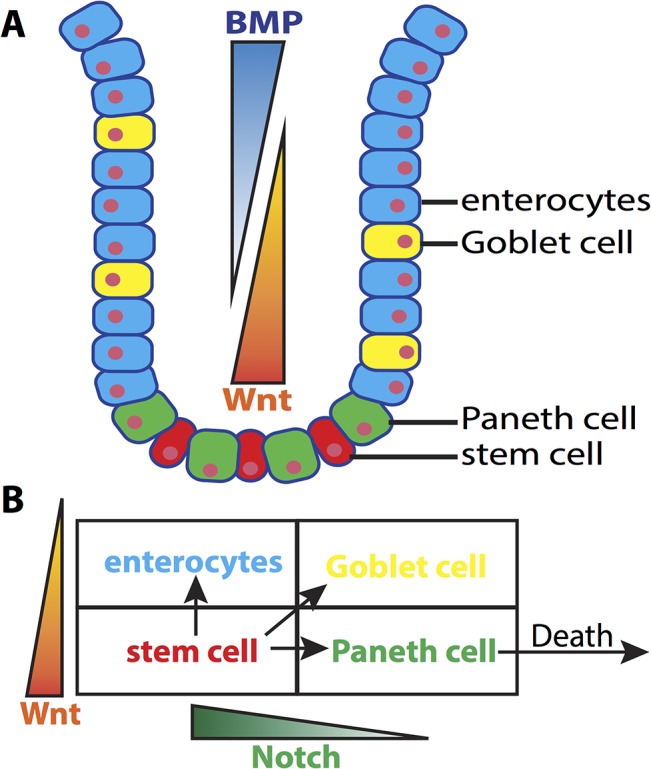
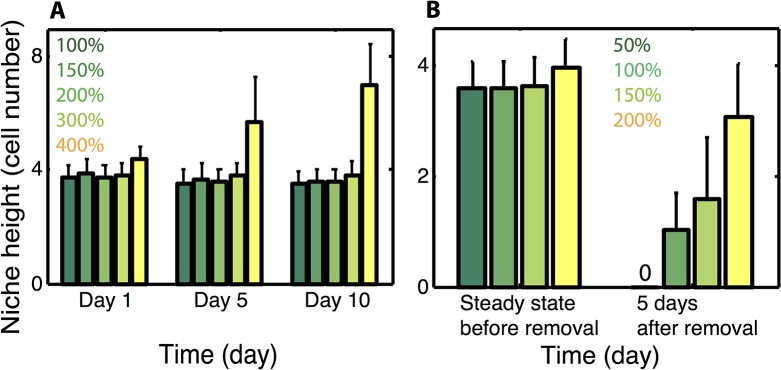
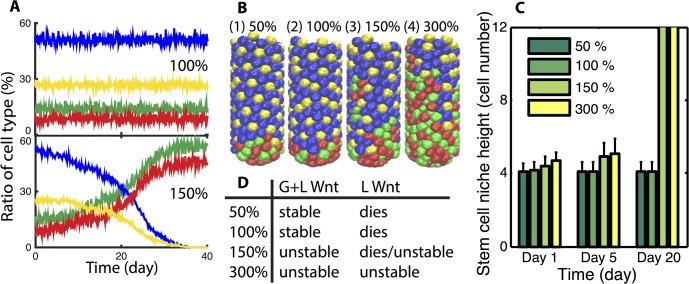
The epithelium of the small intestinal crypt, which has a vital role in protecting the underlying tissue from the harsh intestinal environment, is completely renewed every 4-5 days by a small pool of stem cells at the base of each crypt. How is this renewal controlled and homeostasis maintained, particularly given the rapid nature of this process? Here, based on the recent observations from in vitro "mini gut" studies, we use a hybrid stochastic model of the crypt to investigate how exogenous niche signaling (from Wnt and BMP) combines with auto-regulation to promote homeostasis. This model builds on the sub-cellular element method to account for the three-dimensional structure of the crypt, external regulation by Wnt and BMP, internal regulation by Notch signaling, as well as regulation by internally generated diffusible signals. Results show that Paneth cell derived Wnt signals, which have been observed experimentally to sustain crypts in cultured organs, have a dramatically different influence on niche dynamics than does mesenchyme derived Wnt. While this signaling can indeed act as a redundant backup to the exogenous gradient, it introduces a positive feedback that destabilizes the niche and causes its uncontrolled expansion. We find that in this setting, BMP has a critical role in constraining this expansion, consistent with observations that its removal leads to crypt fission. Further results also point to a new hypothesis for the role of Ephrin mediated motility of Paneth cells, specifically that it is required to constrain niche expansion and maintain the crypt's spatial structure. Combined, these provide an alternative view of crypt homeostasis where the niche is in a constant state of expansion and the spatial structure of the crypt arises as a balance between this expansion and the action of various sources of negative regulation that hold it in check.
小肠隐窝的上皮组织对保护其下方组织免受恶劣肠道环境的影响起着至关重要的作用,每个隐窝底部的一小群干细胞每4 - 5天就能使其完全更新。尤其是考虑到这个过程的快速性,这种更新是如何被控制以及内环境稳态是如何维持的呢?在此,基于近期体外“迷你肠道”研究的观察结果,我们使用一种隐窝的混合随机模型来研究外源性微环境信号(来自Wnt和BMP)如何与自我调节相结合以促进内环境稳态。该模型基于亚细胞元素法构建,以考虑隐窝的三维结构、Wnt和BMP的外部调节、Notch信号的内部调节以及内部产生的可扩散信号的调节。结果表明,实验观察到潘氏细胞衍生的Wnt信号在培养器官中维持隐窝,但它对微环境动态的影响与间充质衍生的Wnt信号有显著不同。虽然这种信号确实可以作为外源性梯度的冗余备份,但它引入了一种正反馈,使微环境不稳定并导致其不受控制的扩张。我们发现在这种情况下,BMP在限制这种扩张方面起着关键作用,这与观察到其缺失会导致隐窝裂变一致。进一步的结果还指向了一个关于Ephrin介导的潘氏细胞运动作用的新假说,具体来说,它是限制微环境扩张和维持隐窝空间结构所必需的。综合起来,这些为隐窝内环境稳态提供了一种不同的观点,即微环境处于持续扩张状态,而隐窝的空间结构是这种扩张与各种负调节源的作用之间平衡的结果,这些负调节源对其进行控制。