Hoelzl Franz, Bieber Claudia, Cornils Jessica S, Gerritsmann Hanno, Stalder Gabrielle L, Walzer Chris, Ruf Thomas
Department of Integrative Biology and Evolution, University of Veterinary Medicine, Vienna, Savoyenstraße 1, 1160, Vienna, Austria.
J Comp Physiol B. 2015 Dec;185(8):931-9. doi: 10.1007/s00360-015-0929-1. Epub 2015 Aug 21.
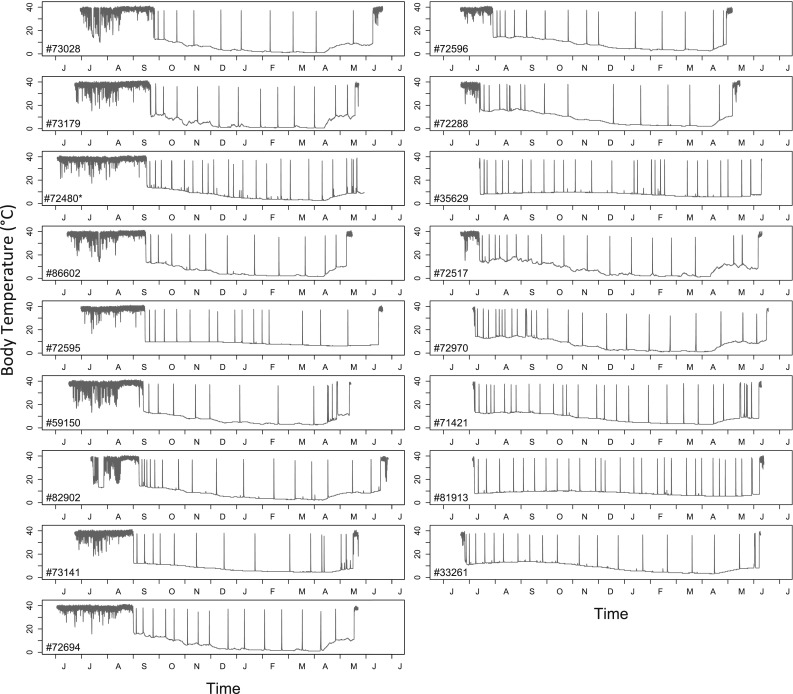
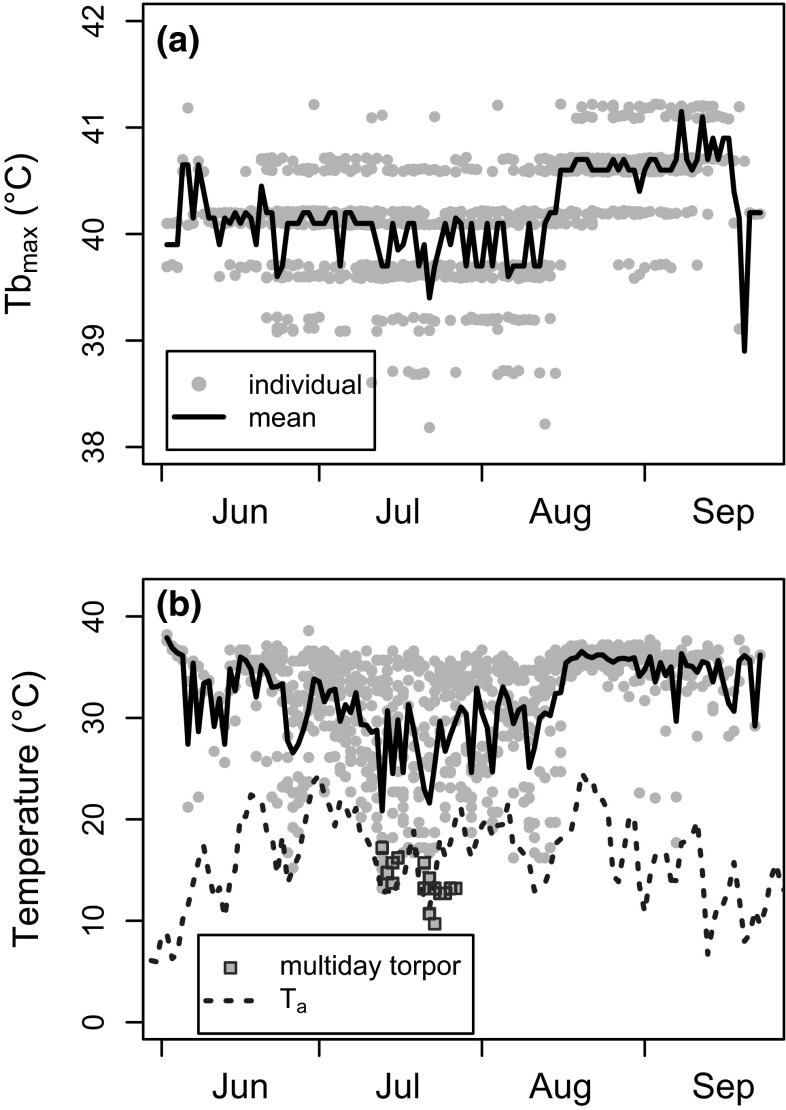
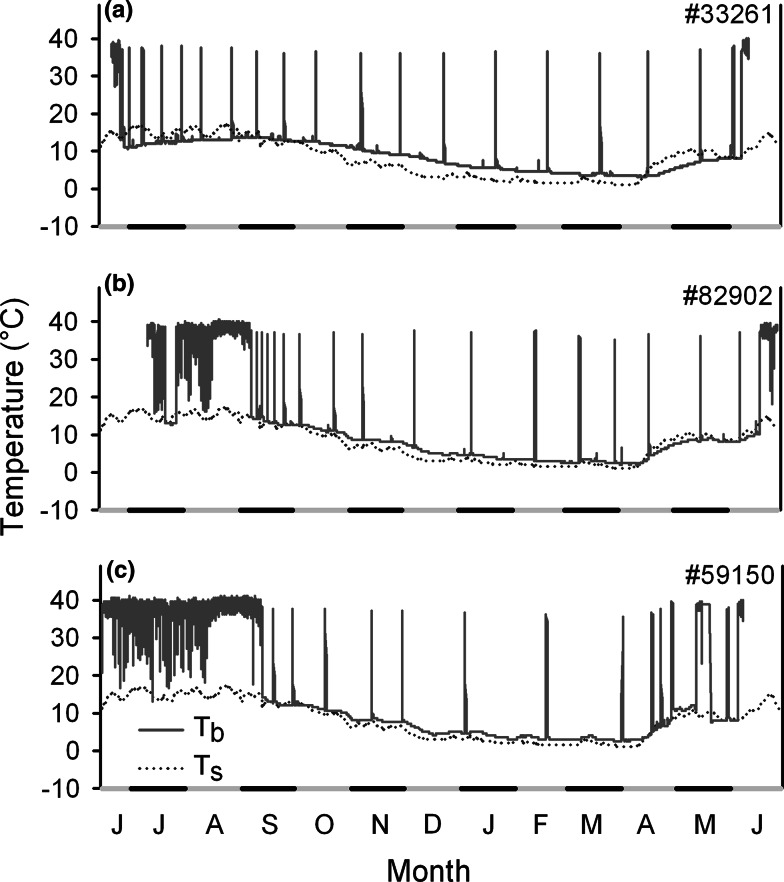
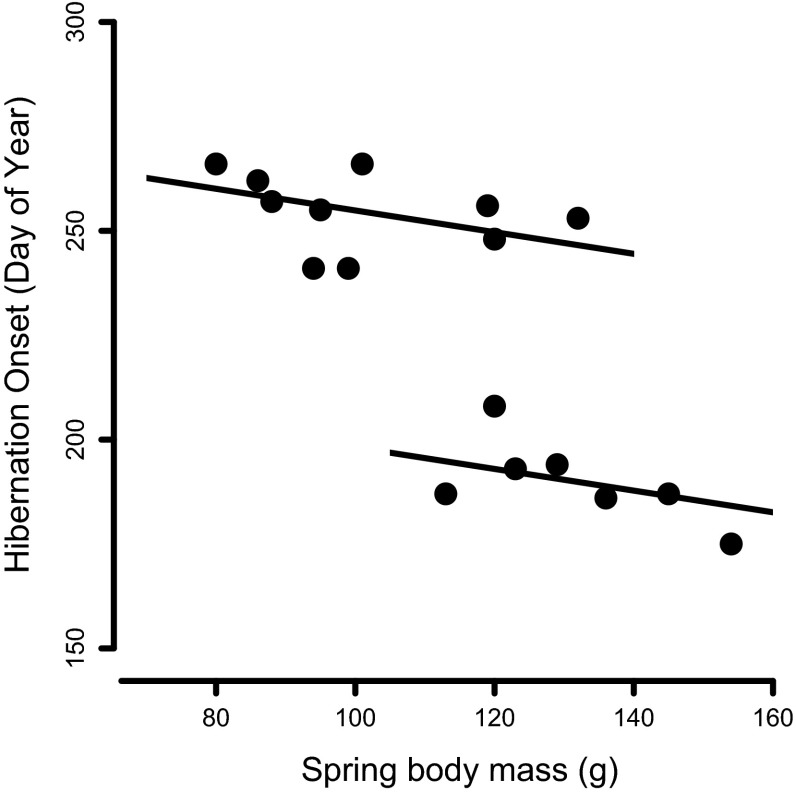
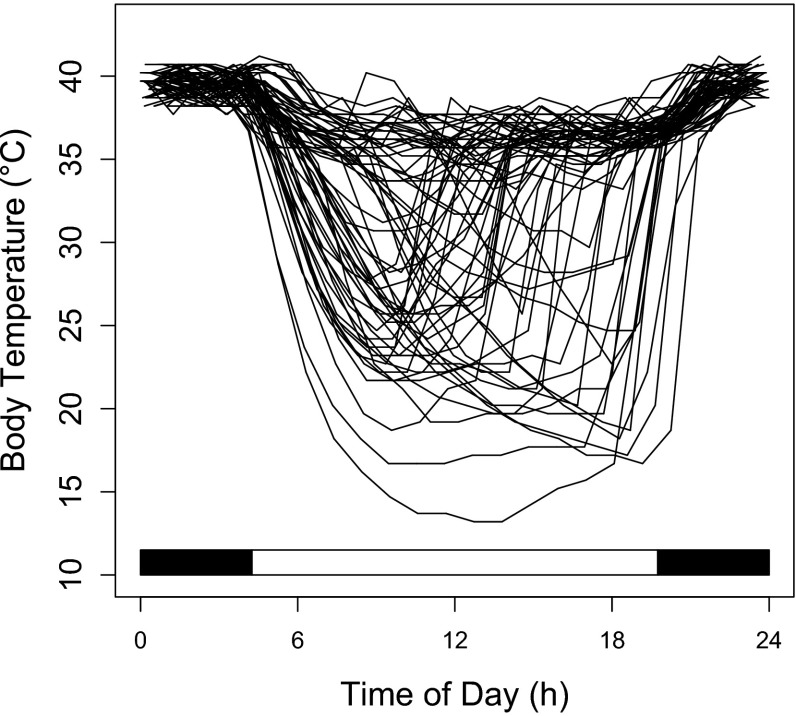
Edible dormice are arboreal rodents adapted to yearly fluctuations in seed production of European beech, a major food source for this species. In years of low beech seed abundance, dormice skip reproduction and non-reproductive dormice fed ad libitum in captivity can display summer dormancy in addition to winter hibernation. To test whether summer dormancy, that is, a very early onset of hibernation, actually occurs in free-living dormice, we monitored core body temperature (Tb) over ~12 months in 17 animals during a year of beech seeding failure in the Vienna Woods. We found that 8 out of 17 dormice indeed re-entered hibernation as early as in June/July, with five of them having extreme hibernation durations of 11 months or more (total range: 7.8-11.4 months). Thus, we show for the first time that a free-living mammal relying on natural food resources can continuously hibernate for >11 months. Early onset of hibernation was associated with high body mass in the spring, but the distribution of hibernation onset was bimodal with prolonged hibernation starting either early (prior to July 28) or late (after August 30). This could not be explained by differences in body mass alone. Animals with a late hibernation onset continued to maintain high nocturnal Tb's throughout summer but used short, shallow torpor bouts (mean duration 7.44 ± 0.9 h), as well as occasional multiday torpor for up to 161 h.
食用睡鼠是树栖啮齿动物,适应欧洲山毛榉种子产量的年度波动,欧洲山毛榉是该物种的主要食物来源。在山毛榉种子产量低的年份,睡鼠会跳过繁殖期,圈养中自由采食的非繁殖期睡鼠除了冬季冬眠外,还会表现出夏季休眠。为了测试夏季休眠,即非常早开始的冬眠,是否真的发生在自由生活的睡鼠身上,我们在维也纳森林山毛榉种子歉收的一年里,对17只动物的核心体温(Tb)进行了约12个月的监测。我们发现,17只睡鼠中有8只早在6月/7月就重新进入冬眠,其中5只的极端冬眠期长达11个月或更长(总时长范围:7.8 - 11.4个月)。因此,我们首次表明,一种依赖天然食物资源的自由生活哺乳动物可以连续冬眠超过11个月。冬眠的早开始与春季的高体重有关,但冬眠开始的分布是双峰的,长时间冬眠要么开始得早(7月28日之前),要么开始得晚(8月30日之后)。这不能仅用体重差异来解释。冬眠开始晚的动物在整个夏季持续保持较高的夜间体温,但会采用短时间、浅度的蛰伏期(平均时长7.44 ± 0.9小时),以及偶尔长达161小时的多日蛰伏。